Momentum Trading Strategy
Some traders wait for a market to settle. Others chase the opposite: the loud, fast, high-conviction move everyone is watching. That second group is trading on momentum. The idea sounds simple, ride strength while it lasts, but doing it well takes more than jumping on a green candle. This guide covers how the approach works, which tools confirm a move, and where beginners get burned.

What Is Momentum Trading?
At its core, momentum trading is a bet that a strong price move keeps going a while longer. Instead of hunting cheap, ignored assets, the trader looks for something already moving with force, up or down, and joins the ride. The logic behind momentum trading rests on one observation: strength tends to attract more strength in the short term, until it runs out of fuel. The trader spots sharp price movement, checks the move has real backing, and weighs an entry in the same direction. Done right, momentum trading is disciplined, not reckless. The trick is telling a real surge from a market that has simply overheated.
Want to watch strong moves unfold without risking a cent? Open a free demo account and follow live price action on 100+ assets with virtual funds.
Open DemoReading about a breakout is one thing. Watching one build in real time, volume climbing, price accelerating, is where it clicks. You start to feel the difference between a move with conviction and a spike that fizzles minutes later. That only comes from screen time, and there is no reason to pay for it with real money while learning.
A demo trading account lets you track live moves with virtual funds, so you can practice spotting real strength before a single dollar is on the line.
What Creates Strong Price Momentum?
Most momentum trading strategies start with one question: what is driving this move? Strong price momentum rarely appears from nowhere. It usually traces to a clear cause, a break above a key level, a surge in volume, fresh news, a sharp swing in demand or supply, or a shift in sentiment. Any one can light the fuse. The stronger momentum trading strategies lean on context, not price alone. A candle shooting up means little on thin volume with nothing fundamental behind it. For a hands-on look at how price and volume move together, the pocket option tutorial is a good place to start.
How Traders Avoid Entering Too Late
A big part of what is momentum trading done well is resisting the urge to chase. Piling in after a move has run for hours is how beginners buy the top. So seasoned traders check a few things first. How far is price from the breakout level? Is volume still rising or fading? Is the candle structure tight or wild and stretched? Any signs of exhaustion, like long wicks or weak follow-through? The earlier you enter a clean move, the better your risk sits. Chase it late and you often buy right as smart money sells.
Momentum Trading Indicators
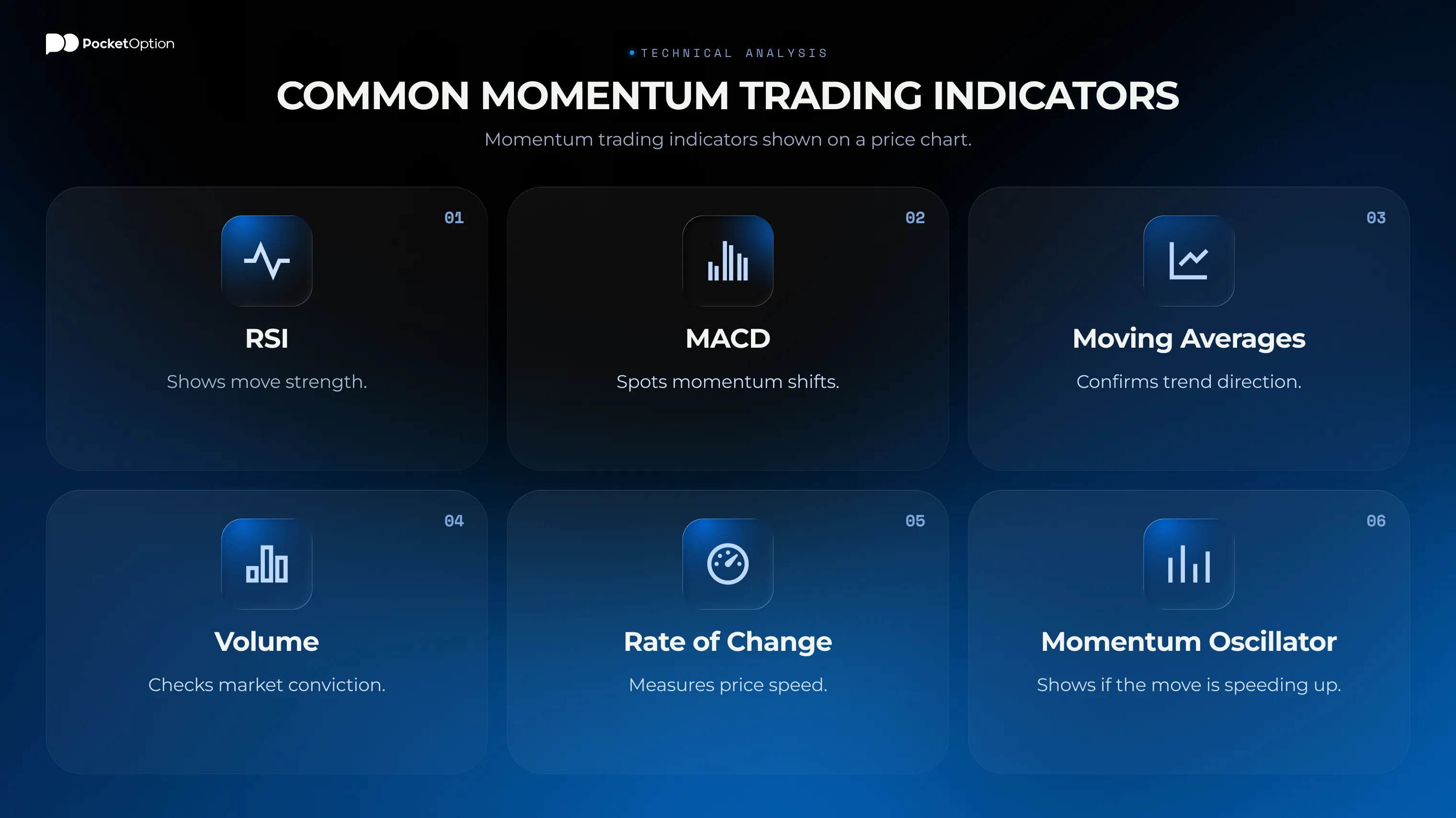
No momentum trading strategy should run on gut feel alone. Indicators add a second opinion on whether the strength you see is real or wishful. None predict the future, but together they build a clearer picture. Here are the tools most any momentum trading strategy leans on, and what each one tells you.
Indicator | What It Shows | How Traders Use It |
|---|---|---|
RSI | Speed and strength of a move, overbought or oversold zones | Judge whether momentum is strong or stretched thin |
MACD | The gap between two moving averages | Spot momentum shifts and crossover signals |
Moving averages | Direction and a smoothed price path | Confirm the move's direction and dynamic support |
Volume | How much conviction is behind the move | Check that a breakout is real, not hollow |
Rate of Change | How fast price is moving | Measure the pace of the current move |
Momentum oscillator | Current price against a past price | Read whether the move is speeding up or slowing |
One indicator on its own can lie. Two or three agreeing is a far stronger signal than any single line.
Simple Momentum Trading Example
Let us put those momentum trading indicators to work in a plain scenario, no heavy math. A stock sits under resistance for days. Then it breaks above, and volume jumps well past its recent average. RSI rises but is not screaming overbought, and MACD ticks into a bullish crossover. Price plus volume plus confirmation, that is what a momentum trader waits for. A long entry might sit just after the breakout, stop loss back below the broken level, exit planned for when the move loses steam. The short side is a mirror. Price breaks down through support, volume confirms the selling, indicators roll over, and the trader joins the move lower with a stop above the broken level.
Momentum Trading vs Trend-Following
People often lump trading momentum together with trend-following, but they are not the same animal. Momentum focuses on the raw strength of the move right now and means more active, earlier entries. Trend-following is calmer, waiting for a trend to establish itself, then riding it, often for much longer. The table lays out the main differences.
Aspect | Momentum | Trend-Following |
|---|---|---|
Main focus | Strength of the current move | An already established trend |
Entry style | More active, often near breakouts | Enter once the trend is confirmed |
Holding time | Usually shorter | Often much longer |
Key signal | Price strength plus volume | Direction of the ongoing trend |
Works best in | Sharp, fast moves | Steady, sustained trends |
When Momentum Trading Works Best
Whether you swing over days or lean into momentum day trading on shorter charts, the same holds: this approach shines in specific conditions and struggles in others. It works best when a market moves with clear direction, breaks out of a range, rides rising volume, or reacts to an obvious catalyst. Those are the moments strength feeds on itself. The flip side matters just as much. In a flat, range-bound market, on thin volume or messy whipsawing volatility, momentum signals turn unreliable fast. Knowing when to sit on your hands counts as much as knowing when to act.
Common Momentum Trading Mistakes
Plenty of traders can recite the momentum trading definition and still fall into the same traps. These are the ones that catch beginners most often:
Entering too late: jumping in after the move has already run, right before it stalls.
Buying the overheat: chasing a stretched, exhausted move instead of a fresh one.
Ignoring volume: trusting a price spike with no real participation behind it.
Mistaking a random spike for momentum: noise is not a trend.
Trading without a stop loss: leaving no plan for when the move reverses.
Using indicators blindly: reading signals without the market context around them.
Overstaying: holding long after momentum has clearly faded.
Risks of Momentum Trading
With the momentum trading strategy explained, the risks deserve equal airtime. Strong moves reverse without warning, and a false breakout can trap you the moment you enter. Late entries leave you exposed as a move tops out. High volatility cuts both ways and can blow through your stop. In fast markets, slippage means your fill can land worse than expected. And quick, high-conviction trades feed emotional decisions, the opposite of what this approach needs. Skipping a stop loss or an exit plan is how one bad move erases a lot of progress. Respect the speed, size positions for it, and never assume a strong move owes you anything.
Risk Disclaimer: Trading involves significant risk of capital loss. This article is for educational purposes only and does not constitute financial advice. Always conduct independent research and consider your risk tolerance before making any trading decisions.
See more:InterestingTrading Strategies