ATR Trailing Stop Loss Swing Trading Strategy
Give a dog too little leash and it chokes itself on every twitch. Give it too much and it wanders into traffic. A stop loss that trails a trade works on the same logic, except the dog is your open position and the leash length needs to match how much the market is actually moving, not some fixed number you picked out of habit.

What Is an ATR Trailing Stop in Swing Trading?
An atr trailing stop loss swing trading strategy solves a specific problem. A fixed stop loss gives every trade the same leash regardless of how calm or wild the market has been lately. ATR itself is nothing exotic, just the average distance price has traveled per candle over a chosen lookback period, usually 14. Feed that number into your stop distance and the leash automatically lengthens on volatile days and shortens on quiet ones.
Swing traders lean on this particular atr trailing stop loss swing trading strategy because their trades stay open for days, sometimes weeks. A stop set once at entry and never touched again either gets clipped by ordinary noise long before the real move happens, or sits so far away that a single bad swing erases weeks of gains. Trailing it with ATR keeps the leash appropriate to the moment, all the way through the trade.
Want to see how a trailing stop actually moves once a real trade is running?
Open a free demo account and watch how a trailing stop moves with real price action, using virtual funds.
Try Demo AccountWatching a stop trail behind live price, candle by candle, makes the mechanics click faster than any formula.
Open a demo trading account and follow a swing trade from entry to exit, with virtual funds and zero pressure.
How to Use ATR for Stop Loss Placement
Using an atr trailing stop starts with picking a multiplier, some fixed number you multiply the current ATR reading by. That result becomes your stop distance. From there the mechanics are almost boring. Price moves in your favor, the stop moves too, always trailing behind by that same ATR-based distance. Price moves against you, the stop holds still. For a long trade the stop only ever climbs, never drops back down. For a short trade it only ever falls, never creeps back up. That one-way ratchet is the entire point.
New to placing stops at all? The pocket option tutorial covers the basics first.
ATR Stop Loss Formula and Calculation
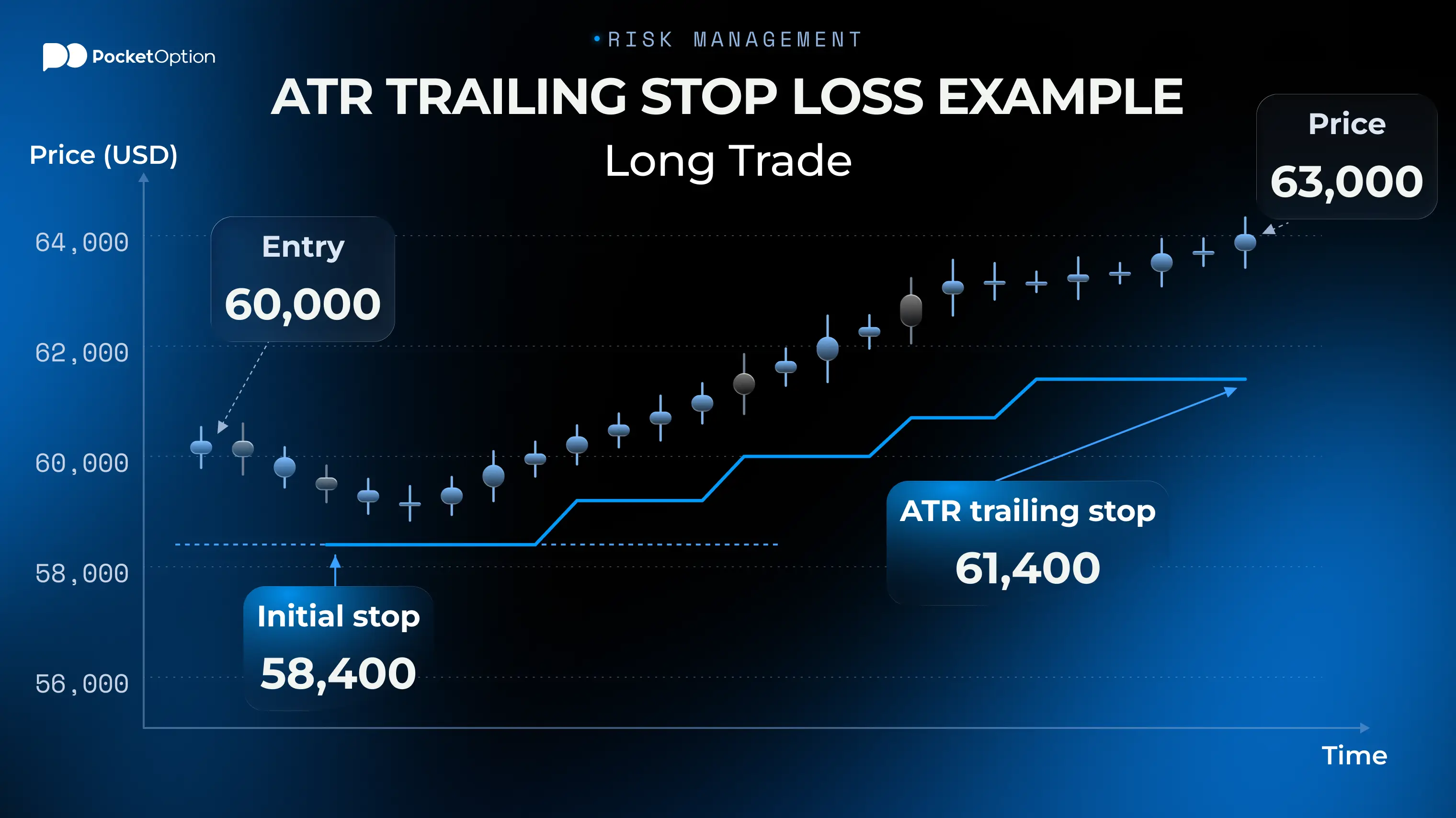
The atr stop loss formula is short enough to do in your head. For a long trade, stop equals entry price minus ATR multiplier times ATR value. For a short trade, stop equals entry price plus ATR multiplier times ATR value. Say Bitcoin's 14-period ATR reads 800, and you are using a 2x multiplier. That is 1,600 dollars of distance. Buy at 60,000 and your initial stop sits at 58,400. Nothing more complicated than that.
Choosing 1x, 1.5x or 2x ATR for Your Stop
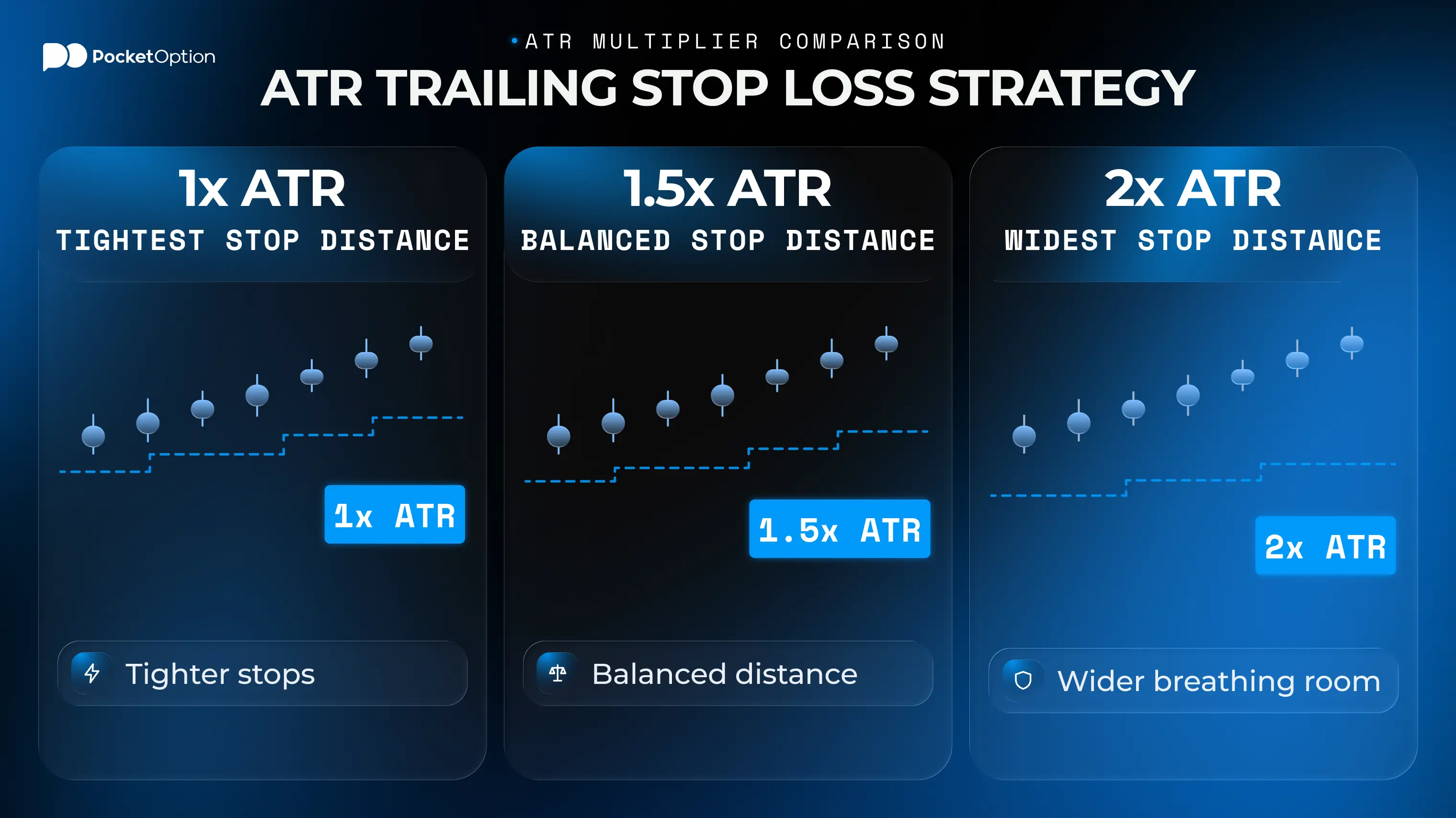
Picking a multiplier is really picking how much room you are willing to give a trade before you admit it failed. Learning how to use atr for stop loss well usually comes down to testing these three starting points and seeing which fits your market and timeframe.
ATR Multiplier | Stop Distance | Best Fit |
|---|---|---|
1x ATR | Tightest | Fast markets, quick exits, more stop outs |
1.5x ATR | Balanced | Most swing setups, a middle ground |
2x ATR | Widest | Choppy markets, fewer stop outs, bigger risk per trade |
Tighter multipliers protect gains sooner but get clipped by noise more often. Wider ones survive the noise but cost more when a trade genuinely fails.
ATR Stop Loss vs Fixed Stop Loss
A fixed stop loss is a straight line. Fifty pips, two percent, whatever number you picked before entry, and that number never changes no matter what the market does afterward. An atr trailing stop strategy throws that rigidity out. The distance breathes with the market, wider when candles are large and choppy, tighter when things calm down. Neither approach is objectively correct. Fixed stops are simpler to plan around. ATR-based stops respect the fact that a calm Tuesday and a news-driven Friday are not the same market.
Feature | Fixed Stop Loss | ATR Trailing Stop |
|---|---|---|
Stop distance | Same every trade | Changes with volatility |
Adapts to market conditions | No | Yes |
Planning simplicity | Easier to calculate | Requires ATR value each time |
Risk in quiet markets | Can be too wide | Tightens automatically |
Risk in volatile markets | Can be too tight | Widens automatically |
ATR Trailing Stop Strategy Example
Here is a full atr stop loss strategy example, long and short side by side, using clean round numbers so the arithmetic stays out of the way.
Long trade: entry at 60,000, ATR reads 800, multiplier is 2x. Initial stop distance is 1,600, so the stop opens at 58,400. Price climbs to 63,000. ATR is still roughly 800, so the stop trails up to 61,400, locking in gains without touching the original entry.
Short trade: entry at 60,000, same 800 ATR, same 2x multiplier. Initial stop distance is again 1,600, placed above entry at 61,600. Price drops to 57,000. The stop trails down to 58,600, protecting profit while still leaving room for normal pullbacks.
Both examples use the exact same math, just mirrored. The stop only ever moves in the direction that protects profit, never back the other way.
Common ATR Stop Loss Mistakes in Swing Trading
Most damage from an atr trailing stop loss setup comes from a handful of repeat mistakes, not from the tool itself.
Setting the multiplier so tight that ordinary candle noise stops you out before the real move even starts.
Going too wide out of fear, then holding a losing trade far longer than the setup ever justified.
Moving the stop backward against the trend because price dipped, which defeats the entire point of a trailing stop.
Ignoring that ATR itself changes over time and never updating the distance as volatility shifts.
Using the same multiplier on every market, from a sleepy forex pair to a wild altcoin, as if they behave the same way.
That first one deserves its own warning. A stop set too tight does not fail because the trade idea was wrong. It fails because normal, meaningless wiggling got mistaken for a reversal.
Risks of Using ATR Trailing Stops
A trailing stop built on ATR is a risk management tool, not a guarantee. Sharp gaps, especially over a weekend or around major news, can blow straight through a stop level and fill the exit far worse than the price you expected. Extreme volatility spikes can widen the ATR itself so fast that the stop lags behind reality for a candle or two. Go too wide with the multiplier and a single trade can cost more than the setup was ever worth. Go too tight and ordinary market noise closes positions that would have worked out fine left alone.
Risk Disclaimer: Trading involves significant risk of capital loss. This article is for educational purposes only and does not constitute financial advice. Always conduct independent research and consider your risk tolerance before making any trading decisions.
See more:InterestingTrading Strategies