
Airdrop Farming Guide for Beginners
A project hands out free tokens just for using it early. Sometimes those tokens end up worth hundreds, even thousands of dollars. That is the dream. It is also what pulls people toward airdrops in the first place. But under the hype is an actual strategy, with steps to follow and ways to lose. This guide is for beginners: how it works, where to look, how not to get burned.

What Is Airdrop Farming?
An airdrop is when a crypto project gives away free tokens, usually to its early or active users. Airdrop farming is the deliberate version of that. You use new projects before they launch a token, doing the things that might later qualify you for a drop. Picture planting seeds across a bunch of promising protocols and hoping a few sprout. No project owes you anything. That is why farmers spread their bets wide and treat it as a numbers game, never a paycheck.
New to crypto and want a safe place to learn the ropes? Open a free demo account and trade 100+ assets with virtual funds.
Open DemoBefore you touch a real protocol with real money, learn how trades, swaps, and wallets actually behave. Most beginners do not lose to bad luck. They lose to silly mistakes, a wrong network, a fat-fingered amount, a missed approval. Getting the mechanics down first is cheap insurance against expensive blunders later.
A demo trading account lets you practice reading markets and placing orders with virtual funds, so the basics are second nature before anything real is on the line.
Why Do Crypto Projects Reward Active Users?
To see what is airdrop farming worth chasing, you have to know why projects give tokens away at all. It is not charity. A new protocol needs users, liquidity, and a crowd, fast. A future token is a magnet for all three. Handing tokens to early adopters spreads ownership around, which decentralizes the project and looks a lot healthier than one giant insider pile. It also pays back the people who showed up before anyone knew the thing would survive. Marketing, decentralization, loyalty, all in one move.
If the basics of wallets and transactions still feel fuzzy, the pocket option tutorial is a quick primer on how trading and order flow work before you dive in.
Popular Airdrop Farming Opportunities
Most crypto airdrop farming falls into a few familiar buckets. Knowing which is which helps you weigh the effort against the likely payoff.
| Type | What You Do | Reward Timing |
|---|---|---|
| Testnet airdrops | Use a project's test network with test tokens | After mainnet and token launch |
| Retroactive airdrops | Use a live protocol early, before any token exists | Granted later for past activity |
| Community rewards | Complete social, quest, or governance tasks | Often quicker, usually smaller |
Testnets cost next to nothing, the tokens are fake, but payouts can take months, if they come at all. Retroactive drops are the famous ones. Early users of a live protocol get rewarded out of nowhere, the way the first Uniswap and Arbitrum users did. Community rewards are the quick, small stuff, handed out for quests, governance votes, or holding the right NFT.
How to Find Airdrop Opportunities
Finding good airdrop farming crypto opportunities is half the job. The best hunting grounds? Projects with real money behind them but no token yet, because a drop is often how they eventually launch one. Where to look: airdrop aggregator sites tracking live campaigns, crypto X and project Discords where launches break first, quest platforms like Galxe and Layer3, and funding news. A well-backed protocol with no token is a prime suspect. Then do the math. Weigh the time and gas a project wants against how likely, and how big, the reward might really be.
How to Start Airdrop Farming: Step-by-Step Guide
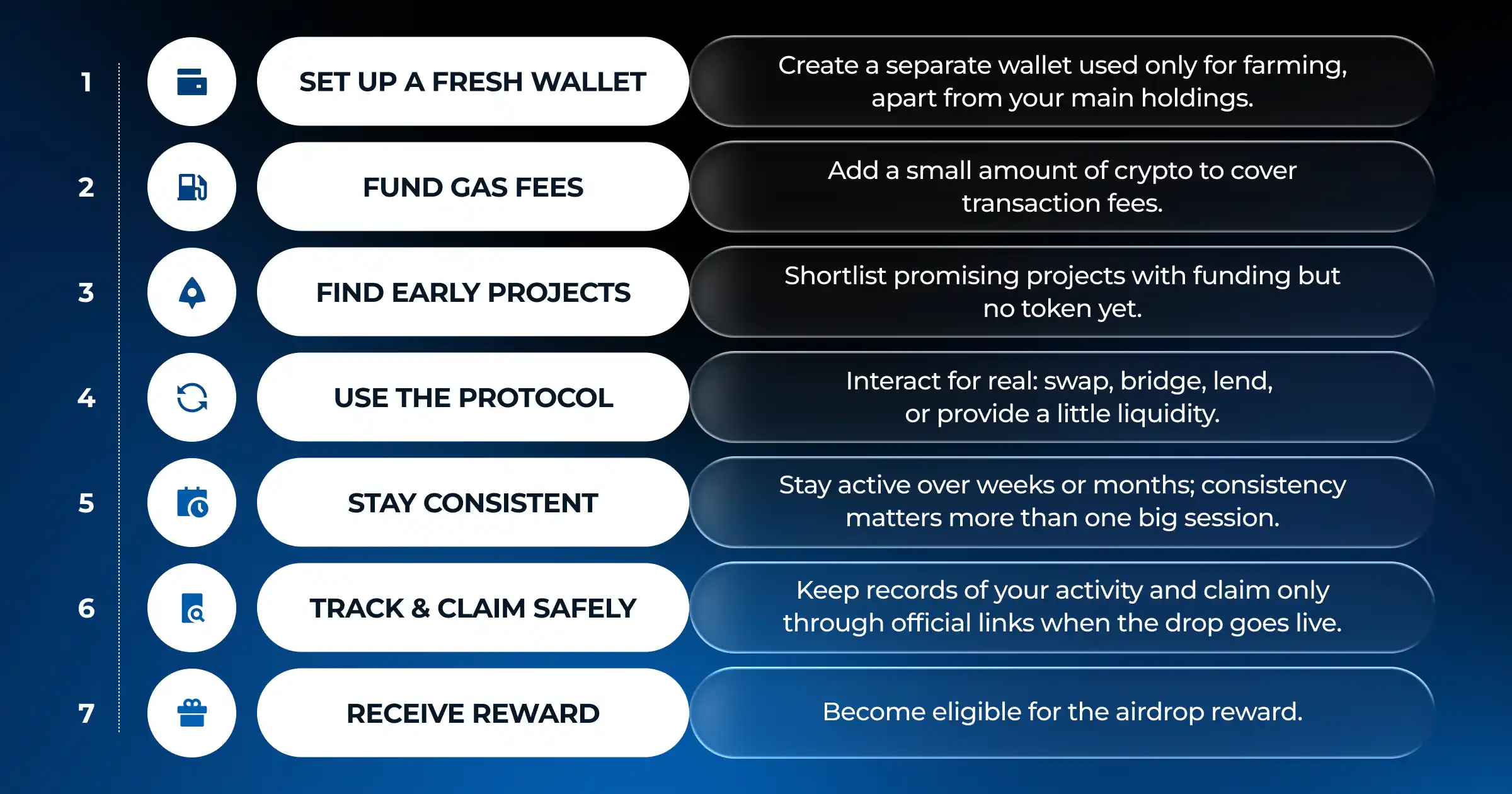
Once you know what is crypto airdrop farming in practice, the process itself is fairly simple. Here is a beginner-friendly sequence:
Set up a fresh wallet just for farming, kept well apart from your main holdings.
Add a small amount of crypto to cover transaction fees.
Shortlist promising projects that have funding but no token yet.
Use each protocol for real: swap, bridge, lend, or provide a little liquidity.
Stay active over weeks or months, since consistency tends to count more than one big session.
Keep a record of what you did, then claim only through official links when a drop goes live.
Slow and steady wins here, not frantic clicking. Real, repeated use is what most projects want to reward. It is also the one thing bots and one-off visitors cannot fake.
Common Mistakes in Airdrop Farming
Even the best airdrop farming guide cannot fully protect you from the usual beginner traps. The most common ones:
Spreading too thin across dozens of projects and doing each one half-heartedly.
Ignoring gas costs, which can quietly swallow any reward on a small wallet.
Obvious sybil behavior, like identical activity across many wallets, which projects filter out and disqualify.
Chasing loud, hyped names that have no real product behind them.
Rushing to unofficial claim links the moment a drop is announced.
Avoiding these does not guarantee a payout. It just stops you from burning money and getting quietly filtered out for nothing.
Risks and Safety Tips
The real danger is not a wasted afternoon. It is a drained wallet. Fake claim sites are everywhere, and one careless signature can sweep out everything you hold. Then there are the fake airdrops that ask for your seed phrase or an upfront payment. Both are instant red flags. No real project will ever ask. Build a few habits instead: use a throwaway burner wallet, never share your seed phrase, reach claim pages only through official channels, and revoke stale token approvals on a schedule. Assume most farming pays little, and never risk money you cannot afford to lose.
Risk Disclaimer: Trading involves significant risk of capital loss. This article is for educational purposes only and does not constitute financial advice. Always conduct independent research and consider your risk tolerance before making any trading decisions.
See more:InterestingTrading Strategies