What Is Stockbroking and How Do Stockbrokers Execute Client Orders?
Every share order you place has to reach a market somewhere, and something has to carry it there. That is the job stockbroking does. Most of it finishes in under a second, which is part of why so few people look at how.

What Is Stockbroking?
Stockbroking is the business of taking a client's buy or sell instruction and getting it done in the market. A broker holds the exchange membership, or a relationship with someone who does, and passes client orders through to where they can be matched. Without that link a private investor has no way to reach an order book at all. The practical steps of buying your first stocks are mostly a description of the broker's side of the process.
The word covers two things at once in normal use, the activity and the industry built around it. Both meanings are fine. What matters is that stockbroking is a service business, and the service is access plus execution.
The Role of a Stockbroker in Modern Markets
What is a stockbroker, in the plain sense? A licensed intermediary. The client sends an instruction and the broker handles the plumbing: checking the account holds the cash or the shares, routing the order onward, confirming what happened, then settling.
The old picture of somebody shouting on a trading floor is mostly gone. Modern stockbroking is software. The broker's real work sits in where orders get sent, how fast the systems are, and how costs get charged. Plenty of the vocabulary traders use day to day comes from this side of the market rather than from the exchanges.
How Stockbrokers Execute Client Orders
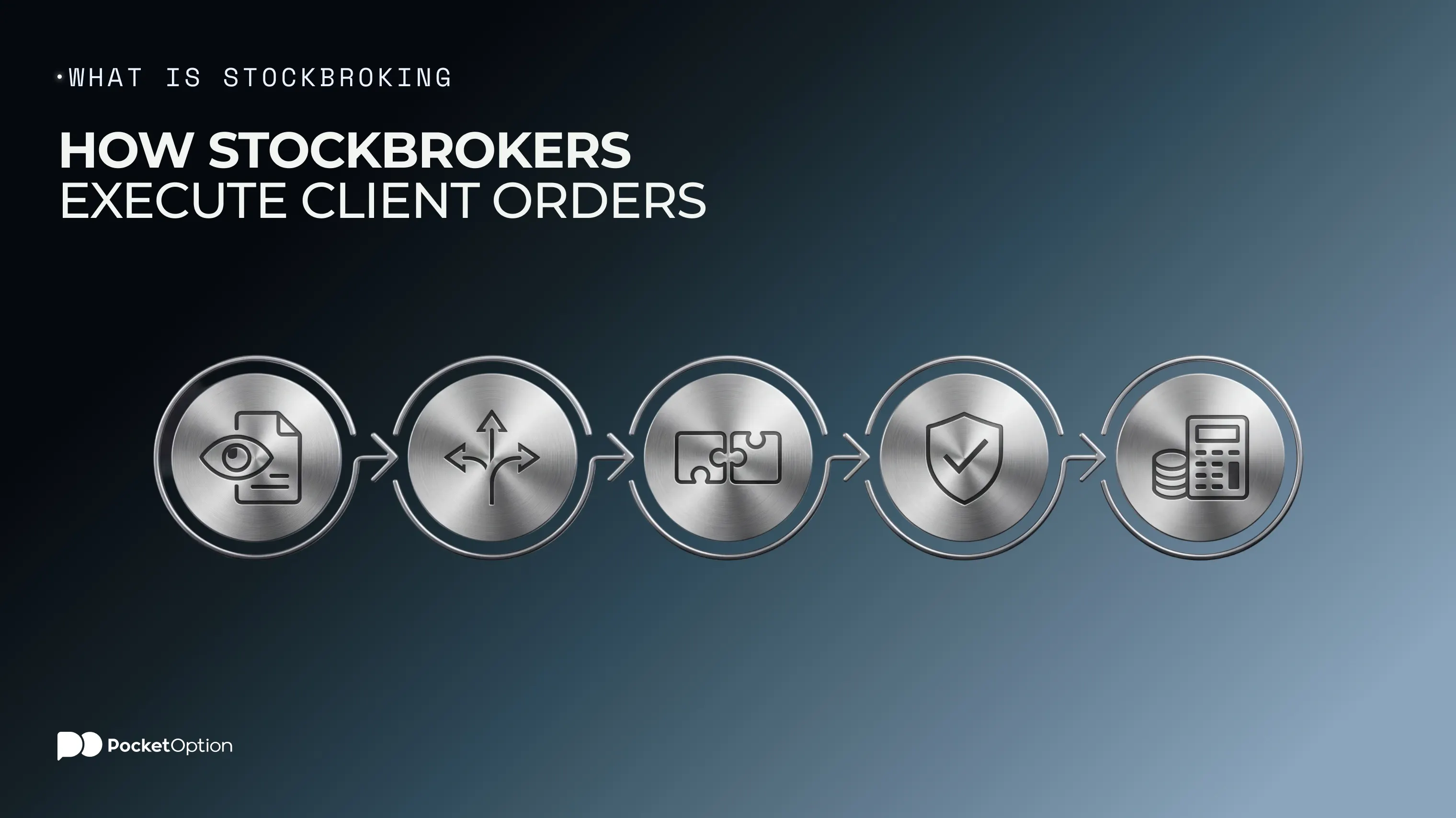
How stock orders are executed follows a fairly fixed sequence, whatever the platform looks like on your screen.
The order is entered and checked. Cash, holdings and any account limits get verified before anything leaves the broker.
The order is routed. It goes to an exchange, to an alternative venue, or to an internal desk willing to take the other side.
The order is matched against a resting order at that venue, either in full or in part.
A fill is confirmed and reported back, with the price and quantity you actually got rather than the one you saw.
Settlement follows a day or two after the trade, depending on the market.
Order routing and execution quality is where brokers genuinely differ, and it is the part almost nobody compares. Two brokers can both advertise no commission and still hand you slightly different prices, because they send orders to different places. Over one trade that gap is invisible. Over a few hundred it is not. This look at commission-free stock brokers works through some of the fee mechanics behind it.
The stock exchange and liquidity venues involved are more varied than they used to be. One order can end up on a primary exchange, on an alternative venue, or filled by a market maker holding its own inventory. All three are legitimate. They just do not always produce the same price at the same moment.
Order Types: Market, Limit, and Stop Orders
The market order vs limit order choice decides which of two things you are willing to give up: certainty about the price, or certainty about getting filled at all.
Order type | What you control | The trade-off |
|---|---|---|
Market | Nothing about price; you take what is there | Fills almost always, but the price can move against you in a fast market |
Limit | The worst price you are prepared to accept | May not fill at all if the market never reaches your level |
Stop | The level at which an order gets triggered | Once triggered it usually becomes a market order, so slippage is possible |
In a calm, heavily traded stock the difference between the first two is often a fraction of a cent. In a thin stock, or in the first minutes after an earnings release, it can be a great deal more. Stop orders are worth a second look before you lean on them, because the trigger price and the fill price are not the same promise.
Full-Service vs Discount vs Execution-Only Brokers
The full-service vs discount broker split is really a question about what you are paying for. Full-service means advice, research and a person who answers the phone, charged accordingly. Discount means a platform, some tools, much lower headline costs. Execution-only sits at the far end: it takes your order, fills it, and offers no view on whether the order was sensible.
None of the three is better in the abstract. Someone who wants a second opinion before every decision is badly served by execution-only pricing, and someone placing frequent small trades will watch full-service fees eat the returns. Brokerage fees and commissions come in more forms than the headline number suggests: platform charges, currency conversion, inactivity fees, the spread itself. Availability and pricing of any of these can change, so current terms are the ones worth reading rather than a comparison written last year.
One more thing worth mentioning here. Best execution is a regulatory duty in many markets, and it means the broker must take reasonable steps toward a good overall result. It does not mean the best possible price on every fill, which is a promise nobody can make.
Practice execution before it costs you.
Get StartedConclusion
The part of stockbroking most worth understanding is the routing decision, because it is the one you never see and cannot easily audit. Fees are printed on a page. Execution quality is not. If you place enough trades for small price differences to add up, that is the thing to ask a broker about, and the answer tells you more than the commission schedule does.
Disclaimer: Trading involves significant risk of capital loss and may not be suitable for all investors. Past performance does not guarantee future results.
See more:Glossary