What Is On‑Chain and How Do On‑Chain Transactions Work?
A transfer is on-chain when it is written directly into a blockchain, the shared public record that anyone can check. Most crypto activity, from sending coins to running smart contracts, ends up there, and each step leaves a trace that cannot be quietly edited.

What Is On-Chain
On-chain describes any activity recorded on chain, in the blocks of a public blockchain ledger. That ledger is copied across thousands of computers, called nodes, so no single party controls it and every participant can verify its history. An on-chain transaction moves coins between addresses and is sent from a crypto wallet that holds the private key for the sending address. A balance change inside an exchange's own database, by contrast, is off-chain.
How an On-Chain Transaction Works
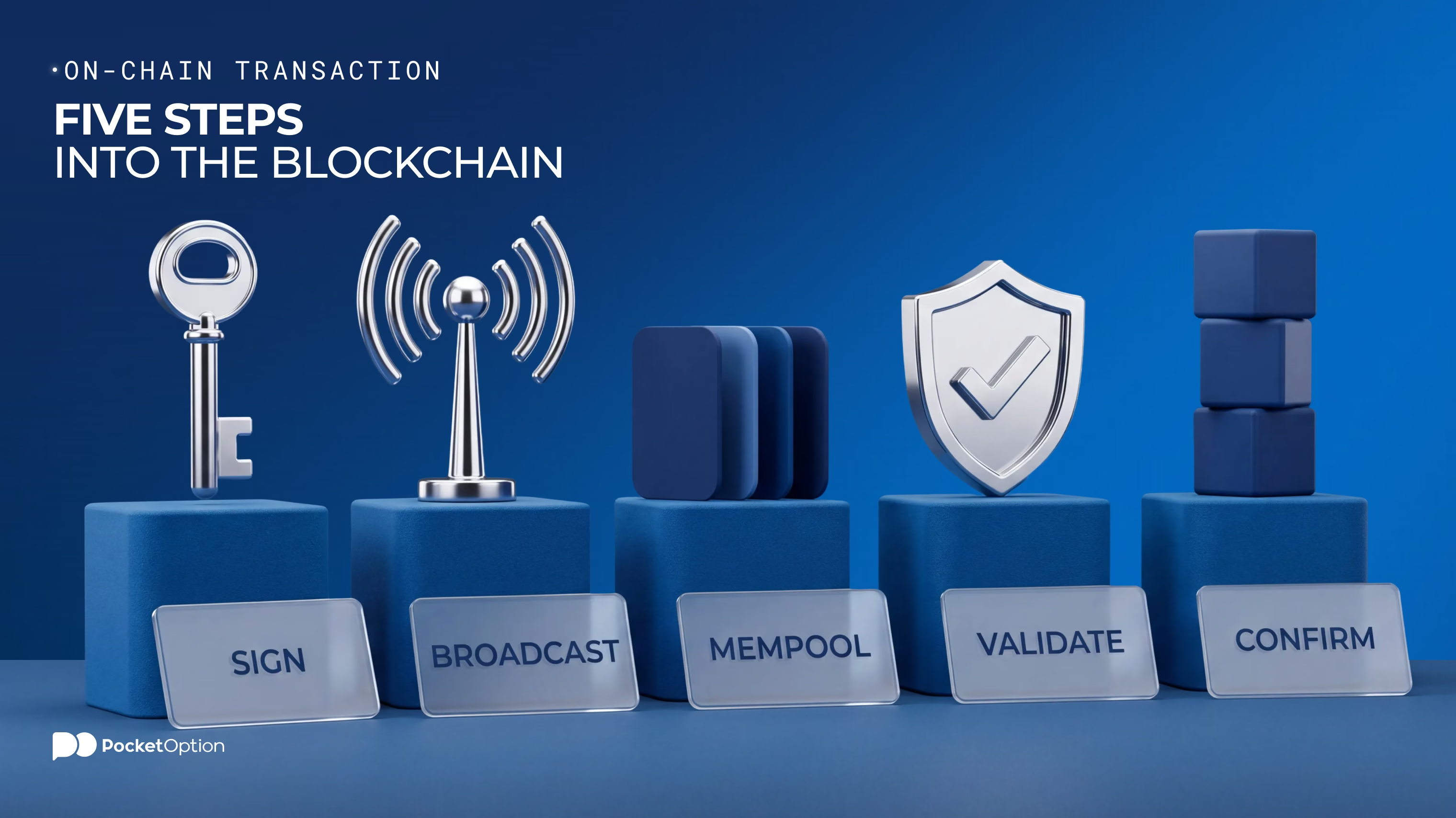
An on-chain transaction passes through five steps:
Signing: the wallet signs the transfer with the sender's private key, proving ownership without revealing the key.
Broadcast: the signed transaction is sent to the network and waits in a pool of pending transactions, the mempool.
Validation: nodes check the signature and confirm that the sender has enough funds.
Block inclusion: a miner or validator adds the transaction to a new block, which the network accepts under its consensus rules.
Confirmation: each later block built on top adds one more confirmation.
The same flow is at the heart of how Bitcoin works, where miners compete to add each new block.
Confirmations and Finality
Confirmations count how many blocks have been added after the block holding a transaction, and the more there are, the harder it is to reverse. On Bitcoin a block arrives about every 10 minutes on average, and six confirmations, roughly an hour, is a common threshold for large amounts. Ethereum produces a block every 12 seconds and treats blocks as final after about 13 minutes. Once final, a transfer cannot be reversed by the sender, the receiver or any company, so coins sent to the wrong address are usually lost.
Fees on the Blockchain
Every on-chain transaction pays a fee to the miners or validators who process it. Block space is limited, so users compete for it: when the network is busy, fees rise, and a transaction with a low fee can wait longer. Bitcoin fees depend on the size of the transaction in bytes, not on the amount sent, so moving $10 can cost the same as moving $10,000. On Ethereum the fee is paid in gas, and part of it, the base fee, is burned.
Other On-Chain Actions
Transfers are only one use of the ledger. Other recorded activity includes:
Smart contract calls, such as swapping tokens on a decentralized exchange or depositing collateral.
Token issuance, when a new token is created or minted under a contract's rules.
Governance votes, when holders vote on protocol changes with their tokens.
Each of these is an on-chain transaction too, with its own fee and confirmations.
What On-Chain Data Shows
Because the ledger is public, anyone can look up addresses, balances, transaction histories and fees with a block explorer, a website that searches the chain. Analysts track large transfers to exchanges, active addresses and fee levels, data that some traders combine with chart work when they analyze bitcoin price moves. Addresses are pseudonymous rather than anonymous: they show no names, but once an address is linked to a person, its whole history is visible.
On-Chain vs Off-Chain in Brief
Off-chain activity is settled outside the main blockchain, for example inside an exchange or on a Layer 2 network that later records a summary on the base chain. It is usually faster and cheaper, but it relies on the operator or the Layer 2 design rather than the base layer alone. The trade-offs are explained in detail in the guide to Bitcoin Layer 2 networks.
Conclusion
On-chain means recorded in a public blockchain ledger, where a transaction is signed, broadcast, validated, added to a block and confirmed. Check the address before sending, since a final transfer cannot be undone, set the fee according to how fast it must arrive, wait for enough confirmations on larger amounts, and remember that every on-chain move stays visible.
Practice first on a demo.
Get StartedDisclaimer: This article is for informational purposes only and does not constitute financial advice. Trading involves risk, and losses can exceed initial deposits.
See more:Glossary