What Is Max Supply and How Does Maximum Token Supply Affect Crypto?
Most currencies can be printed. Most tokens cannot, at least not past a number written into the code before anyone bought any. That number is the max supply, and it shapes a surprising amount of what follows.

What Is Max Supply?
Max supply is the hard ceiling on how many coins or tokens can ever exist for a given cryptocurrency. It is set in the protocol, not decided later by a treasurer, and for a fixed-cap asset it does not move. Once the ceiling is reached, no new units get created, whatever the demand looks like.
The term maximum token supply means the same thing and turns up more often for tokens issued on someone else's chain. Some assets have no ceiling at all, which is a design choice rather than an oversight. Either way this is one of the first items on any list of tokenomics basics, because almost every other supply figure is measured against it. The question of what happens when Bitcoin runs out is really a question about what a network does once its ceiling is in sight.
Max Supply vs Total Supply vs Circulating Supply
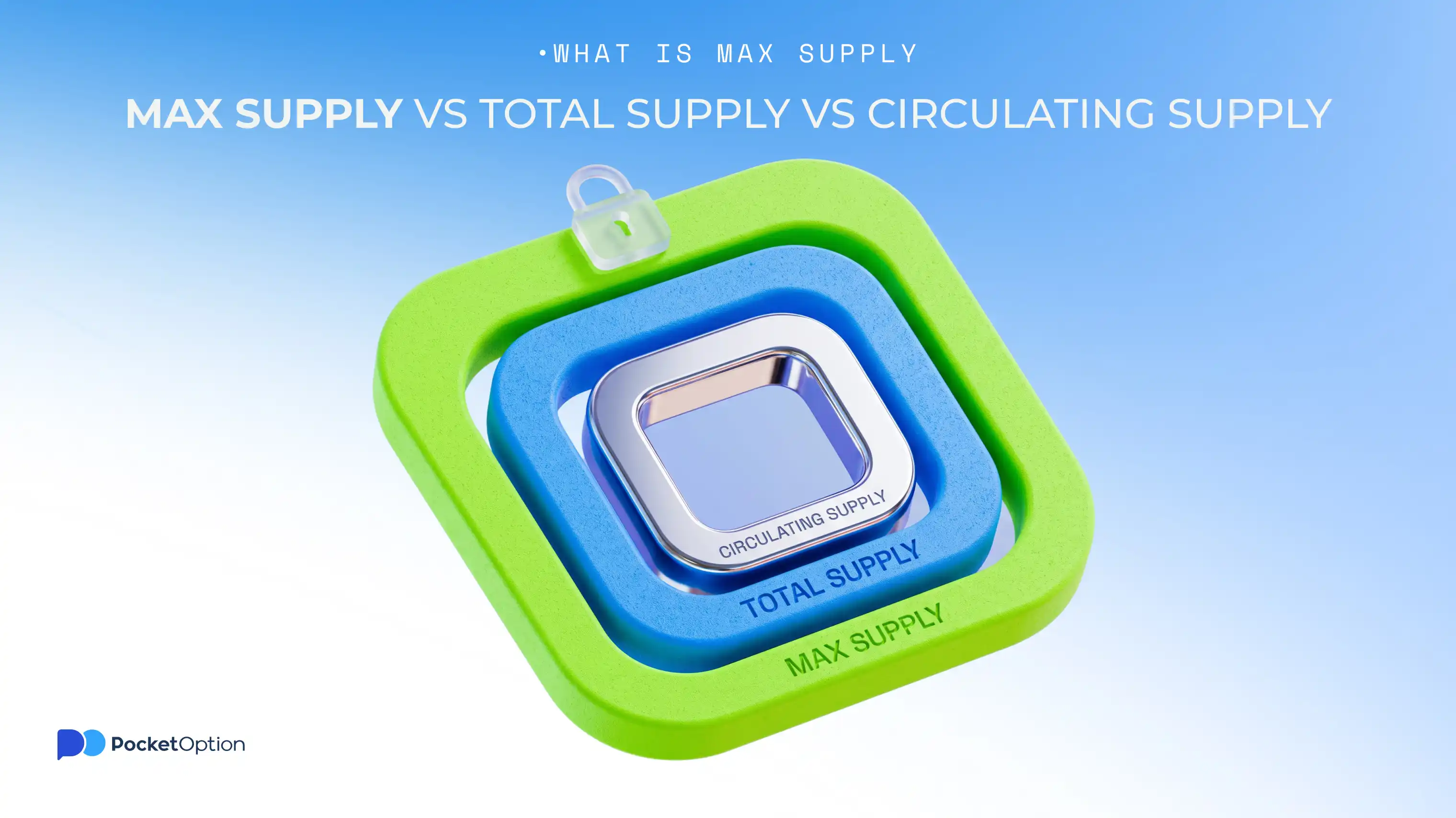
Three numbers get confused constantly, and the circulating vs total vs max supply comparison is worth getting straight once.
Figure | What it counts | Why it matters |
|---|---|---|
Circulating supply | Units available to trade right now | Used to calculate market capitalization |
Total supply | Units created so far, minus any burned | Shows what already exists but may be locked or vested |
Max supply | Units that can ever exist | Sets the long-run inflation limit and feeds fully diluted valuation |
The gap between circulating and max supply is the part that catches people, mostly because it gets read as future issuance when it is not. A good deal of that gap is made up of units that already exist and are simply held back: team allocations, treasury balances, tokens sitting under a vesting cliff. Those are counted in total supply while staying out of circulation. Only the remainder has genuinely never been minted.
Sizing what is still to come therefore takes two readings rather than one. Total supply set against max supply shows how much has yet to be created at all, and the project's unlock or emission schedule shows when the created-but-locked portion is due to reach the market. Both flows have to be absorbed by somebody, and they arrive on different timetables.
How Max Supply Is Set and When It Can Change
It gets written into the protocol at launch, usually through the issuance schedule rather than as a standalone line. Bitcoin max supply 21 million is the best-known example: nobody stores that figure anywhere, it simply falls out of a block reward that halves roughly every four years until new issuance rounds to nothing. The mechanics behind each Bitcoin halving are what actually enforce the cap.
Can it change? In principle yes, and that is worth knowing. A hard fork could alter it if enough of the network agreed, and on chains with formal governance a vote can adjust issuance parameters. In practice, changing a well-known cap would break the main thing holders were counting on, so it stays put. Minting and mining limits are enforced by code and consensus, not by promise, and consensus is a social thing as much as a technical one.
Why Max Supply Matters for Scarcity and Inflation
A ceiling makes future dilution knowable. That is the whole appeal. Crypto scarcity and inflation stop being a matter of trust in a central bank and become a matter of reading the schedule, which anyone can do. You can work out how many units will exist in ten years without asking anyone's permission.
Worth keeping in proportion, though. A cap limits supply growth; it does nothing about demand. An asset with a tiny ceiling and no users is still worth very little. And the pace of issuance often matters more in the short run than the ceiling does, since a token releasing a large share of its supply over the next two years has a real overhang regardless of where the cap sits. Tracking how much Bitcoin is left to mine is one way to see that distinction in practice.
Max Supply in Valuation: Market Cap and FDV
Market capitalization uses circulating supply times price. It answers what the traded portion is currently worth. Fully diluted valuation fdv uses max supply times price instead, so it answers a different question: what would this project be worth if every unit that can ever exist already did, at today's price?
The two figures can be very far apart, and that spread is informative as long as it is not over-read. A project whose fully diluted valuation fdv sits at several times its market cap has most of its supply outside circulation, which is not the same thing as most of its supply being unissued. A share of it may already have been minted and locked away. Neither number is a verdict. Both are inputs, and turning the ratio into an actual issuance forecast means going back to total supply and the unlock schedule, because that is where the split between minted-but-locked and not-yet-minted shows up.
Examples: Fixed-Cap and Unlimited-Supply Assets
Bitcoin. A fixed ceiling of 21 million units, approached through halvings and reached somewhere around the year 2140 on current schedule assumptions.
Litecoin. Also fixed-cap, at 84 million, with a comparable halving structure.
Ethereum. No maximum token supply at all. Issuance and fee burning together decide whether net supply grows or shrinks in any given period.
Dogecoin. Uncapped, with a steady fixed issuance per block, so the inflation rate falls over time as a percentage while the absolute number keeps climbing.
Uncapped does not mean badly designed. It means the supply discipline has to come from somewhere other than a ceiling.
Common Misconceptions About Max Supply
The biggest one is treating a low ceiling as a reason to expect a high price. Price per unit depends on how the total value is divided across units, so a token with a billion-unit cap and a token with a million-unit cap can be worth exactly the same in aggregate. Comparing per-unit prices between assets with different caps tells you almost nothing.
Two more come up often. That the cap is unchangeable in an absolute sense, which is not quite true, as code can be forked. And that reaching the cap ends the project, which it does not; a network can keep running on transaction fees once issuance stops, though whether that pays for enough security is a genuinely open question.
Read the schedule before you buy.
Get StartedConclusion
The figure worth checking first is not the cap itself. It is the share of the cap already circulating. That one ratio tells you how much of the supply story has already happened and how much is still queued up ahead of you, and it is printed on every major data site next to the numbers people actually look at.
Disclaimer: This article is for informational purposes only and does not constitute financial advice. Digital asset prices are highly volatile and losses can be substantial.
See more:Glossary