What Is Helicopter Money and How Does This Policy Tool Work?
The name comes from a thought experiment, not from a policy anybody has actually run. Money gets created and handed straight to the public, no borrowing, nothing owed back. Simple enough to picture. Considerably harder to reverse.

What Is Helicopter Money?
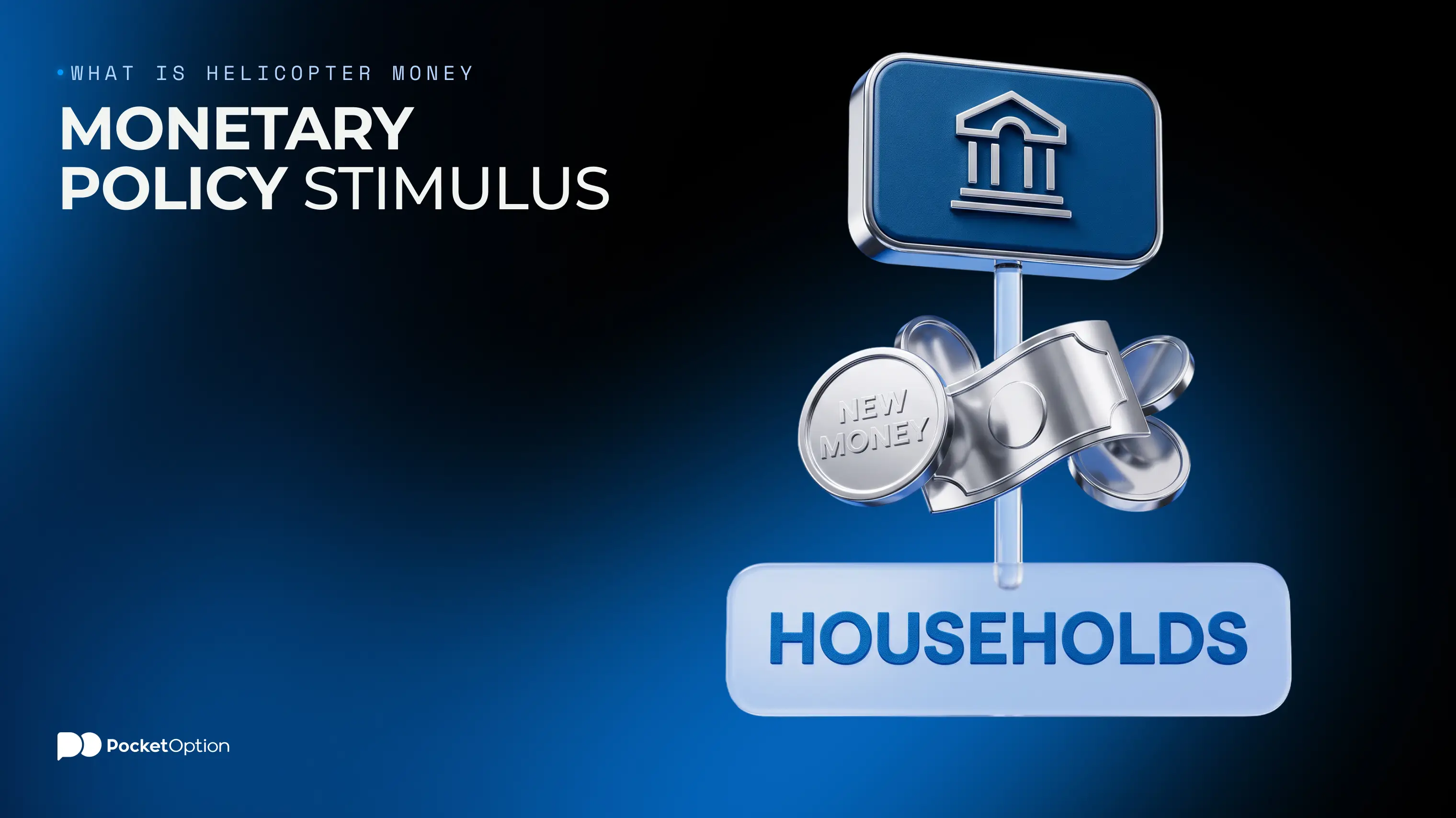
Helicopter money is newly created central bank money passed directly to households or to the government, with no repayment attached. No bonds issued against it. No schedule for taking it back. The money is simply out there and it stays out there.
The helicopter drop definition traces to Milton Friedman, who imagined a helicopter scattering banknotes over a town as a way of showing what happens when the money supply rises and nothing else about the economy does. It was a teaching device. The label stuck and got pulled into real policy arguments decades later.
Two features separate it from nearly everything else in the toolkit. The money is permanent, and it goes to people rather than to banks. Both matter more than they sound.
How Does Helicopter Money Work?
Mechanically it is two steps that are normally kept well apart.
A central bank creates money.
That money reaches households or the treasury as a transfer rather than as a loan.
In ordinary times those two things live in different buildings. Money creation belongs to the central bank, spending belongs to the finance ministry, and the ministry funds itself by issuing debt that somebody has to buy. Direct money distribution collapses the gap between them. Fiscal and monetary policy stop being separate exercises and turn into one operation.
The form it takes varies. Payments made straight into bank accounts. A tax cut matched by permanent monetary financing. Government spending covered by money that nobody expects to be withdrawn later. Different plumbing, same principle sat underneath.
Helicopter Money vs Quantitative Easing and Fiscal Stimulus
This is where most of the confusion sits, so a table earns its place.
What is created | Who receives it | Reversible? | |
|---|---|---|---|
Helicopter money | New central bank money | Households or the treasury | No, by design |
Quantitative easing | New reserves used to buy assets | Banks and bondholders | Yes, assets can be sold |
Rate cuts | Nothing | Borrowers, indirectly | Yes |
Fiscal stimulus | Nothing, funded by debt | Households or firms | Debt is repaid or rolled |
Quantitative easing vs helicopter money comes down to whether an asset sits on the other side of the entry. Under QE a central bank buys bonds and holds them, so the money can in principle be pulled back later by selling, and the effect of all that buying shows up across the Treasury yield curve rather than in anybody's bank account. Under a helicopter drop there is nothing to sell. The money was given, not lent.
Stimulus payments are the other common mix-up. Those are fiscal transfers financed by government borrowing, which means a bond exists somewhere and somebody eventually pays interest on it. Money went out, debt came in. Not the same thing at all, even though the payment looks identical to whoever receives it.
Why Would Policymakers Use Helicopter Money?
As monetary policy stimulus goes, the case for it only turns up once the usual levers have stopped moving.
Rates are already at or near zero, so cutting further achieves very little.
Asset purchases have run for years and lending still has not picked up much.
Demand is weak and prices are flat or falling.
Getting money to people who will spend it is quicker than waiting for it to work through the banking system. Or so the argument goes.
Money that lands in a household account tends to get spent sooner than money that lands in a bank's reserve balance. Spending becomes somebody else's revenue, revenue supports employment, employment supports more spending. The chain is meant to be shorter and more direct than the one asset purchases rely on.
How Helicopter Money Can Affect the Economy
Effects spread unevenly across markets, and none of them are guaranteed.
Inflation. Money creation and inflation are linked when supply cannot keep up with the extra demand. How much, and how quickly, is contested.
Interest rates. Short rates may stay pinned where they are, while longer yields can rise if markets start pricing higher inflation.
Currencies. A currency can weaken against others when its supply expands and nobody expects it to shrink back.
Bonds. Rising inflation expectations push yields up and prices down, and inflation linked bonds behave differently from conventional ones.
Equities. Higher nominal demand can lift earnings while higher discount rates pull valuations the other way.
Commodities. Often bid up, partly on demand and partly as a hedge.
Those channels do not fire in sequence or to any timetable. Inflation data and how markets take it shapes expectations long before the real economy shows anything, which is why the reaction usually arrives well ahead of the evidence.
Risks and Limitations of Helicopter Money
The risks are the reason the idea has stayed largely theoretical.
Inflation overshoot. Adding demand to an economy already near capacity pushes prices rather than output.
No exit. There is no asset to sell, so draining the money afterwards means raising rates hard or raising taxes, and neither is politically easy.
Confidence. A central bank seen to be funding the government directly can lose the independence its credibility rests on.
Currency depreciation, which raises the cost of everything imported and lands hardest on the people the policy was meant to help.
Distribution. Who gets it, how much, and on what basis are political questions rather than technical ones.
Worth saying plainly that no major economy has run a textbook version of this. Pandemic era payments came closest in appearance and were still funded by government borrowing, so the defining feature was missing. Currency pairs and what tends to move them gives some sense of how fast an FX market prices a shift in monetary stance, which is usually faster than the policy itself takes to reach anyone.
Policy moves, markets react, you watch.
Open an AccountConclusion
The helicopter in the metaphor only ever flies one way. Friedman's town could pick the notes up off the street and no part of the story explained how anyone might collect them again afterwards. That missing second half is the whole of the practical objection. Creating the money is the easy part of helicopter money, and every difficult question sits on the far side of it.
Disclaimer: This article is for informational purposes only and does not constitute financial advice. Policy outcomes are uncertain, and market reactions to monetary decisions can differ from expectations.
See more:Glossary