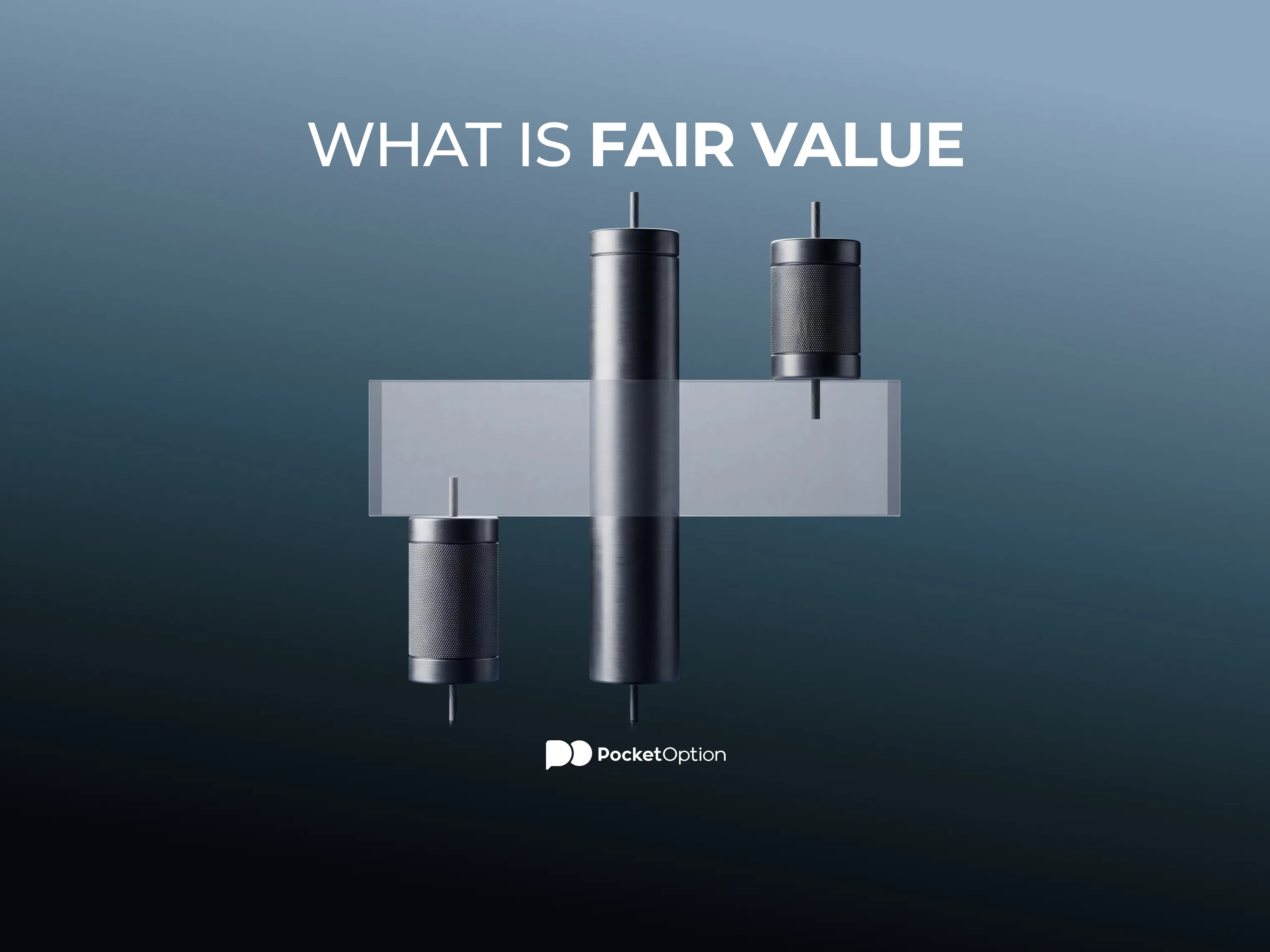
What Is Fair Value and How Do Traders Use Fair Value in Pricing?
If you have spent any time looking at trading charts, you have probably heard the term fair value thrown around. The answer is surprisingly split: in one context, it is a theoretical price calculated by quants and institutional traders; in another, it is a visual pattern on a price chart called a Fair Value Gap (FVG), which most active traders actually care about.

What Is Fair Value: Definition
At its simplest, fair value is the price at which an asset would change hands between a willing buyer and seller. In trading, it is the theoretical value of an asset based on mathematical models, rooted in the idea that identical instruments should trade at the same price. If a futures price sits above its fair value it is considered expensive, and if below, cheap; traders can exploit these differences through arbitrage.
Fair Value in Trading vs Fair Value Accounting
Fair value means two different things depending on whether you are talking to a trader or an accountant. In trading it is forward-looking, a theoretical price derived from models used to identify mispricing. In accounting it is more of a current exit price, used to report values on financial statements.
The key differences:
Aspect | Fair Value in Trading | Fair Value in Accounting |
|---|---|---|
Purpose | Identify mispricing and arbitrage | Report asset/liability values on financial statements |
Focus | Forward-looking (theoretical) | Current (exit price) |
Method | Mathematical models (e.g., Black-Scholes, cost-of-carry) | Market prices or valuation techniques |
Users | Traders, quants, arbitrageurs | Companies, auditors, regulators |
For most retail traders, the accounting definition is irrelevant. What matters is how fair value appears on a chart as a Fair Value Gap.
What Is a Fair Value Gap (FVG)
A Fair Value Gap is a price area on a chart where the market moved so quickly that little or no trading happened between two price levels, a visible void in price action. This is not an overnight gap that happens when markets are closed, but an intraday inefficiency. FVGs are a core concept in ICT (Inner Circle Trader) methodology, and the market tends to return to these untraded areas to fill them.
How an FVG Forms on a Chart
A Fair Value Gap typically forms as a three-candle pattern. The first candle trades normally and establishes one boundary. The second is a strong directional candle that skips over price levels. The third continues the move, and its wick does not fully retract into the first candle's range; the untouched space between them is the Fair Value Gap.
How Traders Use FVGs as Entry Zones
Traders useFair Value Gapsin several ways. When price returns to an FVG, it often bounces or reverses, offering a potential entry zone. In an uptrend, a bullish FVG can act as support on a pullback; in a downtrend, a bearish FVG can act as resistance on a retrace.
An FVG can also act as a magnet for price: approached from above, it may act as support; approached from below, it may act as resistance.
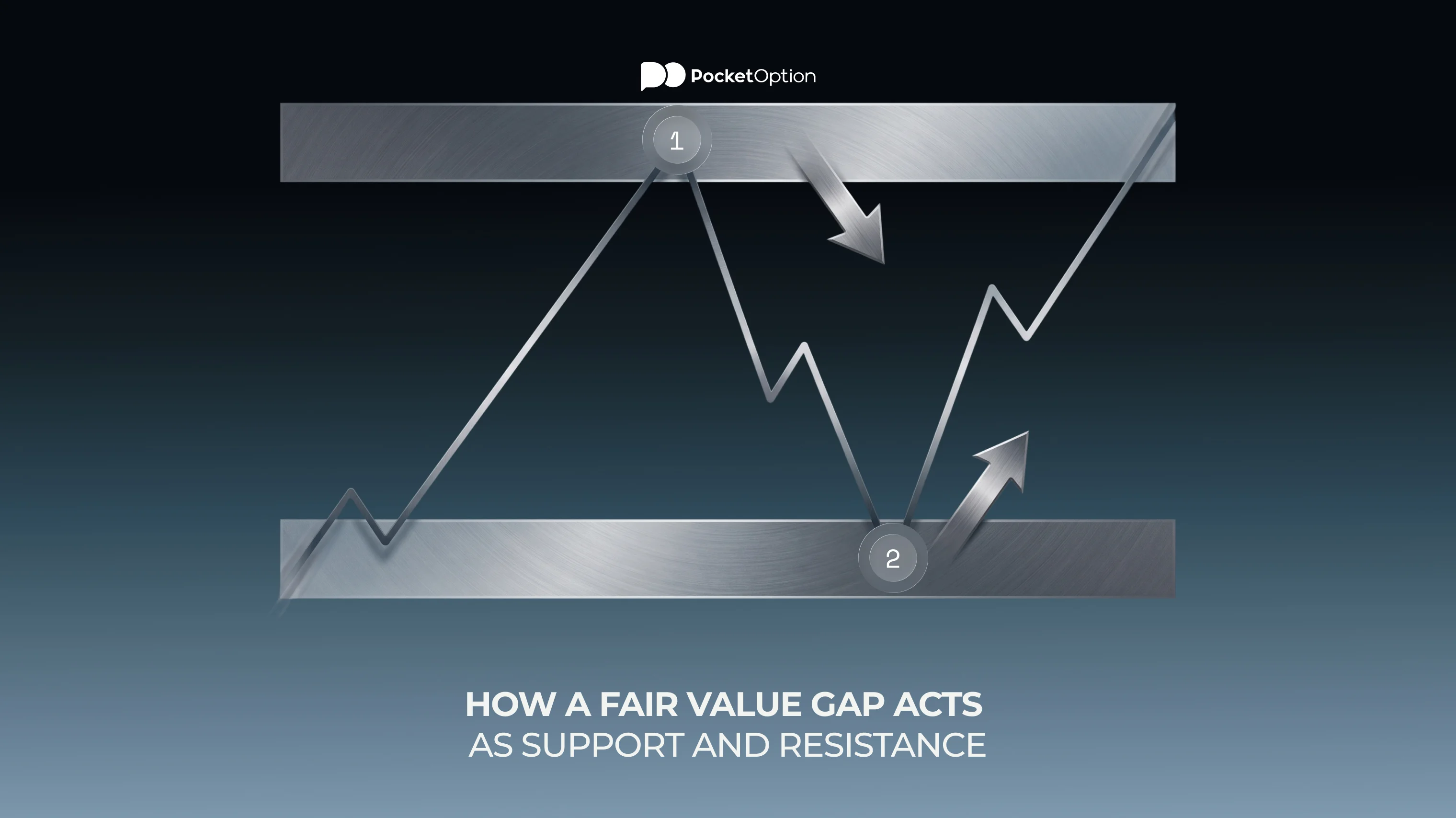
Traders also use FVGs as profit targets, since price may return to fill a gap left by a strong move, and as invalidation levels: a close through an FVG that should have held can signal the trade idea is no longer valid.
Best Practices
Combine FVGs with other tools such as order blocks or market structure. Higher-timeframe FVGs carry more weight. Wait for confirmation rather than entering the moment price touches the gap, and manage risk with stops beyond the opposite boundary.
Conclusion
Fair value means different things to different people: an exit price for an accountant, a theoretical price for a trader, but to most active traders the term that matters is the Fair Value Gap. An FVG is a three-candle pattern that forms when price skips over certain levels, leaving an untraded zone the market tends to return to and fill, making FVGs useful as entry zones, support and resistance, and profit targets.
on a Pocket option Demo Account
Open Demo AccountRisk Disclaimer: Trading involves significant risk of capital loss. This article is for educational purposes only and does not constitute financial advice. Always conduct independent research and consider your risk tolerance before making any trading decisions.
See more:Glossary