What Is EBITDAR and How Does It Adjust Company Earnings?
When analysing a company's financial health, you will encounter a confusing alphabet soup of metrics: EBIT, EBITDA, EBITDAR, and more. EBITDAR is one of the more specialised variations, essentially EBITDA with one additional adjustment: rent or restructuring costs are added back. This matters because in industries like airlines, hotels, and retail, rent can be such a large and variable expense that it obscures the true operating performance of the business. This guide explains what EBITDAR is, how it is calculated, and how it differs from EBITDA.

What Is EBITDAR: Definition
EBITDAR stands for Earnings Before Interest, Taxes, Depreciation, Amortization, and Restructuring or Rent Costs. It is a non-GAAP metric used to evaluate operating performance by stripping away financing decisions, tax structures, non-cash expenses, and occupancy costs, and is particularly useful in sectors like hospitality, retail, and airlines, where lease expenses significantly affect profitability.
The EBITDAR Formula
The formula is straightforward: EBITDAR = EBITDA + Rent + Restructuring Costs. Using a bottom-up approach, EBITDAR = Net Income + Interest + Taxes + Depreciation + Amortization + Restructuring/Rent Costs; using a top-down approach, EBITDAR = Revenue – Operating Expenses excluding those same items. Both are conceptually equivalent. For a hotel chain with £4.9m net income, adding back £1.2m tax, £1.2m interest, £2.8m depreciation, £0.4m amortization, and £6.5m rent produces an EBITDAR of £17.0m, about 37.8% of revenue.
EBITDAR vs EBITDA: What's Added Back
EBITDA excludes interest, taxes, depreciation, and amortization; EBITDAR goes one step further and also excludes rent or restructuring costs. Rent largely reflects how a property is financed, lease versus ownership, rather than how efficiently the business operates, so removing it lets comparisons focus on the underlying operations. EBITDAR is similar in spirit to adjusted EBITDA, which strips out other one-time or non-recurring items, though under IFRS 16 the two measures have converged and are close to identical in most cases.
Which Industries Use EBITDAR Most
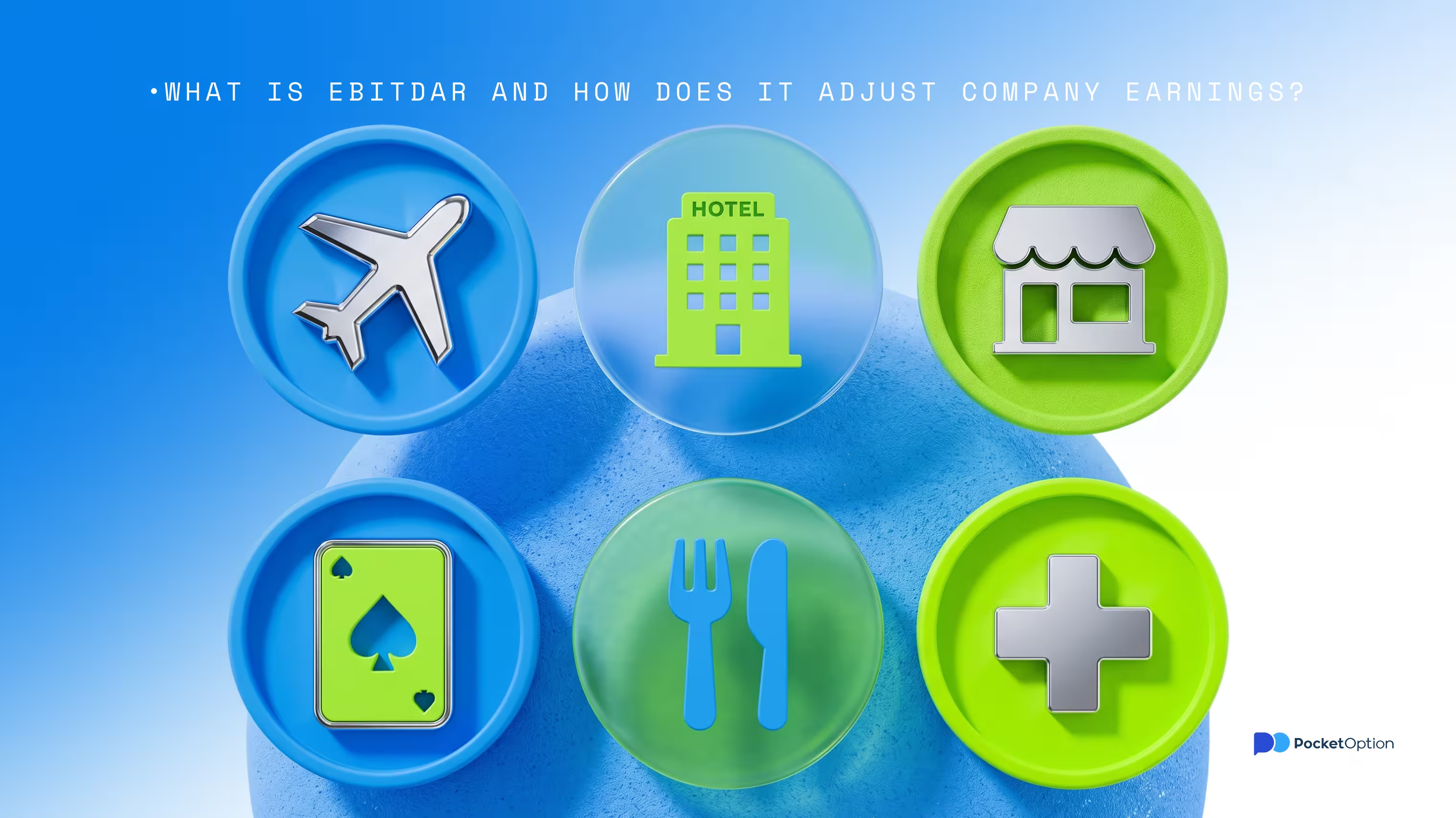
EBITDAR is especially relevant in industries with substantial lease costs: airlines, where aircraft leasing is a major expense; hotels and hospitality, where property leases vary widely; and retail chains, casinos, restaurants, and healthcare operators, all of which typically lease a large share of their physical footprint. In these sectors, rent costs are high enough that results can look very different from one company to another depending on ownership structure alone.
Why EBITDAR Can Overstate Financial Health
Rent is a real, recurring cash expense, so removing it can make a company look more profitable than it is; regulators have noted that excluding a cost like aircraft rent can be misleading without proper disclosure. EBITDAR is also a non-GAAP measure with no standard definition, meaning companies can calculate it differently, and it is not a substitute for cash flow, since it ignores changes in working capital. Because it produces a higher base figure than EBITDA, valuation multiples applied to EBITDAR also tend to run lower, which can create confusion when comparing companies across metrics.
Conclusion
EBITDAR extends EBITDA by adding back rent and restructuring costs, making it especially useful for comparing companies in lease-heavy industries with different ownership structures. But as a non-GAAP metric with no standard definition, it excludes real cash costs and should not be used in isolation from measures like cash flow and net income.
Risk Disclaimer: Trading involves significant risk of capital loss. This article is for educational purposes only and does not constitute financial advice. Always conduct independent research and consider your risk tolerance before making any trading decisions.
on a Demo account for free
Open Demo AccountSee more:Glossary