
What Is Currency Appreciation and How Do Stronger Currencies Impact Trade?
Currency appreciation is a rise in the value of one currency against another. A stronger currency buys more abroad, which sounds like an unqualified gain until it starts reshaping who can sell what, and at what price, across a border. Appreciation and depreciation are two sides of the same exchange rate, and neither is good or bad on its own.

What Is Currency Appreciation: Definition
The appreciation definition economics students meet first is straightforward: one currency strengthens against another, so it takes fewer units of it to buy one unit of the other. If EUR/USD moves from 1.0500 to 1.1000, the euro has appreciated against the dollar, since a euro now buys more dollars than before. Because currency pairs quote one currency against another, the same move is dollar depreciation seen from the other side.
A Worked Example
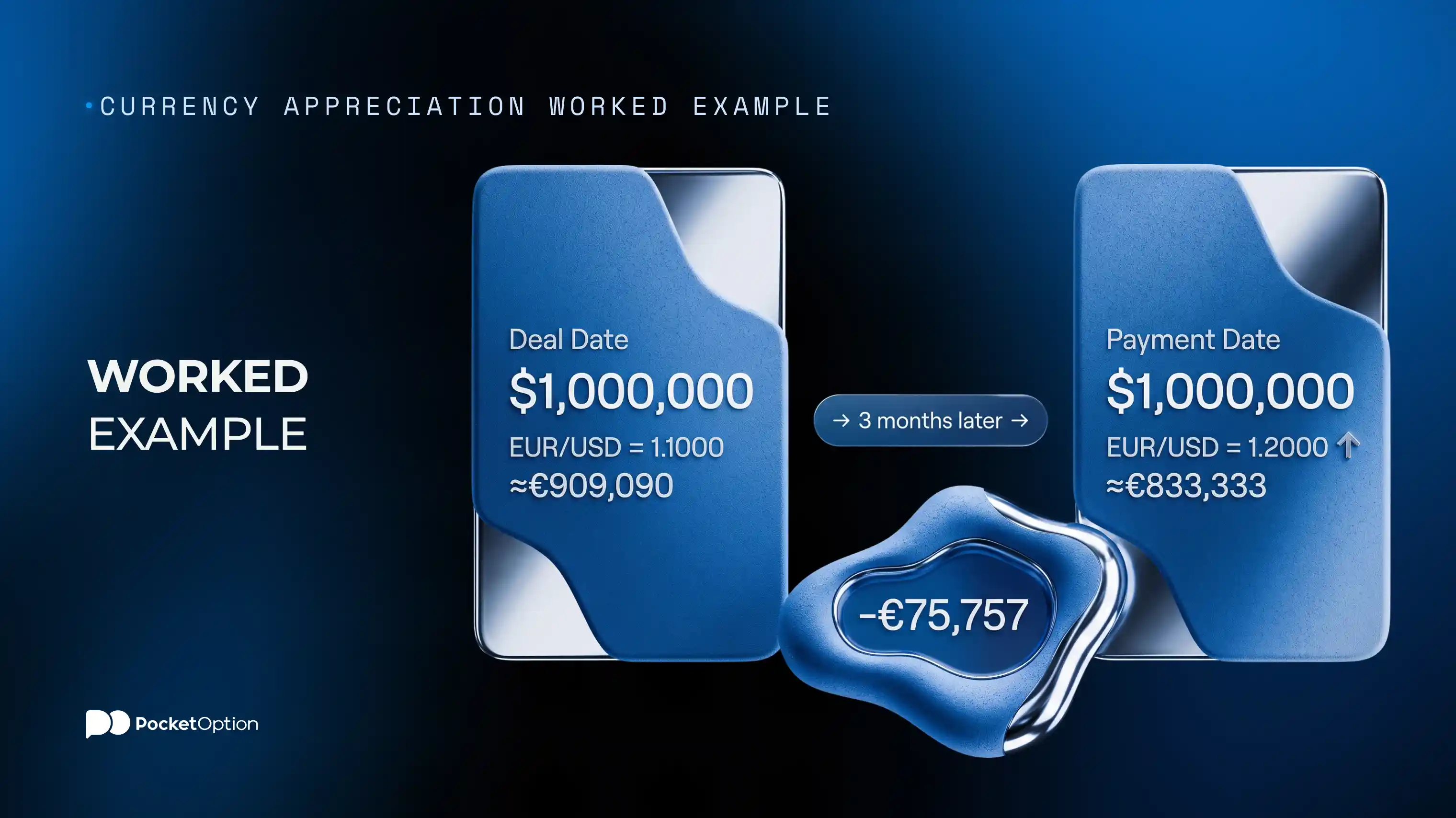
An exporter in the eurozone agrees to sell machinery for $1,000,000, payable in three months. At the time of the deal, EUR/USD sits at 1.1000, so the exporter expects roughly 909,090 euros. By the time payment arrives, the euro has appreciated and EUR/USD has risen to 1.2000. The same $1,000,000 now converts into only about 833,333 euros, a shortfall the exporter never priced in, purely from currency appreciation of the euro against the dollar between the two dates.
Main Causes of Currency Appreciation
A handful of forces, sometimes described in everyday terms as money appreciation, tend to drive one currency higher against another:
Higher interest rates relative to other countries, which draw in yield seeking capital
A trade surplus, since foreign buyers must acquire the currency to pay for exports
Strong economic growth and low inflation relative to trading partners
Capital inflows into stocks, bonds, or direct investment from abroad
Of these, a central bank's benchmark rate is often the fastest acting, since capital can move toward higher yielding currencies within days of a rate decision.
How Currency Appreciation Impacts Imports and Exports
A stronger currency makes imports cheaper, since each unit of the domestic currency buys more from abroad. It makes exports more expensive for foreign buyers, since the forex market that prices these pairs now requires more of their own currency to buy the same amount of the appreciating one. Exporters competing on price can lose market share without changing anything about their product, even as consumers and import heavy businesses benefit from the same move.
Currency Appreciation vs Depreciation
Effect | Appreciation | Depreciation |
|---|---|---|
Imports | Cheaper | More expensive |
Exports | More expensive for foreign buyers | Cheaper, more competitive abroad |
Inflation | Downward pressure, cheaper imports | Upward pressure, pricier imports |
Typical trigger | Higher rates, trade surplus, strong growth | Lower rates, trade deficit, weak growth |
Depreciation answers a common question: what is it called when money loses value against another currency. It is simply depreciation, the mirror image of appreciation.
Why This Matters for Trading Currency Pairs
For a trader, the direction of appreciation or depreciation is the entire basis of a currency pair trade: everything else is timing and position size. On a Quick Trading platform, this comes down to picking an asset such as EUR/USD, choosing a timeframe, and selecting Buy or Sell, rather than managing an open position with margin calls or stop levels attached. Whatever the underlying cause, the trade reduces to one question: does this currency appreciation or depreciation continue from here.
Pick a direction. Set a timeframe.
Start TradingConclusion
Currency appreciation and depreciation are simply two names for the same move in an exchange rate, described from either side. Neither is inherently good news. A stronger currency helps consumers and importers while squeezing exporters, and a weaker one does the reverse. Understanding which forces are pushing a currency up or down matters more than memorizing whether appreciation is supposed to be favorable, since the answer depends on which side of the transaction someone stands on.
Disclaimer: Trading involves significant risk of capital loss and may not be suitable for all investors. Past performance does not guarantee future results.
See more:Glossary