What Is a Lending Protocol and How Does On-Chain Borrowing Work in DeFi?
Borrowing money normally means asking somebody for permission. On a lending protocol there is nobody to ask. The code checks whether you have posted enough collateral, and if you have, the loan goes out.

What Is a Lending Protocol?
A lending protocol is a set of smart contracts that lets people deposit crypto assets and lets others borrow against them. No loan officer, no credit file, no application form. The rules live in the contract and run the same way for everyone who touches it. This is one of the more established corners of decentralized finance, and one of the few where the mechanics stay easy to follow.
Defi lending explained in a sentence: depositors supply assets to a shared pool, borrowers take assets out while locking up collateral of their own, and the interest borrowers pay goes back to the depositors. The protocol keeps a slice. All of it is recorded on a public chain.
How On-Chain Borrowing Works
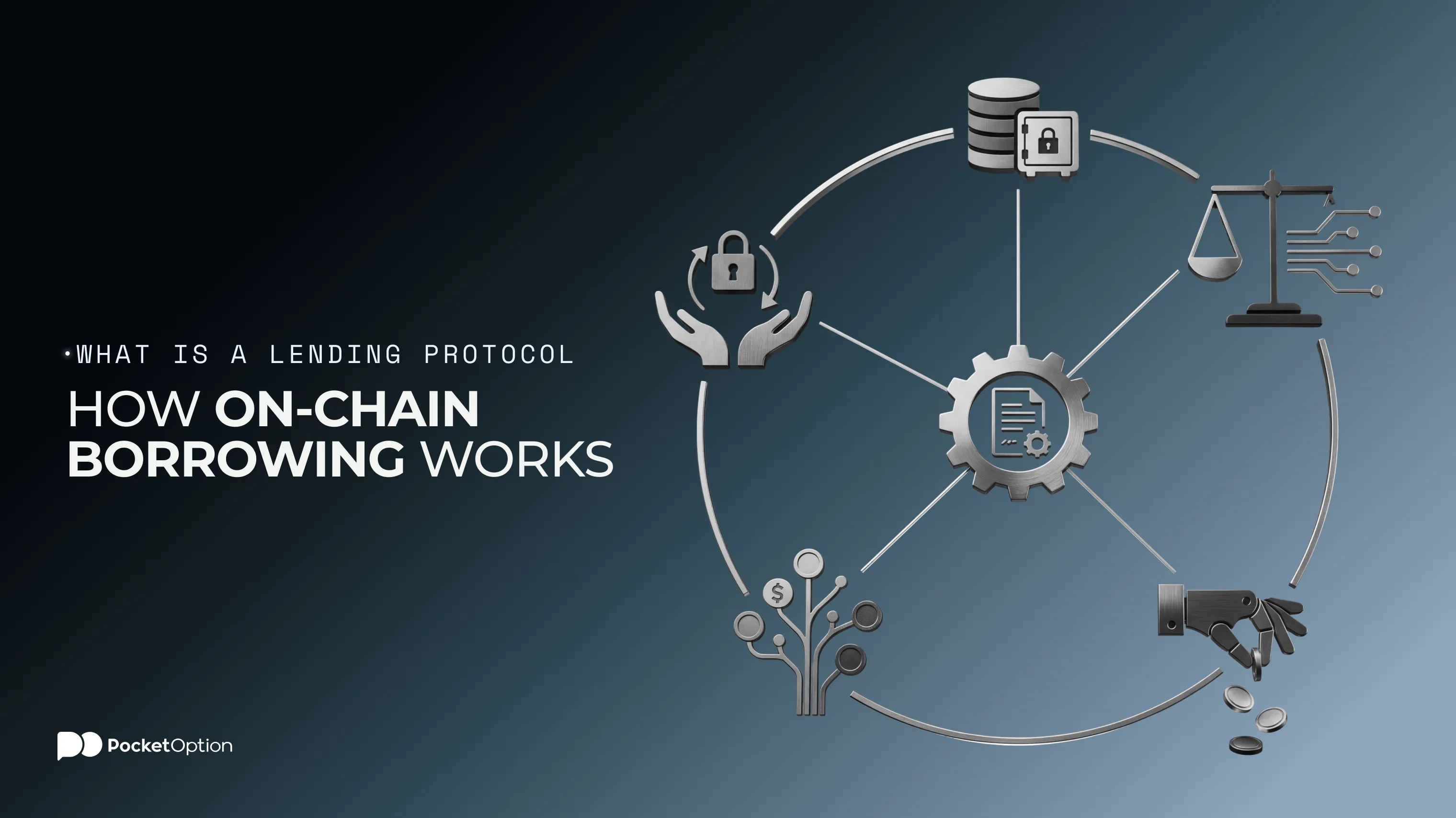
On-chain borrowing skips almost everything a bank would do. There is no assessment of who you are or what you earn. The contract asks a much narrower question instead: is the value you have locked up bigger than the value being lent to you, by enough of a margin?
The steps are short. Assets get deposited as collateral. A borrowing limit is worked out from what that collateral is worth and how risky the asset is considered to be. The borrower draws down up to that limit, interest accrues block by block, and repaying unlocks the collateral again. The wider DeFi trading landscape is built out of pieces that behave like this.
Liquidity Pools, Collateral, and Interest Rates
Liquidity pools in defi are what let the whole thing work without matching individual lenders to individual borrowers. Everyone deposits into the same pot and borrowers draw from the same pot. Nobody has to find a counterparty or agree terms with anyone.
Rates are not negotiated either. Algorithmic interest rates get set by how much of the pool is out on loan, a figure normally called utilization. When most of it is borrowed, borrowing turns expensive and depositing turns more rewarding, which pulls new deposits in. Smart contract lending of this kind reprices constantly, so a rate quoted this morning may not be the rate this evening.
Over-Collateralization and Liquidation
Most loans here are over-collateralized loans, which means you lock up more value than you take out. Post $1,000 of one asset and you might be allowed to borrow $700 or $750 of another. The gap is not a fee. It is buffer.
That buffer exists because the protocol cannot chase anyone for repayment. Collateral and liquidation are its only enforcement tools. Every position carries a liquidation threshold, and if the collateral value drops far enough to cross it, some or all of that collateral gets sold automatically to clear the debt. A penalty is usually applied on top, which is what pays whoever triggered the liquidation.
Price feeds matter enormously here, since the contract has no independent idea what anything is worth. It relies on oracles, which is a dependency worth remembering.
Common Use Cases for DeFi Lending
Getting cash without selling. Borrowing stablecoins against an asset you would rather keep holding avoids a disposal, though it adds liquidation risk in exchange.
Earning on idle deposits. Assets sitting in a wallet earn nothing; supplied to a pool they earn whatever the current rate happens to be, which can fall as easily as rise.
Leverage. Borrowing in order to buy more of the same asset amplifies both directions, and it is the quickest route to a liquidation.
Short-term working capital, including flash loans that get borrowed and repaid inside a single transaction.
The first two account for most ordinary use. The last two are where the losses concentrate. Anyone coming at this from a trading background will find the cryptocurrency fundamentals worth going over first, because the collateral arithmetic only makes sense once the behaviour of the underlying asset does.
Key Risks of Lending Protocols
Smart contract bugs. The code holds the funds, and code can be wrong. Audits reduce this risk without removing it.
Oracle failure. A wrong price, even for a moment, can trigger liquidations that should never have happened.
Liquidation risk. Collateral prices can fall quickly and there is no grace period built into any of this.
Liquidity gaps. If nearly the whole pool is borrowed out, depositors may not be able to withdraw when they want to.
Governance risk. Thresholds, rate curves and supported assets can all be changed by whoever holds the governance tokens.
Choosing a Lending Protocol: What to Check
A few things are worth checking before any assets get committed. How long the protocol has run, and how much value sat inside it through a bad market rather than a calm one. Whether the contracts were audited, by whom, and whether the findings were published rather than summarized. Which oracle supplies prices. What the liquidation threshold and penalty actually are for the specific asset you plan to post, since these vary a great deal between assets on the same protocol.
Also worth reading: who can change the parameters, and how fast. A protocol where a small group can adjust thresholds with no delay is a different proposition from one with a timelock in the way. None of this takes long to look up. It just tends to get skipped.
Start small and learn as you go.
Start TradingConclusion
The number to know before borrowing anything on a lending protocol is your own liquidation price, worked out for the specific collateral you posted. Not the loan-to-value ratio, not the interest rate. The price at which the contract stops asking and starts selling. Almost every painful story in this corner of the market traces back to somebody who never worked that one figure out.
Disclaimer: This article is for informational purposes only and does not constitute financial advice. Digital assets are highly volatile and losses can be substantial.
See more:Glossary