What Does ETP Mean and How Do Exchange-Traded Products Work?
ETF is the term everyone knows. ETP is the wider category it sits inside, and the difference between the two is not academic. Some products in that category own assets, and some only promise to pay you.

ETP Meaning: What Is an Exchange-Traded Product?
The etp meaning is an umbrella one. An exchange-traded product is any security listed on an exchange that is designed to track the value of something else: an index, a single asset, a basket, or a strategy. It trades through the day like a share, with a live price rather than one struck once at the close.
So exchange traded products explained at the top level covers three main families. ETFs, which are funds. ETNs, which are notes issued by a bank. And ETCs, which usually track a commodity or currency. All three are ETPs. Only the first is a fund, which is where most of the confusion starts. Anyone approaching them from a trading angle will find the practical side of day trading ETFs a reasonable place to see how they behave intraday.
How Do Exchange-Traded Products Work?
Understanding how etps work means separating two things: what the product holds, and how its market price stays close to what it should be worth.
The first part depends on the type. A fund actually buys the underlying holdings. A note does not; it is a debt obligation that pays a return linked to an index. The second part is common to most of them. Large institutions can create new units by delivering the underlying assets, or redeem units to receive them back. That mechanism keeps the traded price tethered to the underlying value, because a wide enough gap becomes an arbitrage somebody will close. The precious metals ETFs that hold physical bullion in a vault are a clear case of holdings and price staying linked this way.
Main Types of ETPs: ETFs, ETNs, and ETCs
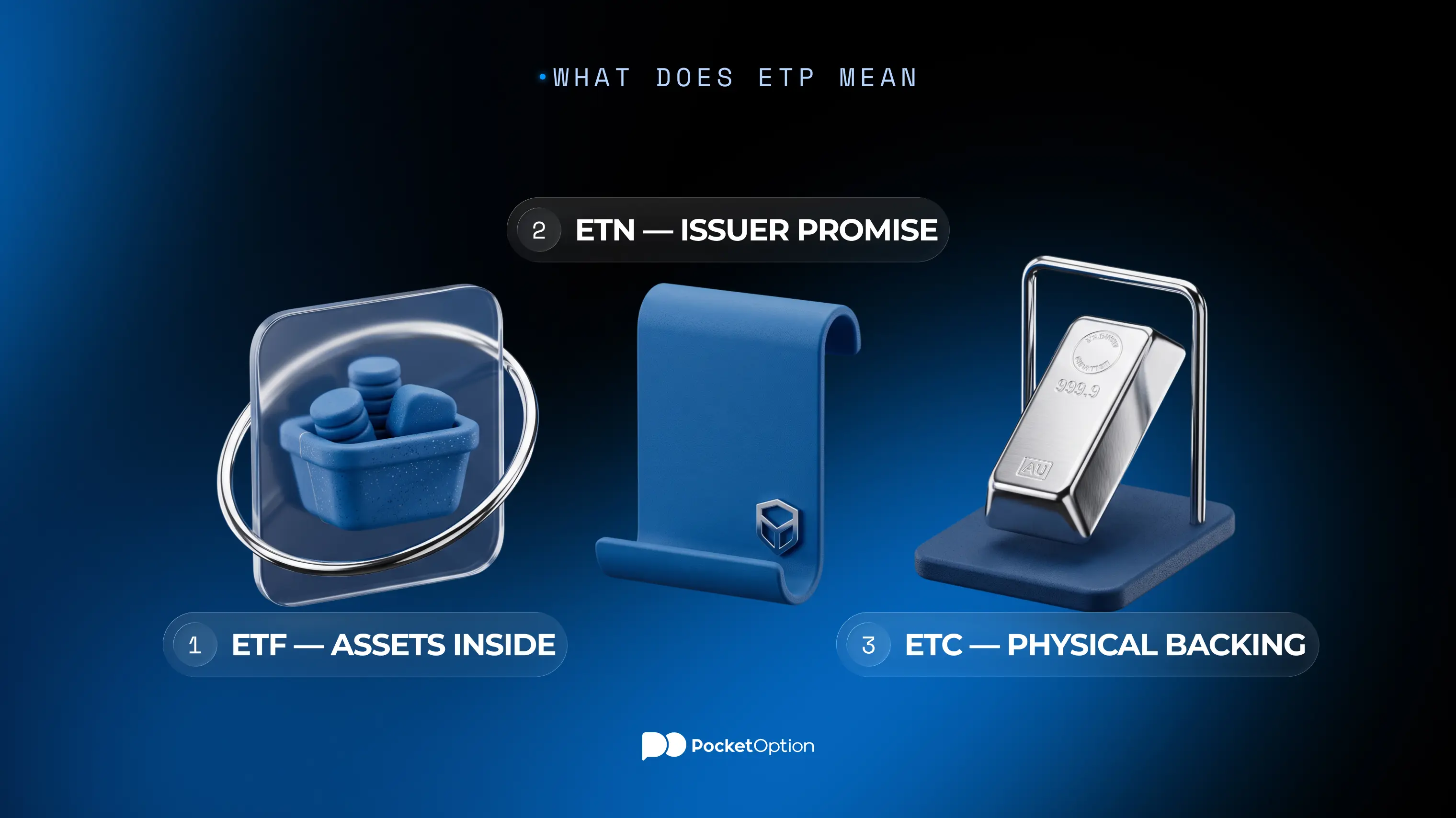
The etp vs etf vs etn distinction comes down to what you own when you buy one.
Type | What you actually hold | Key consideration |
|---|---|---|
ETF | A share of a fund that owns the underlying basket | Assets are ring-fenced from the provider's own balance sheet |
ETN | An unsecured debt note issued by a bank | Repayment depends on the issuer staying solvent |
ETC | Usually a debt security, often backed by physical holdings or collateral | Structure varies by product, so the prospectus matters |
Availability and structures differ by jurisdiction and can change, so the product documents are the source worth checking rather than any general description. In Europe the ETC label is common for commodity and crypto-linked products; in the United States similar exposure often arrives as a trust or a fund instead.
How ETPs Track Indices and Assets
Etf structure and tracking usually works one of two ways. Physical replication means the fund holds the actual constituents, either all of them or a representative sample. Synthetic replication means it holds a swap agreement with a bank that delivers the index return, which introduces a counterparty to the arrangement.
Neither approach tracks perfectly. The gap between the product's return and the benchmark's return is called tracking error, and it comes from fees, cash held for redemptions, dividend timing, sampling choices and trading costs inside the fund. A cheap product tracking a large liquid index tends to have small tracking error. A product tracking something illiquid or exotic often does not, and that is worth checking before deciding a low fee makes it cheap. For assets you cannot easily hold directly, the wider question of choosing a broker for stock investing and what it gives you access to matters as much as the product itself.
Benefits of Using Exchange-Traded Products
Intraday trading. You can buy and sell whenever the exchange is open, at a visible price, rather than waiting for a daily valuation.
Diversification in one line. A single purchase can give exposure to hundreds of holdings, which is difficult to assemble individually at small size.
Access to awkward markets. Commodities, foreign indices and narrow themes become reachable without opening specialist accounts.
Transparent pricing and disclosed holdings, at least for most funds, which publish what they own.
Costs are usually lower than actively managed funds too, though not always, and leveraged or niche products can be considerably more expensive than the headline names.
Key Risks of ETPs
Market risk. The product falls when its benchmark falls. Diversification spreads risk within an asset class; it does not remove it.
Tracking error. Returns can drift from the benchmark for structural reasons rather than because anything went wrong.
Liquidity risk. Thinly traded products carry wider spreads, and the cost of getting out can rise sharply in a stressed market.
Etn credit risk. A note is a claim on the issuer, so an issuer failure can affect the value regardless of how the index performed.
Leverage and compounding. Daily leveraged and inverse products reset each day, so over longer periods their returns diverge from the multiple you might expect.
That last one deserves emphasis. A product promising twice the daily move of an index will not deliver twice the index's move over a year, and in a choppy market it can lose money while the index finishes flat.
Choosing Between ETFs, ETNs, and Other ETPs
Start with what exposure you actually want, then look at which structures offer it. If a plain fund holding the assets is available, the ring-fencing argument is a real one, since fund assets sit apart from the provider's own balance sheet. A note makes more sense where the exposure is hard to hold physically and the issuer's creditworthiness is something you have looked at rather than assumed.
After that it comes down to the details. Total cost rather than the headline fee. Typical spread and trading volume. Whether replication is physical or synthetic. Domicile and how distributions are taxed where you live. Etc commodity products in particular vary a lot in structure between issuers that look similar from the outside, so reading the specific document beats reasoning from the label.
Try the structure before the money.
Get StartedConclusion
The question that separates one of these products from another is not what it tracks. Two products can track the same index and leave you holding completely different things: a slice of a fund that owns the shares, or an unsecured promise from a bank. Find out which one you are buying, and most of the rest of the analysis becomes easier.
Disclaimer: This article is for informational purposes only and does not constitute financial advice. The value of investments can fall as well as rise, and you may get back less than you invested.
See more:Glossary