What Does Capital Expenditure Mean and How Do Companies Use Capex?
What are capital expenditures, and why do they matter to anyone evaluating a stock? Capital expenditure meaning, in short, is money a company spends on long-term physical assets like property, equipment, or technology, rather than on its day-to-day operating costs.

What Is Capital Expenditure (Capex): Definition
Capital expenditure, commonly shortened to capex, is money a company spends to acquire, upgrade, or maintain physical assets such as buildings, machinery, vehicles, or technology infrastructure. These are assets expected to provide value over multiple years, not items consumed within a single accounting period.
The capex meaning that matters most to investors is what the spending says about a company's plans: heavy capital expenditures often signal expansion, while a sharp pullback can signal caution about future demand.
The Capex Formula
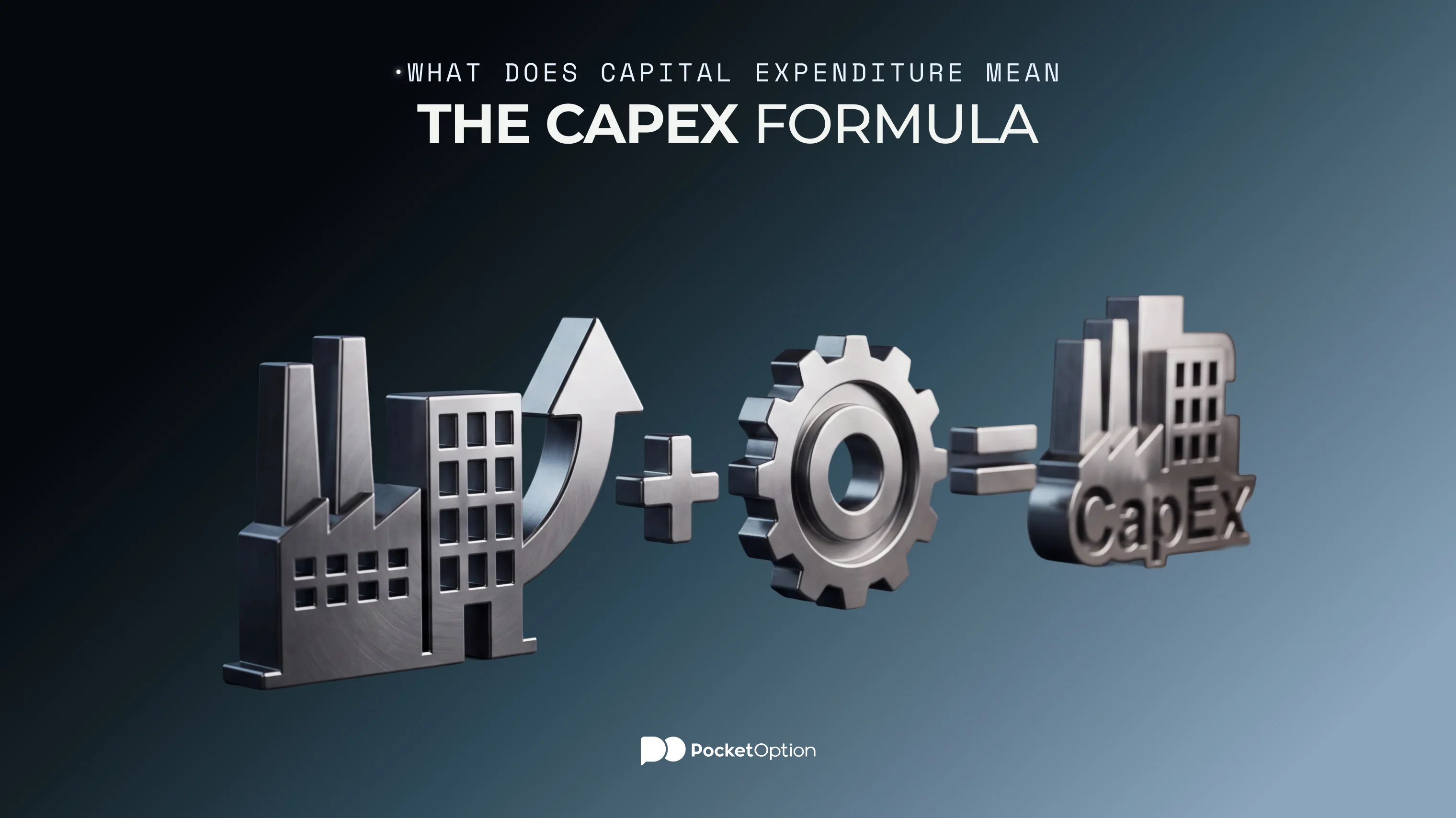
Capex is calculated as: Capital Expenditure = Ending PP&E minus Beginning PP&E plus Depreciation. PP&E stands for property, plant, and equipment, the line item on the balance sheet that tracks a company's long-term physical assets.
If a company's PP&E balance grew from $100 million to $120 million over the year, and it recorded $15 million in depreciation during that time, its capital expenditure for the period was $35 million: the $20 million increase in net PP&E plus the $15 million that depreciation would otherwise have subtracted.
Capex vs OpEx: Key Difference
Operating expenses, or OpEx, cover the costs of running the business day to day: rent, salaries, utilities, and supplies that get consumed within the current accounting period. Capital expenditures buy something that keeps producing value for years, so accounting rules spread their cost out through depreciation instead of expensing the full amount immediately.
The distinction also feeds into a company's broader risk profile: heavier capital-intensive operations tend to carry more fixed costs relative to revenue, which changes how sensitive profits are to a downturn compared with an asset-light business built mostly on OpEx.
Three Types of Capital Expenditure
Capital expenditures generally fall into three categories:
Maintenance capex: spending that keeps existing assets running, like replacing worn equipment or repairing a facility
Growth capex: spending aimed at expanding capacity, such as building a new factory or opening additional locations
Strategic capex: spending on assets that reposition the business entirely, like acquiring new technology or entering a new market
Recognizing which type of capex a company is undertaking is a routine part of fundamental analysis, since growth and strategic spending carry a different risk and payoff profile than routine maintenance work.
Where to Find Capex in Financial Statements
Capital expenditure appears most directly in the investing activities section of the cash flow statement, usually listed as purchases of property, plant, and equipment. The balance sheet shows the resulting PP&E balance, while the income statement reflects the ongoing depreciation expense tied to those assets.
Reading capex alongside the rest of a company's financials, the same groundwork covered in this guide to investing in stocks, gives a fuller picture than looking at any single line item in isolation.
Why Investors Check Capex Before Trading a Stock
Rising capital expenditures can be a genuine growth signal, since a company investing heavily in new capacity is betting on future demand. But heavy capex paired with weak revenue growth can also signal a business struggling to generate returns on what it already owns.
Comparing capex spending against the returns a company actually produces from its existing assets, not just the headline spending number, is what separates a productive growth phase from an unproductive one.
Practice reading financials risk-free.
Try Free DemoConclusion
Capital expenditure is one of the clearest windows into how a company is spending its money and what it expects from the future. Comparing the formula's inputs over several years, not just a single quarter, shows whether that spending is building genuine capacity or just keeping the lights on.
Disclaimer: This article is for informational purposes only and does not constitute financial advice. Company financials can change quickly, and past capital expenditure trends do not guarantee future results.
See more:Glossary