Use Market On Close Orders to Trade Right Into the Session Close
In the final seconds of the trading day, billions of dollars change hands at a single price. For most of the session you buy and sell at whatever price is available, but there is one order type designed specifically for the close: the Market-on-Close (MOC) order. This guide explains what an MOC order is, how the closing auction sets the price, and what an MOC imbalance means.

What Is a Market-on-Close (MOC) Order: Definition
A Market-on-Close order is a market order executed as close as possible to the official closing price of the trading day. Unlike a standard market order, which fills immediately at the best available price, an MOC order is held until the very end of the session and submitted into the closing auction. It has no price limit, is guaranteed to fill in full once accepted, and must be submitted before a cut-off time, typically 15 minutes before the close, after which it cannot be modified or cancelled. In short, an MOC order guarantees execution but not price.
How the Closing Auction Determines the Price
The closing auction is a structured process, not simply the last trade of the day. MOC and LOC (Limit-on-Close) orders accumulate throughout the session and are held for the auction, which, after the cut-off, calculates a single equilibrium price that maximises the number of shares that can execute; all MOC orders fill at that price. This closing price then becomes the most widely published figure for the security and the reference used for portfolio values, index levels, and fund NAVs.
What Is an MOC Imbalance
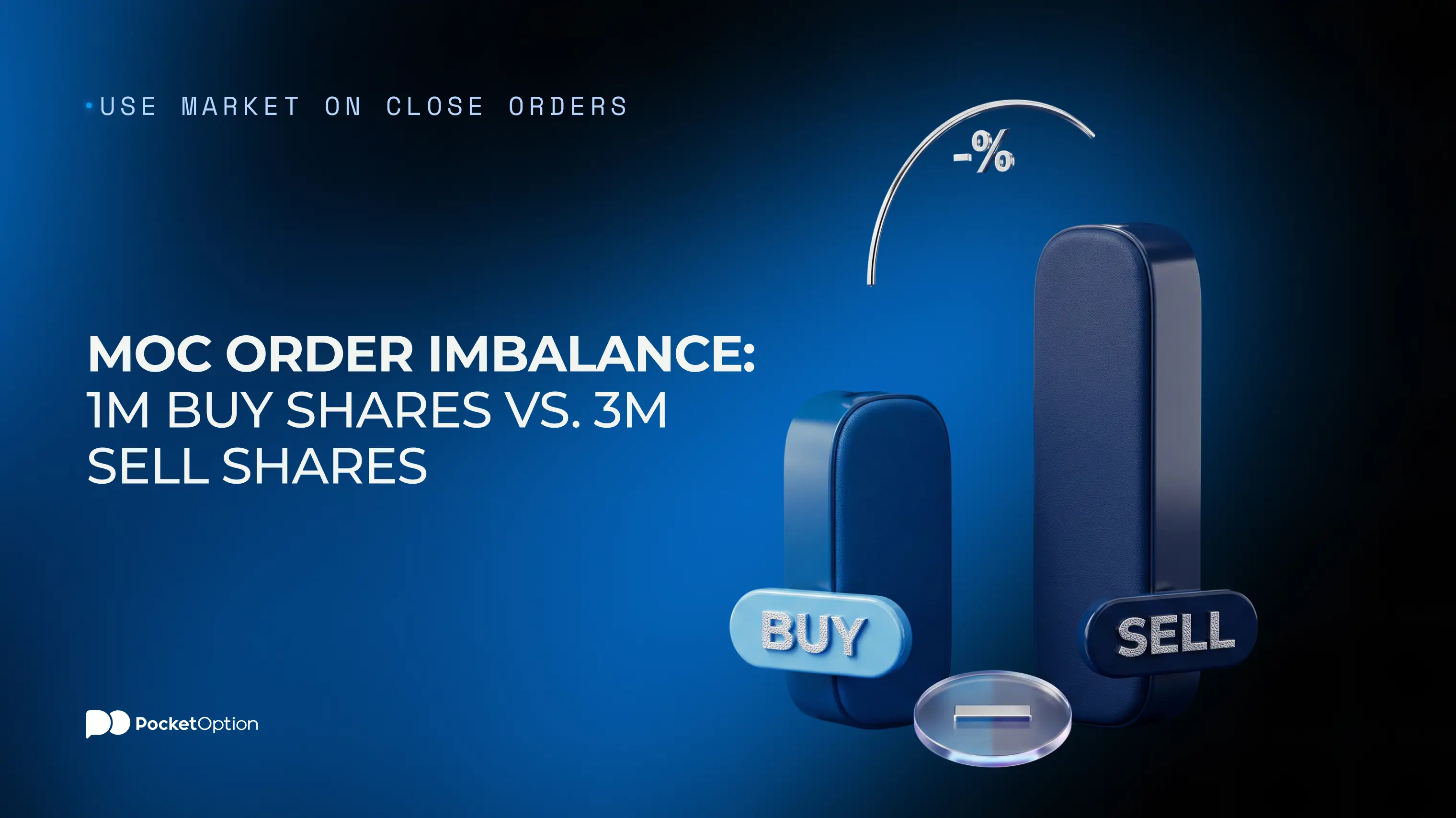
An MOC imbalance occurs when there is a significant excess of buy or sell orders heading into the closing auction, published by exchanges shortly before the close. A positive imbalance means more buying than selling, often read as fresh institutional inflows; a negative imbalance means more selling than buying, often read as outflows or profit-taking. If one million shares were queued to buy a stock on close against three million to sell, that two-million-share shortfall is the imbalance the exchange needs offsetting orders to fill.
MOC vs Limit-on-Close Orders
An MOC order's close cousin is the Limit-on-Close (LOC) order, which specifies a maximum buy or minimum sell price and only fills if the closing price falls within that limit. MOC prioritises execution over price, guaranteeing a fill at an unknown price; LOC prioritises price over execution, guaranteeing a worst-case price but not a fill at all.
Why Prices Can Move Sharply Into the Close
MOC orders have become a dominant mechanism for end-of-day execution, concentrating liquidity in the final minutes of trading. Institutional investors, particularly index funds and ETFs, use MOC orders to rebalance portfolios at the official closing price used to calculate their NAV, so when a large imbalance is published, traders react immediately, sometimes causing the stock to gap toward the closing price to accommodate it.
Conclusion
A Market-on-Close order is an instruction to buy or sell at the official closing price, guaranteeing execution but not the exact price until the auction concludes. The closing auction balances MOC orders, LOC orders, and other interest into a single equilibrium price, and a significant MOC imbalance can signal institutional flow and move prices sharply in the final minutes.
Risk Disclaimer: Trading involves significant risk of capital loss. This article is for educational purposes only and does not constitute financial advice. Always conduct independent research and consider your risk tolerance before making any trading decisions.
on a Demo Account with risk-free conditions
Open Demo AccountSee more:Glossary