Track ROCE to Judge How Well a Business Uses Its Capital Base
Comparing profitability across companies is difficult when each firm carries a different mix of debt equity and shareholders equity. ROCE solves that problem by measuring earnings against the full capital base. This entry explains the metric, walks through the formula, and shows how it differs from return equity (ROE).

What Is ROCE: Definition
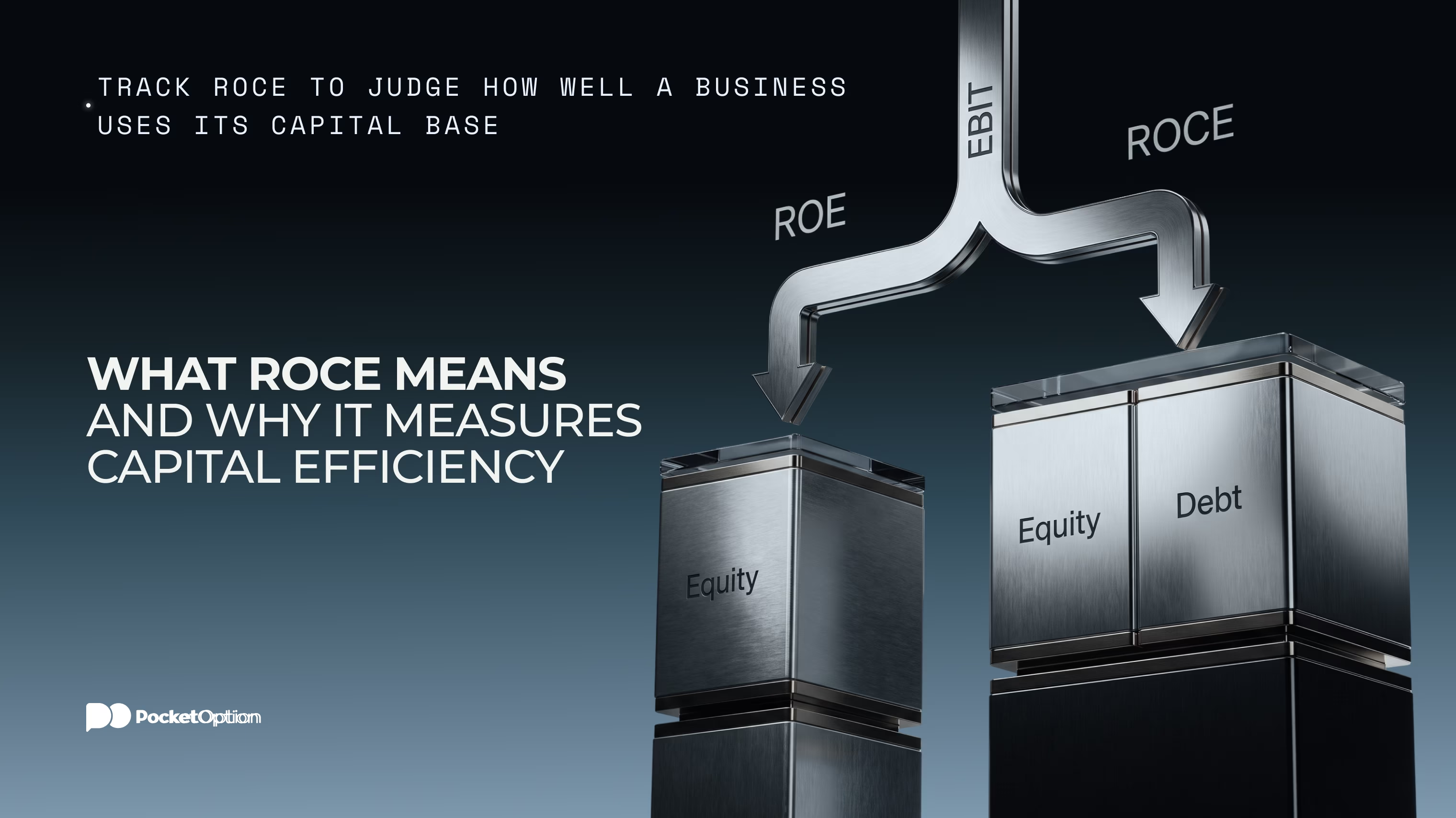
ROCE stands for Return on Capital Employed. It is a profitability ratio showing how efficiently a company generates operating profit from total invested capital. Unlike ROE, which focuses on shareholders equity alone, ROCE includes both equity and debt. That wider lens is especially relevant when analysing fundamental analysis of company financials for firms that rely on borrowed funds.
The ROCE Formula
To calculate ROCE, the following formula is used:
ROCE = EBIT / Capital Employed
EBIT is Earnings Before Interest and Tax. Capital Employed equals Total Assets minus Current Liabilities, or equivalently shareholders equity plus long-term debt. The result is a percentage: a ROCE of 15% means the company generates 15 units of operating profit for every 100 units of capital deployed.
How to Calculate Average Capital Employed
Because the balance sheet captures a single date, analysts often use average capital to smooth seasonal swings:
Average Capital Employed = (Opening Capital Employed + Closing Capital Employed) / 2
Using average capital produces a more representative ROCE, particularly when assets are acquired or disposed of during the year. Consistency in choosing period-end or average capital is essential when comparing peers.
with $50,000 deposit!
Open DemoROCE vs ROE: Key Difference
ROE, or return equity, divides net income by shareholders equity. ROCE divides EBIT by capital employed, including equity and debt. A company can boost ROE simply by adding more debt equity, inflating equity returns while raising financial risk.
ROCE strips out that distortion. A look at equity trading metrics and tools discusses how leverage interacts with profitability metrics. When two firms show similar ROE but different ROCE, the one with the higher ROCE typically delivers better underlying capital efficiency.
Why ROCE Matters Most for Capital-Intensive Businesses
Industries such as manufacturing, utilities, and energy require large fixed-asset investments financed by a mix of debt equity and equity. ROCE captures returns on that entire base, making it a fairer benchmark than ROE where borrowing is structural. A review of how earnings data feeds into stock valuations shows how operating earnings feed into broader valuation models.
What Counts as a "Good" ROCE
There is no universal threshold. A ROCE above the company's weighted average cost of capital (WACC) indicates value creation. As a rough guide, ROCE above 15% is often considered strong, though capital-light technology firms may post far higher figures. Comparing ROCE within the same sector is more informative than cross-industry comparisons.
risk-free on Pocket Option Demo account
Get StartedConclusion
ROCE measures how effectively a company converts its full capital base into operating profit. By including both shareholders equity and debt, it offers a broader view of capital efficiency than return equity alone. For anyone evaluating capital-intensive stocks, learning to calculate ROCE is a practical first step.
Disclaimer: Trading involves significant risk of capital loss. Past performance does not indicate future results. Consider your financial situation and risk tolerance before placing any trades. This article is for educational purposes only and should not be treated as financial advice.
See more:Glossary