What Is Purchasing Power Parity (PPP)? Meaning and How It Affects Exchange Rates
Purchasing power parity compares currencies through the cost of a similar basket of goods. Here is how absolute and relative PPP differ, how a PPP rate is worked out, why market rates drift away from it, and how traders can read it in context.

Same haircut, two cities. $30 in one. $6 in the other. So is the first currency overpriced? Economists have been arguing about that for a century. Their favorite tool has a clumsy name.
What Is Purchasing Power Parity (PPP)?
Purchasing power parity says one thing. The same basket of goods should cost the same everywhere. After converting currencies, of course. If it doesn't, something has to give. In theory, the exchange rate. Gustav Cassel popularized the idea after World War I.
Here's the key bit. The PPP rate is the conversion rate that equalizes the basket's cost. In both economies. It isn't the rate on your screen. And it isn't a trading signal. That's purchasing power parity in one breath. A long-term compass. Not a short-term clock.
Open a demo account and watch an exchange rate move on a live chart.
Try Demo AccountShop prices move slowly. Exchange rates don't.
EUR/USD ticks every second. Your grocery bill changes a few times a year. That gap is the whole story of purchasing power parity. A demo account lets you watch the fast side with virtual funds. Then the slow side of the argument finally makes sense. Years, not days.
Open any currency pair in demo trading. Count the moves before a shop changes a single price tag.
Absolute vs Relative Purchasing Power Parity
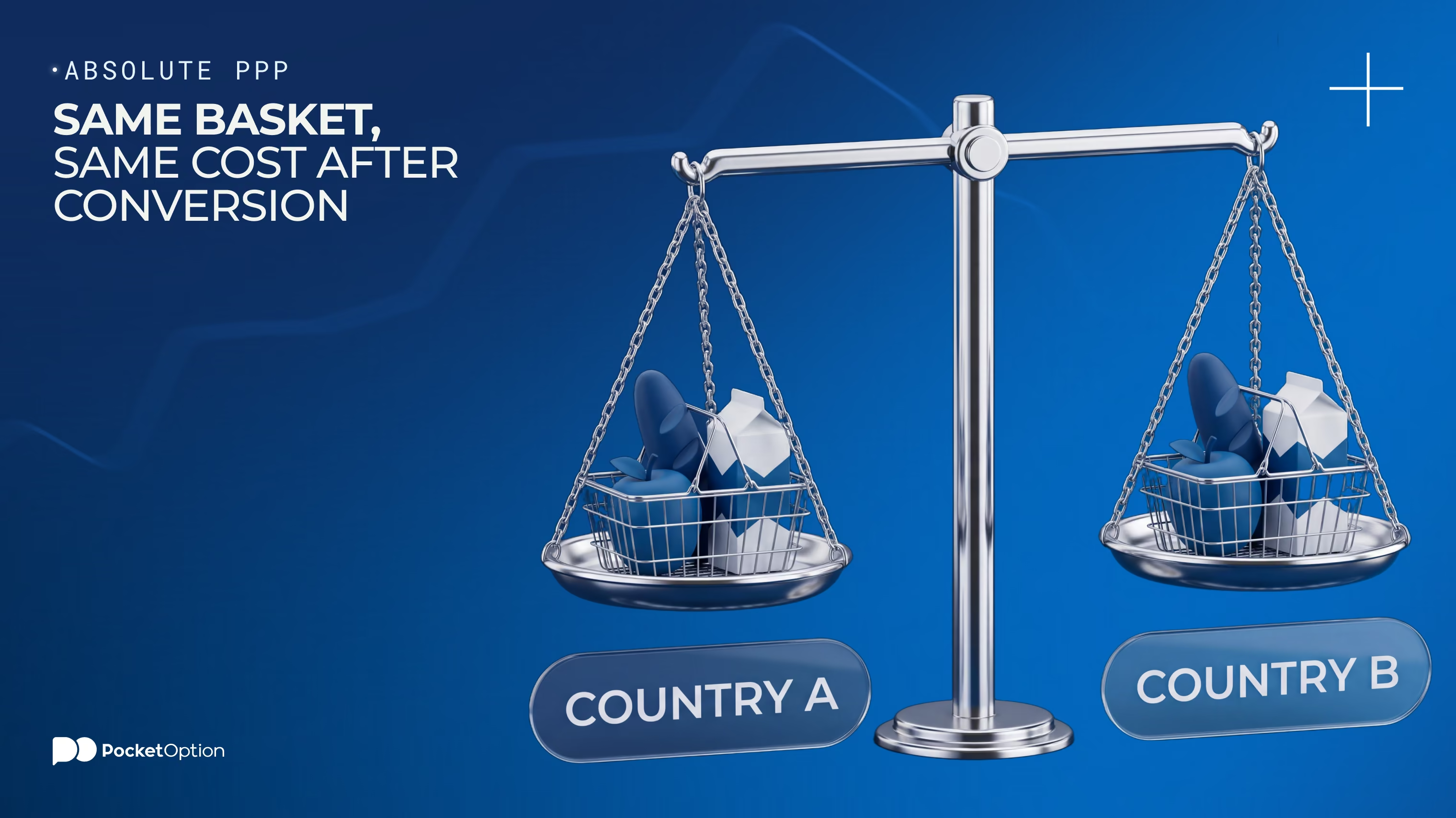
So what is purchasing power parity in practice? Two flavors. Absolute PPP compares price levels. A converted basket should cost the same in both countries. Relative PPP looks at change over time. Prices rise faster in one country? Its currency should weaken by about that gap.
Second chart on screen? The pocket option tutorial shows how.
Aspect | Absolute PPP | Relative PPP |
|---|---|---|
What it compares | Price levels of one basket | Changes in price levels over time |
Key idea | Same basket, same cost after conversion | Exchange rate follows the inflation gap |
Role of inflation | Indirect, through price levels | Central driver of the expected move |
Main use | Judging long-run currency valuation | Tracking long-run drift in rates |
Main limitation | Baskets are never truly identical | Assumes a stable link over time |
Absolute asks where prices stand. Relative asks where they're heading. And what is purchasing power parity good for? Long-run thinking, mostly.
How to Calculate a PPP Exchange Rate
The absolute version is one line. PPP exchange rate = price of the basket in Country B / price of the basket in Country A. The result is units of B per one unit of A.
Say the same basket costs 100 units in Country A. In Country B it costs 150. The implied PPP rate is 1.5 B per A. Made-up numbers.
Relative PPP is looser. It ties expected exchange-rate change to the inflation gap.
How PPP Relates to Exchange Rates
Here's the long-term logic. Prices diverge between two countries. So does what each currency can buy. Theory says market rates tend to adjust over time. Over time. That's the catch.
In the short and medium run, rates wander far from parity. Interest rates pull them. Capital flows pull them. So do risk sentiment and trade conditions. The Economist has compared Big Mac prices across countries since 1986. Many currencies sit far from their burger-implied value for long stretches. Don't expect a quick return to PPP.
Why PPP Has Limitations
Try buying a haircut abroad and shipping it home. You can't. Services don't travel. That's one reason PPP and market rates drift apart. There are more. Why PPP may differ from market exchange rates:
Transportation costs
Tariffs and taxes
Non-tradable goods and services
Different consumption baskets
Productivity and income differences
Capital flows and interest rates
Market frictions
So PPP is a framework. It compares price levels and purchasing power. It isn't an exact fair value for any currency pair.
How Traders Can Interpret Purchasing Power Parity
No strategy here. PPP is one long-term lens. It shows how far a market rate sits from relative price levels. It doesn't show when a reversal starts. And it ignores plenty of short-term drivers. So read it next to other things. Inflation differentials. Interest-rate expectations. Growth. Capital flows. The wider macro picture. Skip the slogan that below PPP means buy. Not a rule. Never was.
Risk Disclaimer: Trading involves significant risk of capital loss. This article is for educational purposes only and does not constitute financial advice. Always conduct independent research and consider your risk tolerance before making any trading decisions.
See more:Glossary