Let Working Orders Sit in the Book Until Your Price Hits
Not every trade is executed the moment it is placed. Some orders are submitted with a specific price attached, and they sit in the order book, waiting, until the market price reaches the requested level. These are working orders: the decision to wait for the price to come to you rather than chasing the current market price. This guide covers what a working order is, where it sits in the book, and how it compares to market, limit, and stop orders.

What Is a Working Order
A working order is any order submitted to the market that has not been executed because its conditions have not been met. It remains active in the system, visible in the order book, until the price reaches the specified level, the trader cancels it, or it expires. The term is broad: it encompasses any unfilled order waiting for execution. In practice, working orders are most commonly limit orders and stop orders, both of which specify a price that must be reached before execution occurs.
Where It Sits in the Order Book
The order book lists all unfilled orders at their specified prices. Buy orders sit below the current market price; sell orders sit above it. When the market price reaches a working order, it is matched with an incoming counterparty and filled automatically. The trader does not need to be watching the screen at the moment of execution. This is one of the primary advantages: entry and exit points are defined in advance, and the system handles the rest.
Working Order vs Market Order
A market order fills immediately at the best available price; speed is guaranteed, exact price is not (slippage). A working order specifies a price and waits. The market price may never reach the level, so execution is not guaranteed. A market order guarantees execution but not price. A working order guarantees price intent but not execution.
Working Order vs Limit and Stop Orders
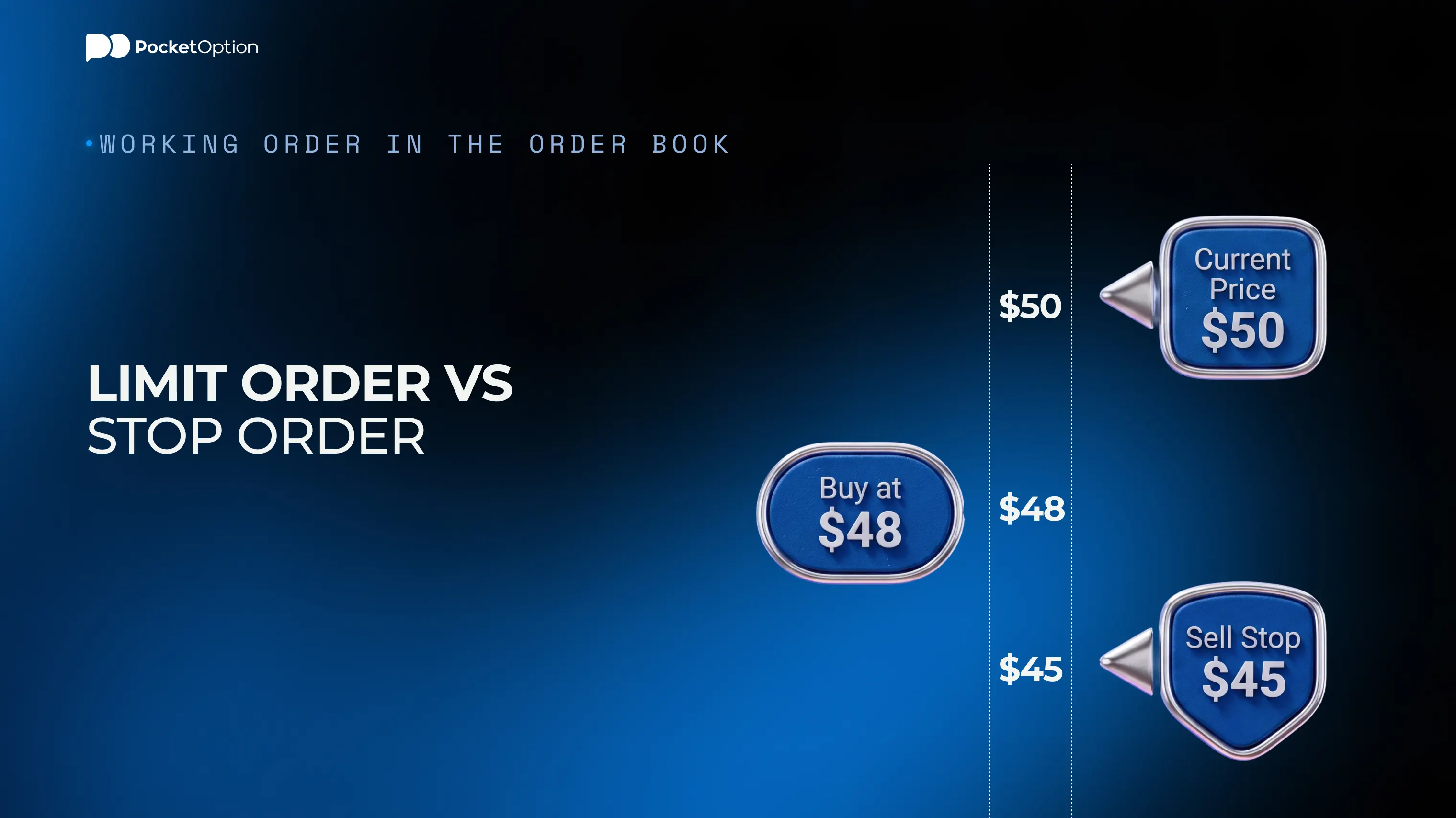
A limit order specifies a maximum buy or minimum sell price and fills only at that price or better. A stop order becomes a market order when the stop price is reached, commonly used for stop loss placement. Both are types of working orders. A limit order to buy at $48 on a stock at $50 is working until the price drops to $48. A stop loss at $45 is working until that level is hit.
What Happens When Price Reaches Your Order
For a limit order, the fill is at the specified price or better. For a stop order, it becomes a market order at trigger and may experience slippage. Reaching the level does not always guarantee a fill in fast-moving or illiquid conditions.
Conclusion
A working order is a trader's instruction: execute this trade, but only at this price. Setting a price in advance separates planned trading from impulsive execution. Market orders guarantee execution. Working orders guarantee price intent.
on Pocket Option Demo
Try Demo AccountSee more:Glossary