How to Calculate Unrealized P&L on an Open Position
An open position carries a number that changes every second and has not actually happened yet. Both halves of that matter. It moves constantly, and none of it is real until the position closes.

What Is Unrealized Profit and Loss?
Unrealized profit and loss is the gain or loss on a position still being held. Paper profit, floating P&L, open P&L, depending on which platform is doing the labelling.
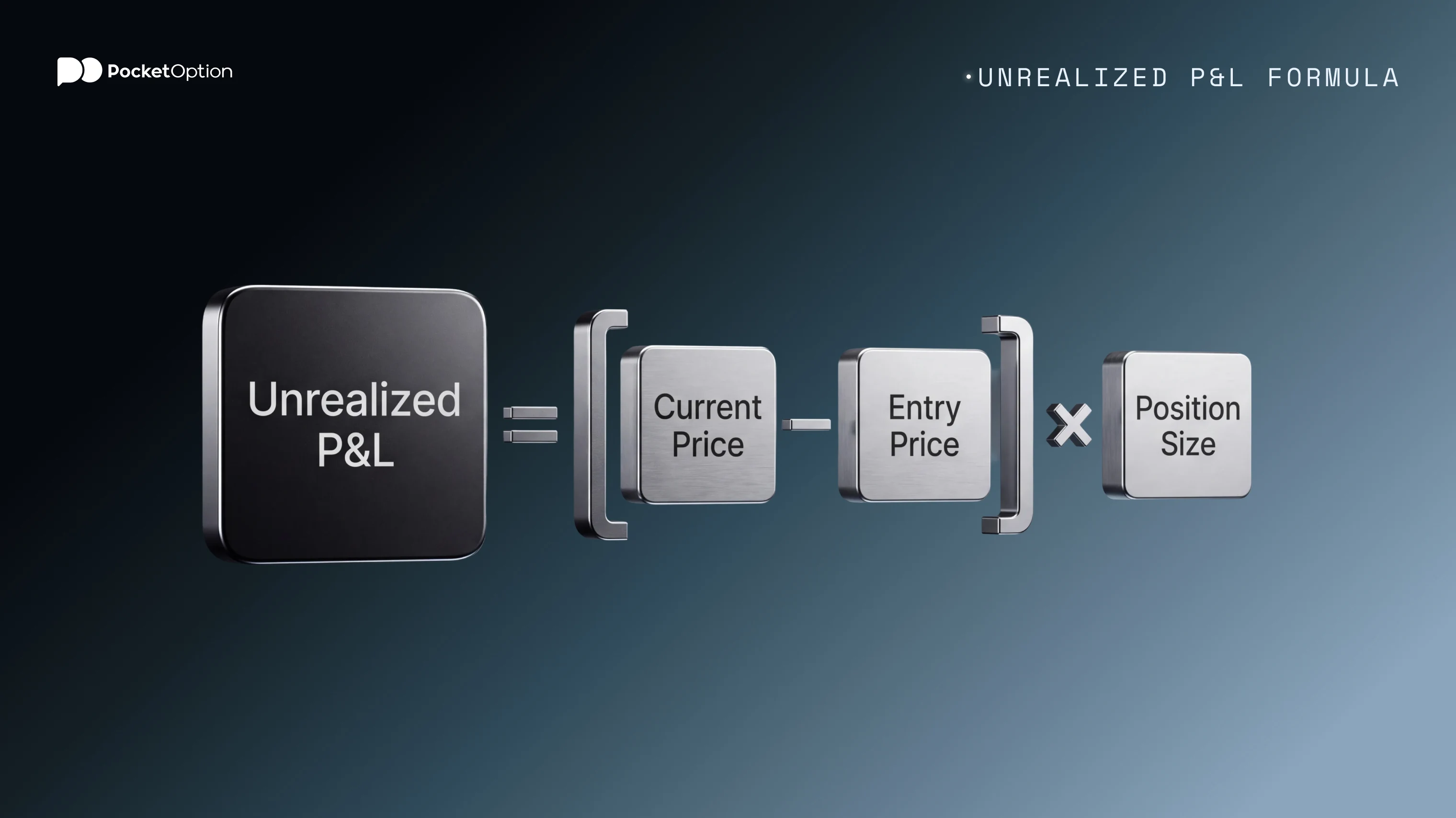
It gets worked out by comparing entry price and current price, then scaling that difference by how much is held. Nothing has been banked. Close the position and the number becomes realized, at which point it stops moving and starts being a fact.
Realized against unrealized in one paragraph: realized P&L is locked in from a closed trade and never changes again, while unrealized P&L belongs to something still open and shifts with every tick. One is history, the other is a live reading. Realized and unrealized PnL compared properly goes through the distinction at more length than fits here.
Unrealized P&L Formula for a Long Position
A long profits when price rises, so the unrealized P&L formula runs in that direction:
Unrealized P&L = (current price minus entry price) × position size
Long position P&L is positive whenever the current price sits above where you bought and negative below it. That is the whole of it. Position size and P&L scale together in a straight line, so doubling the size doubles both the gain and the loss from the same move.
Costs sit outside the formula. Spread, commission, overnight financing and currency conversion all affect what would actually be kept, and platforms differ on which of those get folded into the figure displayed. Some show gross, some net. Worth checking which one is on screen before treating it as final.
Unrealized P&L Formula for a Short Position
A short profits when price falls, so the two terms swap places:
Unrealized P&L = (entry price minus current price) × position size
Short position P&L is positive while the market sits below the entry. Everything else works the same way, though the risk profile does not. A long can lose no more than the position value, since price stops at zero. A short has no equivalent ceiling above it.
Contract specifications matter more here than the formula suggests. One unit of a stock CFD is not one unit of an index or a futures contract, and the multiplier attached to the instrument sits between the price difference and the money. In forex that same job is done by pip value, which depends on lot size and on the account currency.
Long Position Calculation Example
Buy 500 shares at $20.00 and hold them. Current price is $21.40.
Price difference: $21.40 less the $20.00 entry, so $1.40 a share.
Multiply by 500 shares.
Unrealized profit and loss: $700.
Now the price turns and settles at $19.60.
Price difference: $19.60 against a $20.00 entry, which is negative $0.40 a share.
Open position loss calculation: $0.40 multiplied by 500 shares.
Unrealized loss: $200.
Entry price never changed through any of that. It is fixed at the moment the trade filled and stays fixed for the life of the position, which means every figure afterwards is driven by the current price on its own.
Short Position Calculation Example
Sell 300 units short at $50.00. Price drops to $47.50.
Entry of $50.00 less the current $47.50 gives $2.50 a unit.
Multiply by 300 units.
Open position profit calculation: $750 unrealized.
Then it reverses and reaches $52.00.
$50.00 against $52.00 is negative $2.00 a unit.
Times 300 units, so the unrealized loss is $600.
Note the asymmetry between the two moves. A fall of $2.50 earned $750 and a rise of $2.00 cost $600, and the position size did identical work in both directions. That is what position size and P&L moving together actually looks like once there are numbers on it.
How Each Price Tick Changes Unrealized P&L
The figure is recalculated continuously rather than on any schedule.
With 500 shares, a one cent move is five dollars. Ten cents is fifty. No threshold has to be crossed and there is no delay, the number just tracks the price. On a quiet instrument it drifts. On a volatile one during a news release it can swing through a wide range in seconds without you placing a single trade.
Where it matters is the account rather than the screen:
Account equity is the balance plus unrealized P&L, so equity moves even though nothing closed.
Available margin comes out of equity, which means a losing open position quietly shrinks what can be used elsewhere.
Fall far enough and margin requirements start to bite, at which point a paper loss has very real consequences.
A profitable open position does the reverse and frees margin up, which is how extra positions get added at exactly the wrong moment.
Nothing is banked until the position closes. A trade up $700 on Tuesday and down $200 on Thursday realized neither figure, and the spread between bid and ask means even the closing number lands slightly away from the last price quoted.
Same mechanics, virtual funds.
Try a Demo AccountConclusion
That 500 share position was worth $700 and then it was worth negative $200, and at no point did anybody buy or sell anything. Same shares, same entry, same account. Only the current price changed. Unrealized profit and loss is a measurement of a position rather than an outcome of one, and the distinction stops being academic the moment margin gets involved.
Disclaimer: Trading involves significant risk of capital loss and may not be suitable for all investors. Unrealized results can change rapidly and do not represent funds available for withdrawal.
See more:Glossary