How Partial Fills Change the Real Size of Your Order
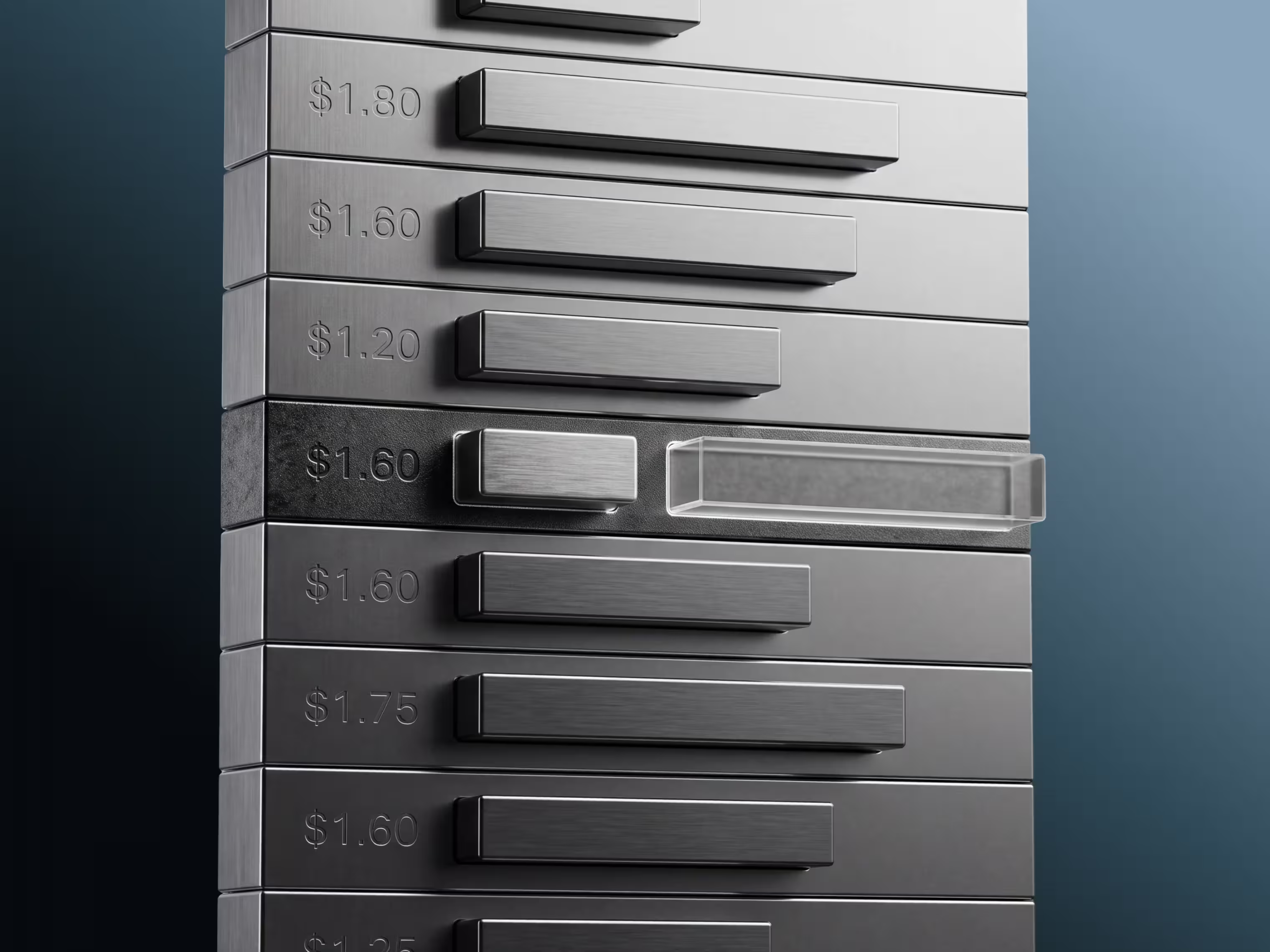
You place an order to buy 1,000 shares at your limit price, expecting it to fill in full. But when you check, only 400 shares went through and the rest is still pending. That is a partial fill: only a portion of an order is executed, and the remainder stays open waiting for more liquidity at your price. This guide explains why partial fills happen and how they affect your average entry price.

What Is a Partial Fill: Definition
A partial fill occurs when only part of a buy or sell order is executed, with the remainder staying active depending on the order's time-in-force setting. It is more common with limit orders than market orders, and is not an error but a normal occurrence in less liquid conditions. It is distinct from slippage, which is about price rather than quantity. A guide to how order types are processed in the market covers how different order types are processed.
Why Orders Get Partially Filled
The most common cause is insufficient liquidity at the chosen price: there are not enough counterparties to fill the full order. This is more likely with thinly traded assets, large order sizes, or quiet trading hours. In fast-moving markets, price can shift before the full quantity matches at a single level.
What Happens to the Unfilled Remainder
This depends on the order's time-in-force and type:
Day or GTC order: the unfilled portion stays active until it fills or the order expires, potentially filling in multiple stages
Immediate-or-Cancel (IOC): any unfilled portion is cancelled immediately after the initial partial execution
Fill-or-Kill (FOK): the entire order must be filled immediately in full, or the whole order is cancelled; no partial fill occurs
All-or-None (AON): partial fills are not accepted, but unlike FOK, the order can remain active in the book until the full quantity becomes available or the order is cancelled
How a Partial Fill Affects Your Average Entry Price
When an order fills across multiple transactions at different prices, the average entry price becomes a volume-weighted average. For example, a market order for 1,000 shares might fill 400 at £1,000 and the remaining 600 at £1,001, producing an average entry of (400 × £1,000 + 600 × £1,001) ÷ 1,000 = £1,000.60. This happens because the order consumed all available liquidity at £1,000 and moved to the next price level.
For limit orders, all fills occur at the limit price or better, so the average entry will always be at or below the limit for a buy, or at or above the limit for a sell. The risk with a limit order is not a worse price but an incomplete fill. A guide to equity trading fundamentals and order mechanics covers how these mechanics affect equity trading in practice.
Partial Fill vs Fill-or-Kill Orders
A standard limit order accepts the possibility of a partial fill in exchange for price control, staying active until the full quantity matches. A Fill-or-Kill order rejects that possibility: the full quantity must execute immediately or the entire order is cancelled. The choice depends on whether filling over time is acceptable or whether the full quantity is needed at once. A guide to managing execution risk in active trading covers how order type selection fits into a broader risk framework.
Conclusion
A partial fill is a normal part of trading, occurring when there is not enough immediate liquidity to fill an entire order. It typically leaves the unfilled portion active unless a stricter order type like IOC, FOK, or AON is used. For market orders that fill across multiple price levels, the average entry price shifts accordingly. For limit orders, all fills occur at the limit or better, but the order may remain partially filled until sufficient liquidity arrives.
Risk Disclaimer: Trading involves significant risk of capital loss. This article is for educational purposes only and does not constitute financial advice. Always conduct independent research and consider your risk tolerance before making any trading decisions.
Test trading strategies and learn how price execution works in a risk-free environment.
Open Demo AccountSee more:Glossary