How Can the Gambler's Fallacy Affect Trading Decisions?
The gambler's fallacy is the mistaken belief that a series of past random outcomes changes the odds of what happens next. This guide covers the psychology behind the bias, two common examples, and how it can quietly shape trading decisions.

What Is the Gambler’s Fallacy?
A weather forecaster who has correctly called six sunny days in a row doesn't owe anyone a rainy day just because the streak feels long. Each day's actual weather depends on its own real conditions, not some invisible scorekeeper balancing things out. The gambler's fallacy is the mental habit of expecting that kind of balancing: believing a string of past outcomes changes the odds of what comes next, even when each outcome is genuinely independent of the last. Recognizing the gambler's fallacy starts with one honest question: does the past outcome actually change the odds of the next one, or does it just feel that way?
The classic example uses a fair coin. Flip it and land on heads five times in a row. The odds of heads on the sixth flip are still exactly 50%, unchanged by anything before it. The coin has no memory. Believing otherwise, that five heads somehow makes tails “due”, is the gambler's fallacy in its purest, cleanest form, before any market complexity gets added. The same mental shortcut, applied carelessly to trading, is what the gambler's fallacy in trading actually looks like.
Open a free demo account and get a feel for real price action, using virtual funds.
Try Demo AccountCurious how this bias actually plays out once real trades are on the line? Reading about the bias only goes so far. Noticing the urge to expect a “due” outcome while watching real price shows the pattern faster than any description can.
Open a demo trading account and get a feel for how price actually behaves, with virtual funds and nothing real on the line.
Gambler's Fallacy Psychology: Why Do We Expect Streaks to Reverse?
A small run of outcomes just feels more meaningful than it is. That's the whole shortcut. Psychologists have a name for it: the law of small numbers, expecting a tiny sample to already reflect the same balance a much bigger one would eventually settle into. Stack representativeness on top of that, the itch to expect any short sequence to “look like” what randomness is supposed to look like, and the gamblers fallacy stops sounding far-fetched. It starts sounding almost reasonable. Watch for that itch through your Pocket Option login account and it gets easier to catch.
What the Gambler's Fallacy Looks Like in Trading
The same gambler's fallacy psychology that misreads a coin flip slips into trading just as easily. Rising closes, several in a row, and suddenly a drop feels “due”. Losing trades pile up, and the next one suddenly “has to” win. Neither feeling has real grounds behind it. Just the streak. To be clear, none of this means market prices behave like independent coin flips. They don't. Trends exist. News moves things. What carries over is the flawed instinct itself, not the coin-flip math, and that instinct can show up regardless of what's actually driving the market.
Gambler's Fallacy Examples: Two Common Mistakes
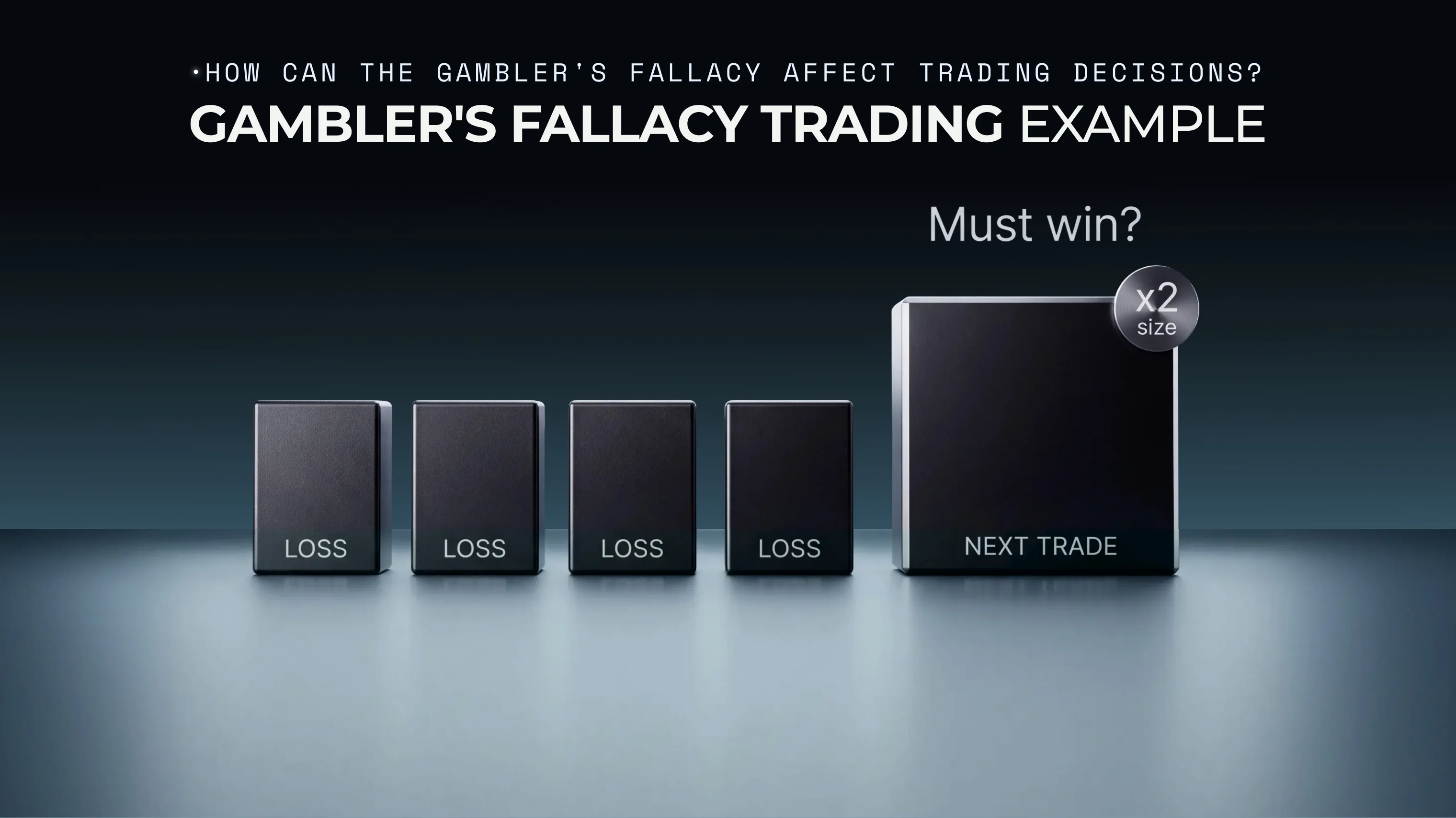
Two gambler's fallacy examples make the pattern concrete. One: five heads in a row, and the sixth flip still sits at a genuine 50/50. No exceptions. The other lives in a trading account. Four losing trades in a row, and suddenly the fifth “has to” win, so the position gets sized up bigger than usual. Not because the setup changed. Just because the streak did. That's the error, right there in the reasoning, not in whether the fifth trade gets taken at all.
Why a Price Streak Does Not Guarantee a Reversal
The coin flip analogy has a real limit, and it's worth naming directly. Market prices depend on trend, news, liquidity, all sorts of things a coin never has to deal with. Treating every price move as its own fixed-probability coin flip misreads what's actually going on. Reversals happen, genuinely. Nobody's denying that. What actually goes wrong is expecting one purely because a streak feels long, with nothing else behind that expectation at all.
How to Recognize the Gambler's Fallacy in Trading
Start by separating actual market data from that nagging feeling that a certain outcome is “due”. Those are two different things, and mixing them up is where this bias sneaks in. Judge the decision against criteria set before the streak even started, not against how long the streak currently feels. And if position size suddenly changes for no reason other than a run of past outcomes, that's usually the tell. None of this guarantees better trading, to be clear. It just keeps one specific reasoning error out of the decision.
Risk Disclaimer: Trading involves significant risk of capital loss. This article is for educational purposes only and does not constitute financial advice. Always conduct independent research and consider your risk tolerance before making any trading decisions.
See more:Glossary