What Is DXY? How the U.S. Dollar Index Works in Forex Trading
DXY tracks the dollar against a fixed basket of six currencies. Here is how the basket and its weights work, how the index is calculated, what a rising or falling DXY means, and how it relates to major Forex pairs like EUR/USD and USD/JPY.

Open any Forex news site. Somewhere near the top sits a ticker called DXY. No explanation. Just a number going up or down. Most beginners nod and move on. Don't.
What Is DXY?
So what is DXY? The U.S. Dollar Index. It tracks the dollar against a fixed basket of six currencies. Think of it as a scoreboard for the dollar. Not the world's opinion of it.
DXY rises when the dollar gains on that basket. It falls when the dollar slips. Simple. But the limits matter. It doesn't measure the dollar against every currency out there. And it isn't a trading signal on its own. So what is DXY, at its core? One lens. A narrow one.
Open a demo account and watch DXY and major pairs move on live charts
Try Demo AccountA ticker alone says little. Next to a chart, it starts to talk.
What is DXY doing while EUR/USD moves? Open both charts and look. Sometimes they mirror each other. Sometimes they don't. A demo account lets you watch that with virtual funds. You see how loosely one pair follows the index. Before you form an opinion. Try it on a quiet day and on a busy one.
Pull up DXY and a major pair in demo trading. Compare how they move.
What Currencies Are in the DXY Basket?
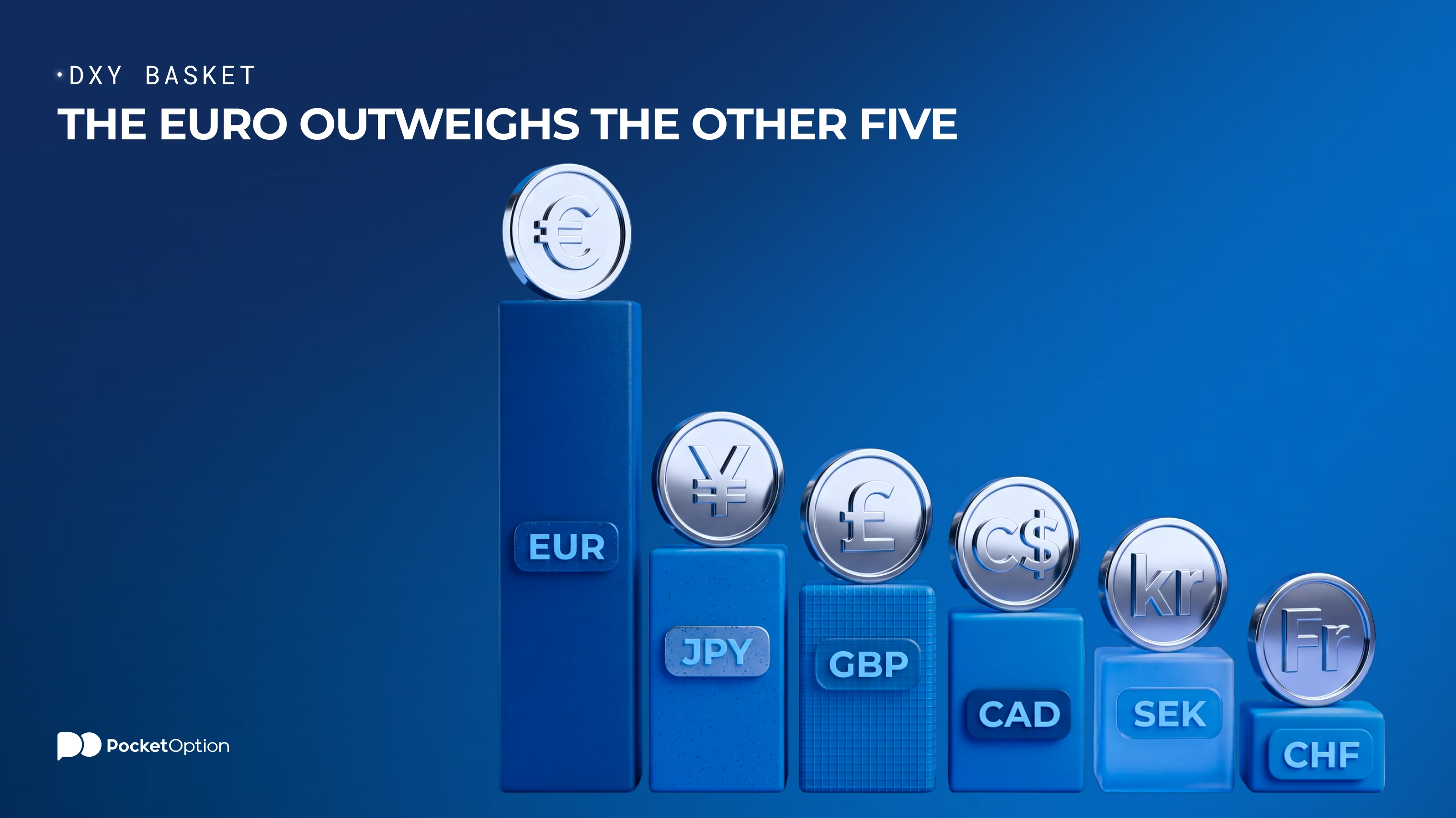
Six currencies. That's the basket. Euro. Yen. Pound. Canadian dollar. Swedish krona. Swiss franc. The weights are fixed. They don't change with trade data. Quick answer to what is DXY in Forex terms: a weighted bet on the dollar against those six.
Where do extra chart symbols hide? The pocket option tutorial has the answer.
Currency | Code | Weight |
|---|---|---|
Euro | EUR | 57.6% |
Japanese yen | JPY | 13.6% |
British pound | GBP | 11.9% |
Canadian dollar | CAD | 9.1% |
Swedish krona | SEK | 4.2% |
Swiss franc | CHF | 3.6% |
Look at the top row. The euro alone is 57.6%. That's more than the other five combined. So EUR/USD swings can steer the whole index. And the basket is old. It isn't a map of America's trading partners today. China and Mexico aren't in it. So what is DXY in Forex worth? A useful shorthand. Not a full picture.
How Is the DXY Calculated?
Not a simple average. DXY is a geometrically weighted index. Each of the six exchange rates is raised to a power. The power equals its weight. Then everything is multiplied together with a constant. ICE sets that constant at 50.14348112. That's why the index started at 100 in 1973.
DXY = 50.14348112 × EUR/USD^-0.576 × USD/JPY^0.136 × GBP/USD^-0.119 × USD/CAD^0.091 × USD/SEK^0.042 × USD/CHF^0.036
The sign of each exponent depends on where the dollar sits in the pair. Base or quote. Don't memorize it. Just get the principle. So what is DXY index math doing? Blending six rates into one number.
What Does a Rising or Falling DXY Mean?
Rising DXY? The dollar is, on average, gaining against the weighted basket. Falling DXY? It's losing. That's all it says. Not why. And mind who's steering. The euro holds 57.6%. One big EUR move can drag the index around. The other five barely budge. Say the euro falls 2% and the yen gains 2% against the dollar. The euro's bigger weight wins. DXY still rises. Reading it as the dollar versus the world is the classic mistake.
How DXY Relates to Major Forex Pairs
EUR/USD and GBP/USD usually move opposite to DXY. The dollar is the quote currency there. Dollar up, pair down. USD/JPY, USD/CAD and USD/CHF can move more in step with it. The dollar is the base. But "usually" isn't "always". Correlation drifts. Every pair has its own story. Rate decisions in Tokyo don't care about the euro. What to check when comparing DXY with a currency pair:
DXY basket weight
Position of USD in the pair
Pair-specific economic factors
Divergence between currencies
No mechanical rules here. Just context.
How Traders Can Interpret the U.S. Dollar Index
Treat DXY as context. A quick read on the dollar against its fixed basket. A second opinion when you study majors. It doesn't tell you why the dollar moved. It doesn't cover every currency. And it never hands you a buy or sell signal. No trades here.
Risk Disclaimer: Trading involves significant risk of capital loss. This article is for educational purposes only and does not constitute financial advice. Always conduct independent research and consider your risk tolerance before making any trading decisions.
See more:Glossary