Currency Strength Meter: How to Compare Strong and Weak Currencies in Forex
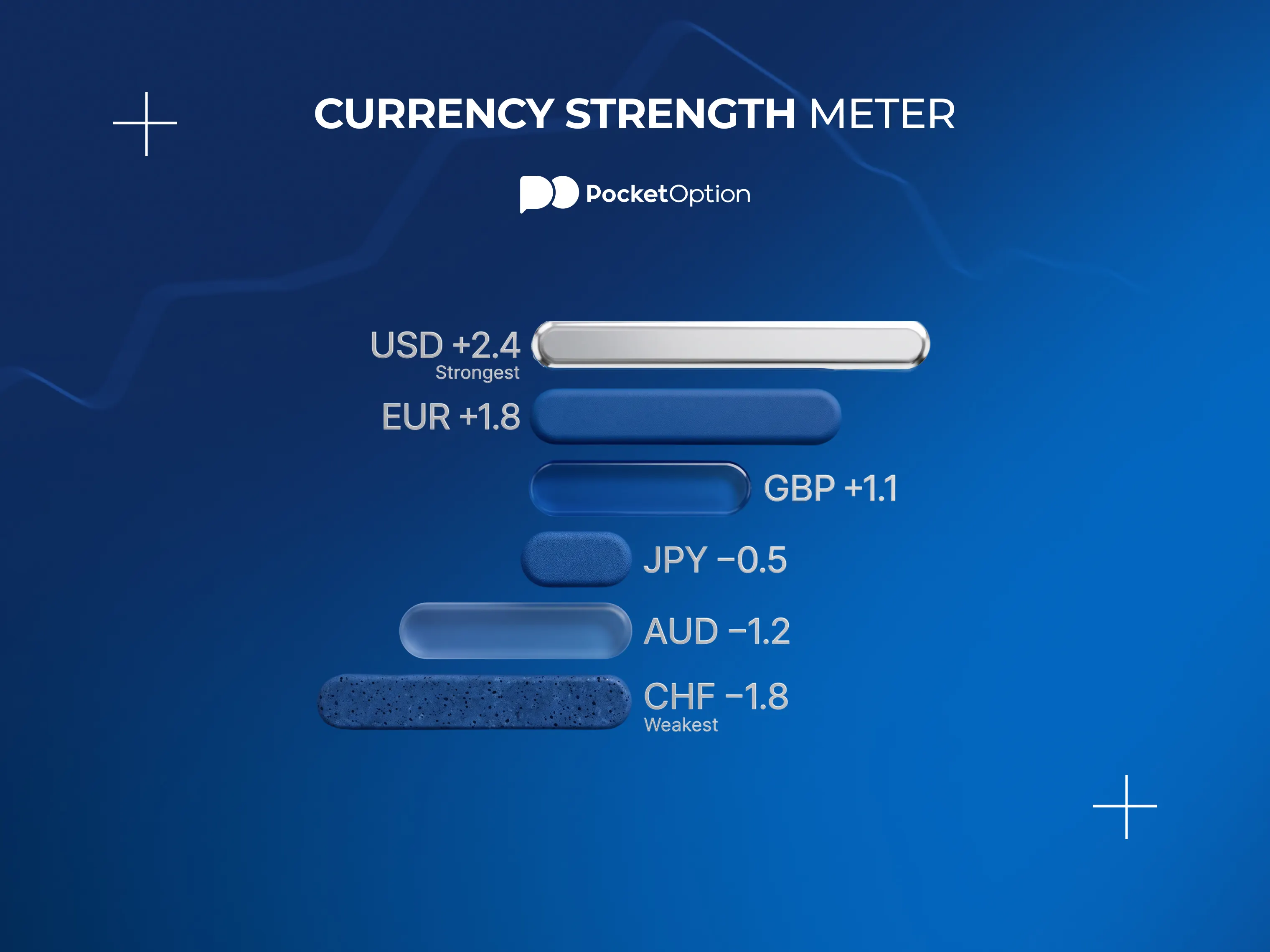
A currency strength meter visually compares how strong or weak major currencies are against each other right now. Reading a currency strength chart correctly helps you pair the strongest currency against the weakest, rather than guessing at a single pair in isolation.

What Is a Currency Strength Meter
A currency strength meter measures each major currency against a basket of the others, then displays the result as a ranked list or a set of bars, one per currency. Rather than watching EUR/USD alone and wondering whether a move is about the euro or the dollar, the strength indicator isolates each currency's own contribution to that move.
How Currency Strength Is Calculated
Most tools calculate currency strength by averaging a currency's percentage change against several other major currencies over a chosen period, then ranking the results. A currency that has gained against most of the basket scores as strong; one that has lost against most of it scores as weak. The exact formula varies by provider, but the underlying logic, comparing one currency against many rather than just one, stays the same across most versions of a forex strength meter.
What Drives Currency Strength
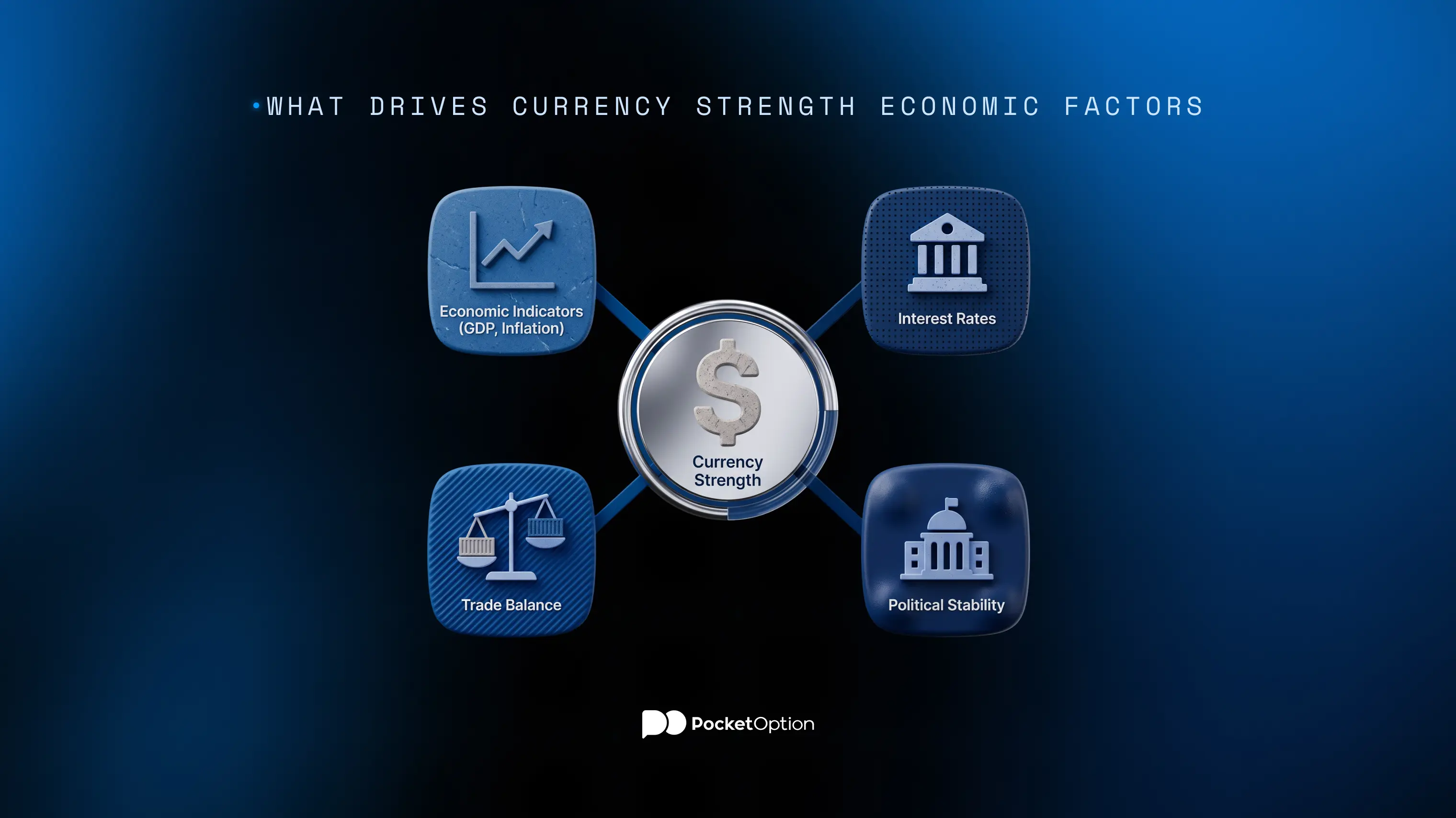
Economic indicators: GDP growth and inflation data shape expectations about a country's economic health and future policy.
Interest rates: higher rates tend to attract foreign capital seeking yield, supporting the currency; central bank decisions such as FOMC interest rate decisions are closely watched for exactly this reason.
Trade balance and foreign investment: a country exporting more than it imports typically sees steady demand for its currency from foreign buyers settling those trades.
Political stability: currencies from politically stable countries tend to hold value better during uncertainty, while instability can trigger capital outflows.
Strong Currency vs Weak Currency: Effects on Trade
A strong currency makes a country's exports more expensive for foreign buyers and imports cheaper for domestic ones, which can widen a trade deficit over time. A weak currency does the reverse, making exports more competitive abroad but raising the cost of imported goods at home. Neither condition is purely good or bad; each creates winners and losers depending on which side of trade a business sits on.
How Traders Use a Currency Strength Meter
The most common approach pairs the currency ranked strongest against the one ranked weakest, on the theory that the resulting pair carries more directional conviction than a pair made of two currencies sitting mid-ranking. Checking the meter alongside the currency exchange market context for that session helps confirm a pair isn't just drifting between two similarly ranked currencies.
start with a free demo account
Get StartedReal-World Example
Suppose a currency strength meter shows the US dollar ranked strongest of the majors following a hawkish rate decision, while the Japanese yen ranks weakest after softer domestic data. A trader following this approach would look at USD/JPY rather than a pair like EUR/GBP, where both currencies sit closer to the middle and offer less separation. Checking GDP releases and other economic data due that week helps confirm whether the ranking is likely to hold or shift before the trade plays out.
Conclusion
A currency strength meter turns a tangle of individual pairs into a simple ranking, making it easier to see which currency is genuinely leading and which is lagging. Pairing the strongest against the weakest gives a trade more room to work with, though the underlying drivers, rates, growth, trade flows, and political stability, still deserve a look before acting on the ranking alone.
Disclaimer: Trading involves significant risk of capital loss and may not be suitable for all investors. Past performance does not guarantee future results.
See more:Glossary