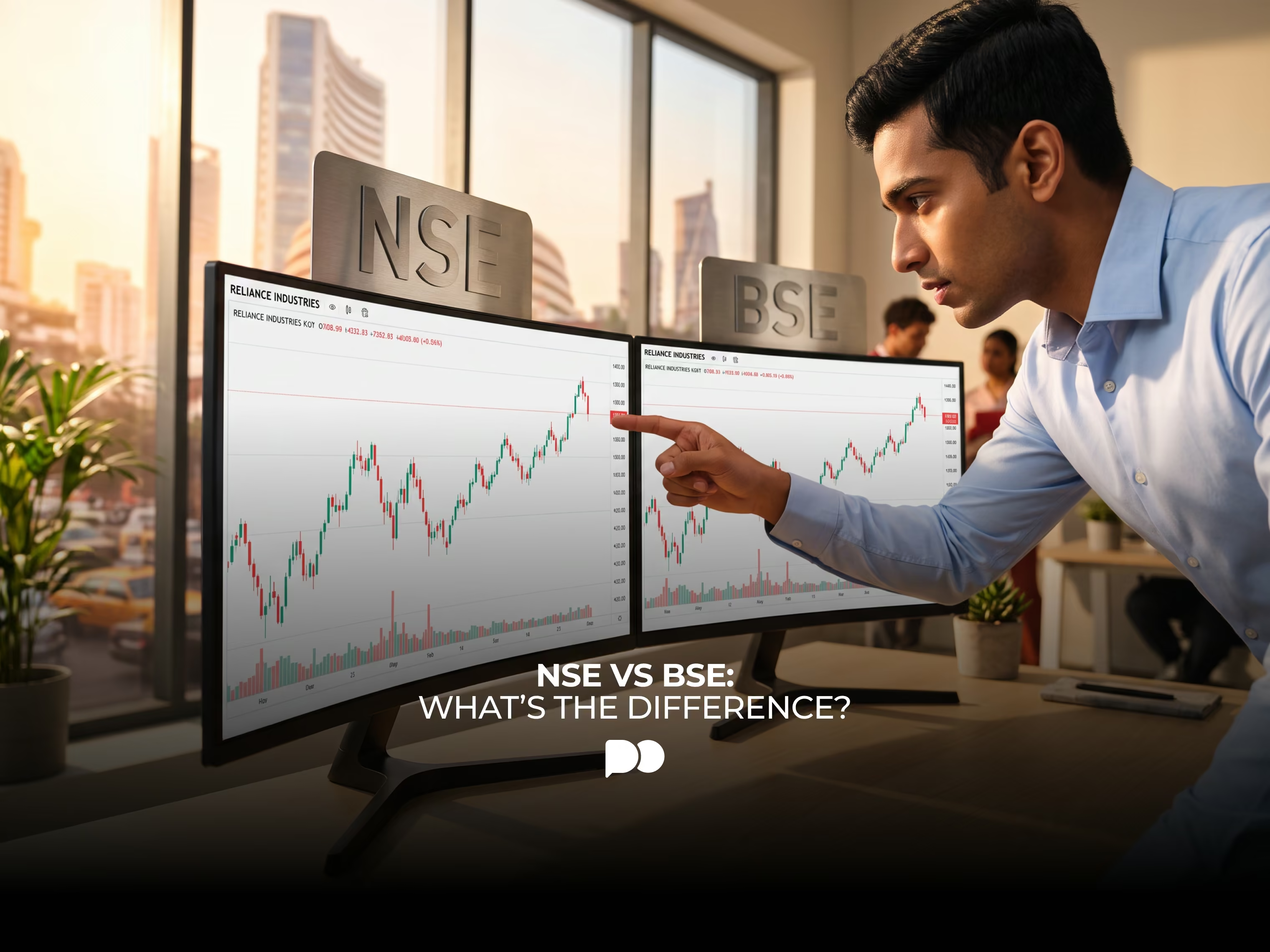
NSE vs BSE: What’s the Difference?
NSE and BSE are India's two main stock exchanges. Here is how they differ in history, listing universe, benchmark indices and trading activity, how dual listing works, and what traders should compare for a given instrument, without picking a universal winner.

One stock. Two exchanges. Two quote screens that rarely match to the last paisa. Newcomers hit this puzzle fast. Why are there two? Does it matter which one your order reaches?
What Are NSE and BSE?
Two big names run Indian equity trading. NSE, the National Stock Exchange. And BSE, once known as the Bombay Stock Exchange. Both sit in Mumbai. Both let companies list shares. Both let investors trade them. One regulator, SEBI, watches over both. So far, so similar.
Four things set them apart. Age. How many companies list. The flagship index. How busy the trading gets. Anyone weighing NSE vs BSE for the first time should start there. And skip the urge to crown a winner. The better venue depends on the instrument, not on the logo.
Open a demo account and practise reading quotes, spreads and price action on live charts
Try Demo AccountDifferences between venues are easiest to grasp with live prices in front of you.
Here's an exercise. Open a demo account and follow one asset's quote all day. Watch how the bid and the ask behave. How wide is the gap? Do it for a few sessions. That small habit explains most of what NSE vs BSE comes down to in practice. Liquidity. Spreads. Who is on the other side of your order.
Study spreads in demo trading for a few sessions before comparing venues.
NSE vs BSE: Key Differences
Functionally they're twins. Yet the core difference between NSE and BSE sits in their past. Plus the way each market was designed. BSE traded as far back as 1875. Brokers shouted on a floor. NSE turned up in the 1990s with screens instead. Each then grew its own flagship index and its own pattern of trading activity.
Prefer to test ideas on a chart first? The pocket option tutorial shows how to open one.
Aspect | NSE | BSE |
|---|---|---|
Full name | National Stock Exchange of India | BSE Limited (ex-Bombay Stock Exchange) |
Year established | 1992, equity trading from 1994 | 1875 |
Benchmark index | Nifty 50 | Sensex |
Listing universe | Typically fewer companies | Typically more, many small and mid-sized |
Typical trading activity | Usually heavier, notably in derivatives | Usually lighter in most stocks, with exceptions |
Major market segments | Equity, derivatives, currency, debt, SME | Equity, derivatives, currency, debt, SME |
Key role | Heavy daily turnover | Oldest exchange, widest listing reach |
My shorthand for the difference between NSE and BSE? NSE: volume. BSE: the long listing roll. Neither crowns a winner. The table is a sketch, not a survey. Check current figures with NSE, BSE and SEBI before relying on any.
How NSE and BSE Differ in Listing and Trading Activity
A company can list on one exchange or both. Many large ones list on both. Smaller ones often sit on just one. So the first question about any stock is simple: where is it listed? Only then does the question of where it trades well make sense.
Trading activity is the second filter. Turnover, spreads and participants can differ between venues. Even for one security. For some stocks, one venue is clearly deeper. For others, the gap barely shows. Searching bse vs nse for a universal rule? There isn't one. Check the instrument.
Nifty 50 vs Sensex: The Main Benchmark Indices
Each exchange has a flagship index. NSE owns Nifty 50, with 50 members. BSE owns the Sensex, with 30. Different members, different methodology, different numbers. Here we only point at them. For the full story, see our separate Nifty 50 explainer and the Nifty 50 vs Sensex comparison.
Can the Same Stock Trade on Both NSE and BSE?
Yes, if the company has listed on both. That's dual listing. The same shares trade in two places, each with its own order book. The quoted price, the volume and the spread can differ a little, because the order flow differs.
Prices usually stay close. Spot a gap? Arbitrageurs buy low on one venue and sell high on the other. The gap shrinks. But close isn't identical. At any given second the two screens may disagree.
What Should Traders Compare Between NSE and BSE?
Before you pick a venue for a particular instrument, run through this list:
Is the stock listed on the exchange at all?
How much trading volume it sees there
The bid-ask spread, in rupees and in percent
Order-book depth near the best prices
Execution conditions for your order type
Whether the contract exists in the market segment you need
No verdict anywhere on that list. On purpose. The answer changes with the instrument and the market conditions. Not with a slogan like NSE better or BSE better.
How Traders Can Interpret the Difference Between NSE and BSE
Picture two doors into one market. Same core job behind both. History, listings, flagship index and trading activity differ. For your instrument, check liquidity, spreads and availability on the venue you actually use. No signal hides in the choice. And no venue wins everywhere. So NSE vs BSE isn't a contest to win. It's a checklist to run.
Risk Disclaimer: Trading involves significant risk of capital loss. This article is for educational purposes only and does not constitute financial advice. Always conduct independent research and consider your risk tolerance before making any trading decisions.
See more:GEO