
How Does the NGX Work and What Moves Nigeria's Stock Market?
Nigerian Exchange Limited runs the nigeria stock market, with the NGX All-Share Index tracking overall movement across listed equities. This guide covers how listing and trading work, what moves prices, and how to read index moves in context.

Nigeria Stock Market: How the NGX and Its Main Index Work
Nigerian Exchange Limited runs the country's stock exchange, the actual trading venue for the nigeria stock market. Don't confuse it with Nigerian Exchange Group, the separate holding company created in the 2021 demutualization that sits above it. Companies list shares on the exchange. Once listed, those shares trade between buyers and sellers on the secondary market. Listing, then ongoing trading among participants: that's the basic shape of the nigeria stock market.
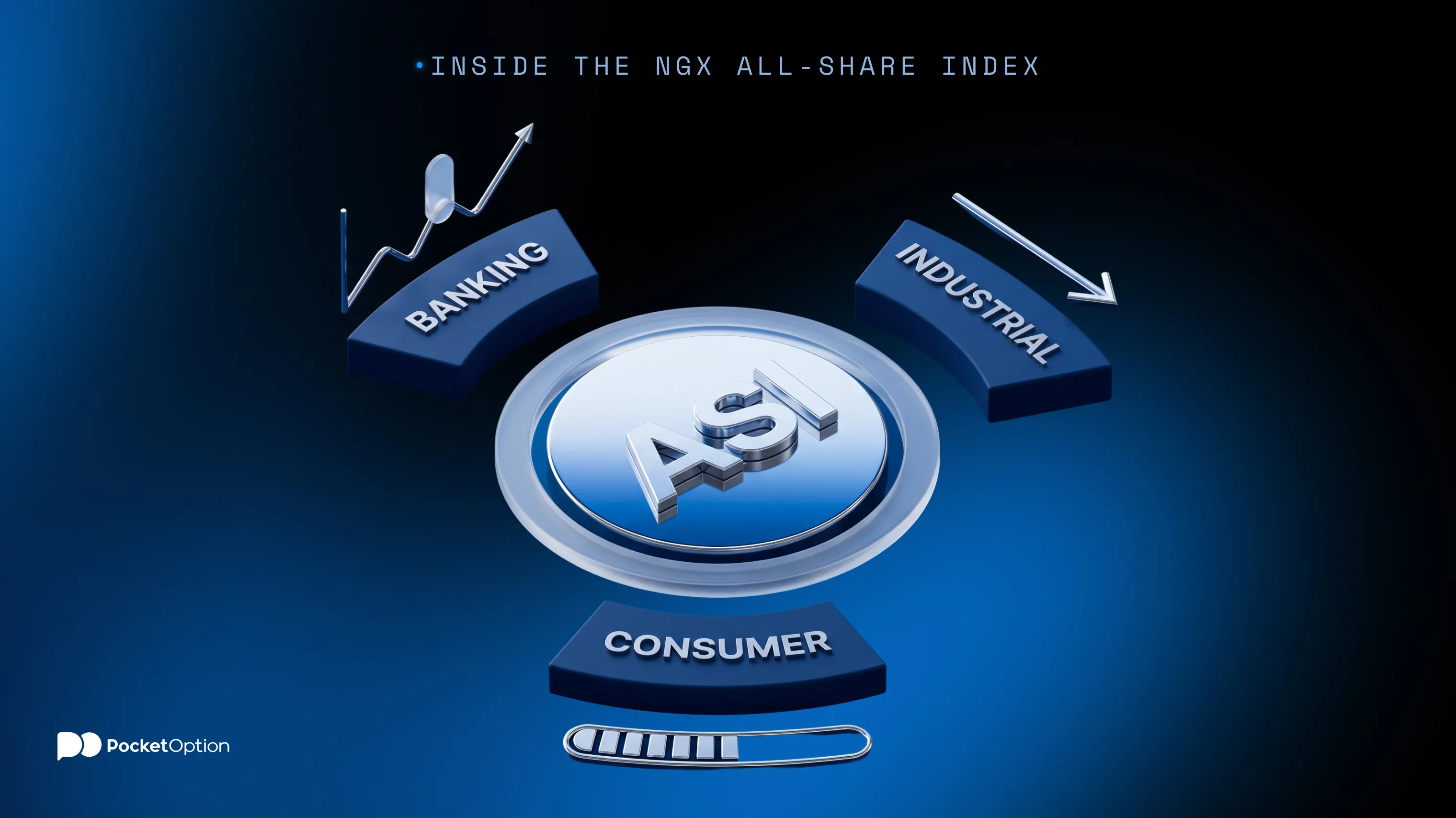
One number gets referenced constantly across the nigeria stock market: the NGX All-Share Index, or ASI. It tracks overall movement across listed equities, a single figure standing in for a huge amount of individual price action. Here's the part worth sitting with. The ASI moving doesn't mean every stock moved the same way, or even the same direction. Some names can rise while the index falls. Some can fall while it climbs. Averages hide plenty. Reading the nigeria stock market through the ASI alone misses most of what's actually happening underneath.
Open a free demo account and get a feel for price action, using virtual funds.
Try Demo AccountCurious how the index and individual stocks actually diverge on a live chart? Reading about the mechanic only goes so far. Watching how a headline index and individual price action can pull apart shows the pattern faster than any description can.
Open a demo trading account and get a feel for how price action actually behaves, with virtual funds and nothing real on the line.
What Moves the Nigerian Stock Market?
A handful of forces can push the nigerian stock market around. Corporate earnings. Dividends and company news. Interest rates, and whatever the CBN decides to do with them. Inflation. The Naira's exchange rate. Oil and commodity prices. Broader economic policy. Liquidity, meaning how easily shares actually change hands without moving the price too much. Investor sentiment, both domestic and foreign. None of these acts alone. How much weight any single factor carries at a given moment depends heavily on current conditions and which sector is actually in question.
Trying to reduce the entire nigerian stock market to one macro number, one headline figure that supposedly explains everything, misses how these forces actually layer on top of each other. There's no universal rule that reliably predicts which direction the broader nigerian stock market heads next, and treating one as if there were skips past a lot of real complexity. Checking current conditions directly through your Pocket Option login account beats leaning on a fixed assumption.
How Inflation, Interest Rates, and the Naira Reach Stock Prices
Macro shifts reach Nigerian companies through several channels at once: financing costs, import expenses, consumer demand, purchasing power, investor expectations. A higher interest rate, for instance, can raise a company's own borrowing costs while also making bonds look more attractive relative to stocks. The same change in inflation, interest rates, or the Naira can hit a bank, an industrial company, and a consumer goods business in genuinely different ways, sometimes in opposite directions entirely. There's no clean, one-line rule here. No version of "a weaker Naira means the nigeria stock market index falls" actually holds up once you look at individual sectors.
Why Earnings and Company News Still Matter
Individual stocks can move quite differently from the ngx all share index, and earnings are usually why. Financial results, dividend announcements, forward guidance, corporate actions, regulatory developments, these company-specific events can send a single stock moving in a direction the broader index isn't following at all. A strong earnings surprise can lift one name even while the wider market drifts lower, and a disappointing one can do the reverse. Any specific example here should come from confirmed corporate disclosures or a genuinely reliable market source, not a guess. None of this amounts to a recommendation. A stock diverging from the ngx all share index is a fact about that stock, not investment advice about it.
How to Read NGX Market Moves in Context
The ngx asi moving in one direction doesn't automatically carry over to any specific company or sector. Reading it properly means looking at sector performance, market breadth, how much is actually trading, company disclosures, and the broader macro backdrop together, not the index number in isolation.
Take a simple, purely illustrative scenario: the index climbs on a given day while a chunk of individual stocks actually decline. That's not a contradiction. It's a reminder that a headline figure and the stocks sitting underneath it can genuinely tell different stories. Whenever specific prices, index levels, market capitalization, or trading volume actually get cited, checking both the source and the date matters, since none of these figures stay fixed for long. None of this is a market forecast, and none of it amounts to a ready-made trade setup.
Risk Disclaimer: Trading involves significant risk of capital loss. This article is for educational purposes only and does not constitute financial advice. Always conduct independent research and consider your risk tolerance before making any trading decisions.
See more:GEO