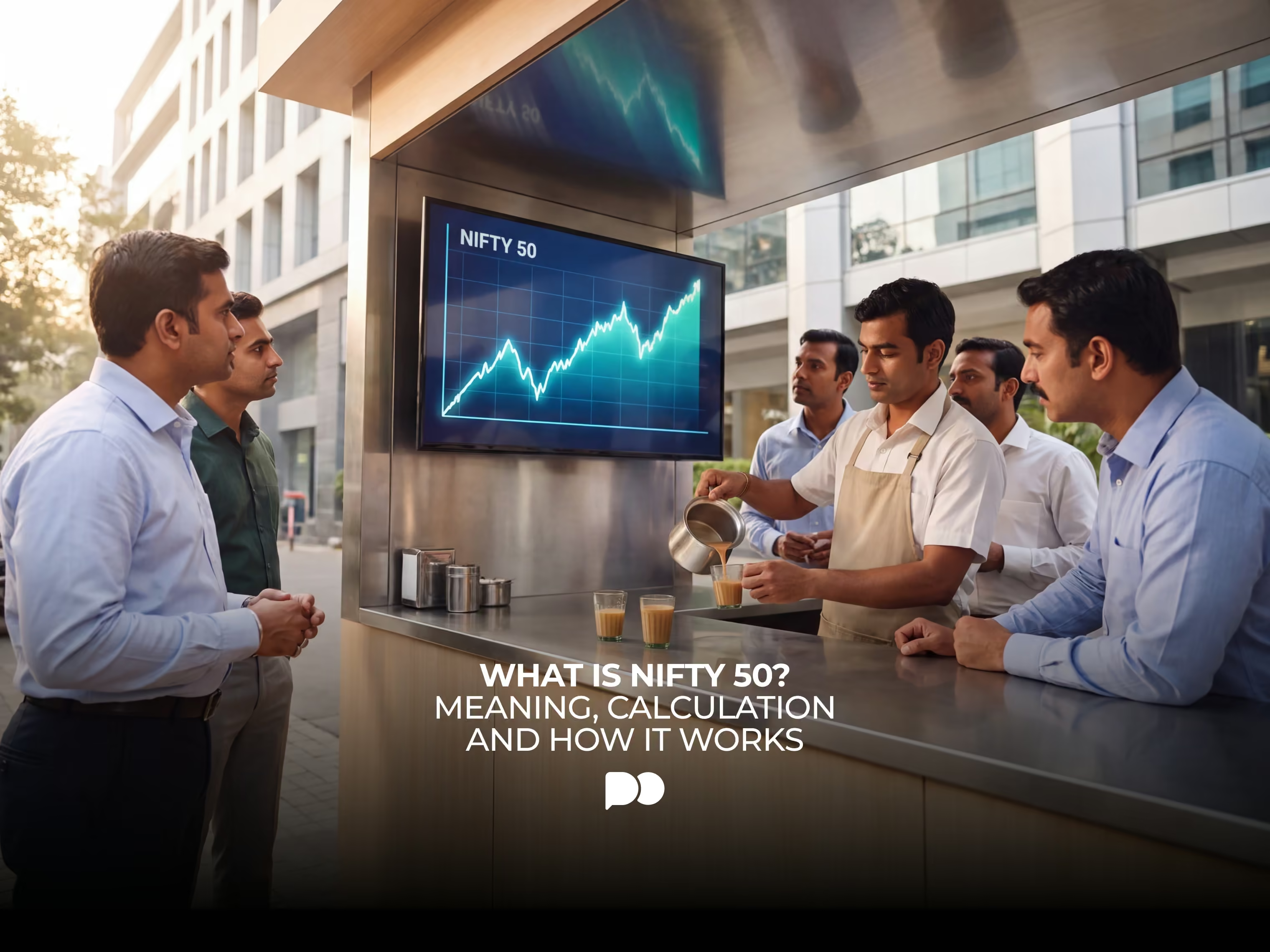
What Is Nifty 50? Meaning, Calculation and How It Works
Nifty 50 is NSE Indices' benchmark of 50 large, liquid Indian companies. Here is which companies are in it, how they are selected, how free-float weighting works, what can move it, how it differs from Sensex, and how traders read it without treating it as a signal.

Turn on any Indian market bulletin and you'll hear the same phrase: the Nifty closed higher, or lower. Fifty companies. One number. Everybody quotes it. Few could define it.
What Is Nifty 50?
So what is Nifty 50? A diversified benchmark index. Fifty large, liquid companies listed on NSE, spread across the main sectors of the Indian economy. NSE Indices calculates it using free-float market capitalisation. Reporters quote it. Fund managers measure against it. Index funds track it.
Don't oversell it. Fifty companies aren't the whole market. Plenty of other listed companies sit outside. Think small and mid-sized firms, for a start. Ask what is Nifty 50 measuring. The honest answer: large-company performance. Not the entire market.
Open a demo account and compare a large stock with the broad index on live charts.
Try Demo AccountA benchmark makes sense once you've seen it move beside its own members.
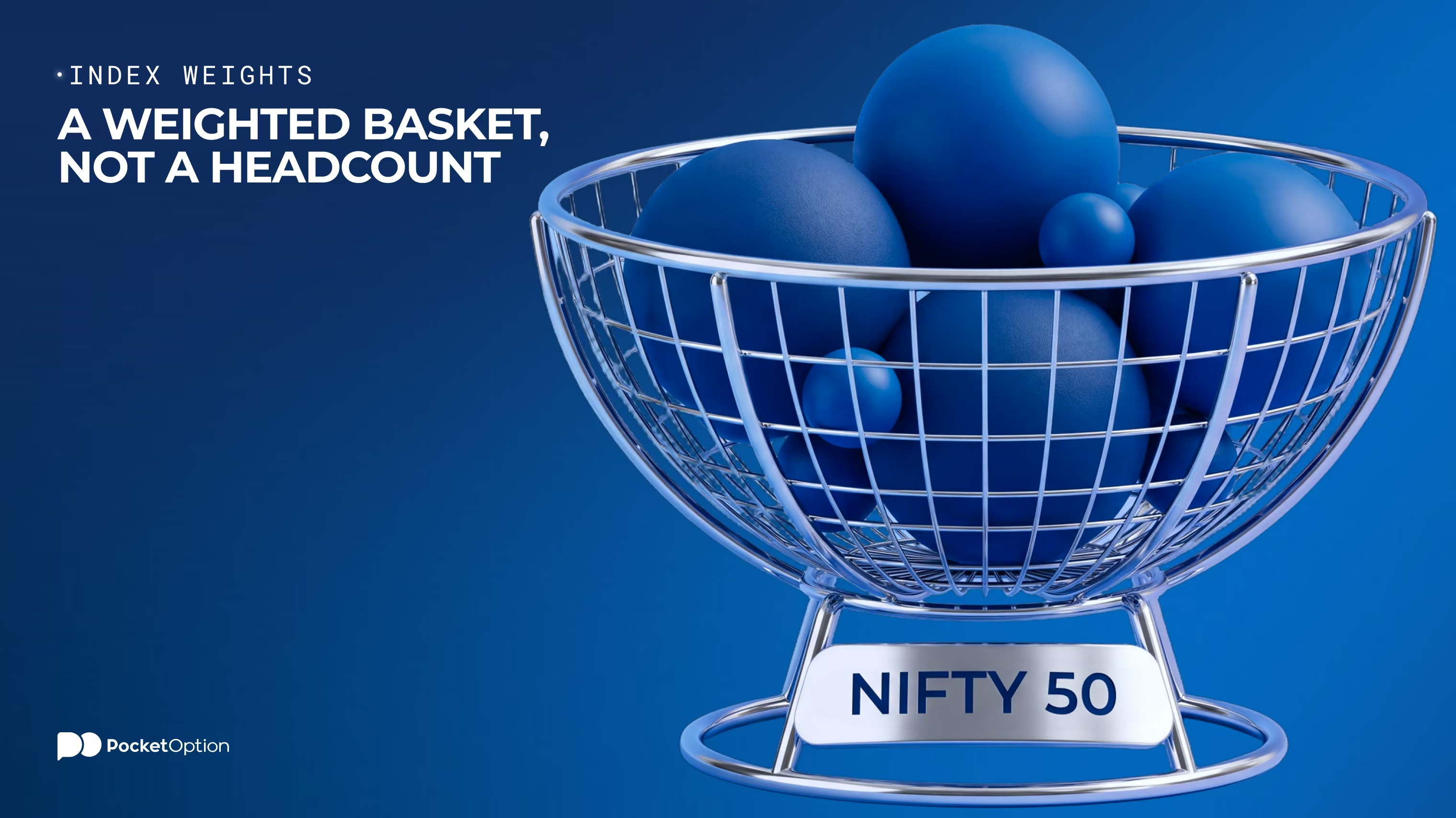
Try this. Open a demo account. Put one large Indian stock beside a broad market index, wherever your platform lists them. For a week, note how much of the index's daily move comes from that single name. You'll start to see what is Nifty 50 really tracking: a weighted, uneven basket, not a headcount. Zero capital at risk.
Spend a week of demo trading watching one heavyweight against the index.
Which Companies Are Included in Nifty 50?
People who ask what is Nifty 50 index membership usually want the company list. Here it is. With a caveat: the line-up changes. The table shows the six heaviest members in NSE's factsheet dated 30 September 2026. Weights are approximate, rounded to one decimal.
Can't find one of these stocks? The pocket option tutorial shows where to start.
Company | Ticker | Sector | Index Weight |
|---|---|---|---|
HDFC Bank | HDFCBANK | Financials, private lender | about 10.4% |
ICICI Bank | ICICIBANK | Financials, private lender | about 9.1% |
Reliance Industries | RELIANCE | Oil and gas, plus retail and telecom arms | about 7.6% |
Bharti Airtel | BHARTIARTL | Telecom, mobile and broadband | about 5.1% |
Larsen & Toubro | LT | Engineering, construction and infrastructure | about 4.2% |
State Bank of India (SBI) | SBIN | Financials, state-owned lender | about 3.8% |
The top ten pass half of the index. The financial sector, taken as a whole, sits above a third. That's what unequal weights look like. So what is Nifty 50 index weighting, really? Free-float market cap. Not equal slices.
How Are Companies Selected for Nifty 50?
Ask what is the Nifty 50 selection process. Three words: eligibility, liquidity, review. It has to trade on NSE and belong to the pool NSE Indices treats as eligible. It has to clear liquidity and trading-frequency tests. And its free-float market cap must be big enough. Exact thresholds? I won't quote them. They move, so check NSE's current methodology.
Then the review. The line-up gets a fresh look at every semi-annual review. Companies can enter or leave. A merger, a delisting or a similar event can force an unscheduled swap.
How Is Nifty 50 Calculated?
So what is Nifty 50 index India calculation in plain words? Free-float market capitalisation. For each company, take the share price. Then multiply by the shares ordinary investors can actually buy and sell. Shares locked away with promoters and strategic investors aren't counted. Add up all 50 results, compare the total with a base value, and you get the index level.
More freely tradable value, more weight. The free-float method has been in place at NSE since 2009. Its base value of 1000 was set on 3 November 1995. The index went live in April 1996. The divisor arithmetic can wait.
Why Nifty 50 Matters for the Indian Stock Market
It packs the large companies of key sectors into a single number. A handy reference for how big Indian stocks are doing. Funds measure themselves against it. Index products track it.
But Indian market and Nifty 50 aren't synonyms. Small caps, mid caps and other segments sit outside. A week can look strong for the index and dull for the rest.
What Can Move Nifty 50?
Many forces, rarely just one. A map of the usual suspects:
Earnings from the biggest members
How individual sectors are doing
RBI policy and rate expectations
Inflation and growth numbers
Foreign and domestic institutional flows
The rupee and global market mood
Commodity prices, where they matter
Weights decide whose voice is loudest. A move in a heavyweight bank or energy giant counts for more. The same move in a lightweight member counts for less.
Nifty 50 vs Sensex: A Brief Difference
Both are major Indian equity benchmarks. They differ in who runs them. In how many companies they hold. In the fine print of the method. Nifty 50 is an NSE Indices product with 50 members. BSE runs Sensex, which holds 30. The full side-by-side lives in a separate Nifty 50 vs Sensex article.
How Traders Can Interpret Nifty 50
Use it as a contextual benchmark. It helps you judge large Indian stocks against the large-cap market. Compare a sector or a company with the broader index. Watch how markets react to macro and company news. It is never a standalone buy or sell signal. No entry rules. No exits.
Risk Disclaimer: Trading involves significant risk of capital loss. This article is for educational purposes only and does not constitute financial advice. Always conduct independent research and consider your risk tolerance before making any trading decisions.
See more:GEO