
Forex Trading in India
Forex trading in India comes with a local layer no generic forex guide covers: INR's sensitivity to RBI policy and oil prices, IST session timing against the London-New York overlap, and legal specifics that need checking directly with RBI or SEBI. This guide walks through that context, a worked IST schedule example, and the mistakes that trip up beginners trading from India.

What Forex Looks Like From India
Forex trading in india looks different from forex trading anywhere else, not because the charts change, but because the context around them does. INR adds a layer no EUR/USD trader in Frankfurt has to think about. RBI oversight shapes what is actually permitted. IST puts the most active global trading hours somewhere specific on an Indian trader's schedule, not automatically overlapping with when everyone else on the planet is most active.
None of this changes the mechanics of a chart. Forex trading in india still means analyzing price movement and managing risk under uncertainty, same as anywhere. What changes is the surrounding structure: which instruments are accessible, which regulator has a say, and which hours actually matter most given where India sits on the clock. Getting oriented on forex trading in india specifically saves confusion later.
Open a free demo account and watch how price behaves during different trading sessions, using virtual funds.
Try Demo AccountCurious how forex actually trades during the hours that matter most from an Indian time zone? Reading about session timing only goes so far. Watching price actually move during a real overlap window teaches the rhythm faster than any schedule can.
Open a demo trading account and watch how price behaves during different hours of the trading day, with virtual funds and nothing real on the line.
The Rupee's Role in the Bigger Picture
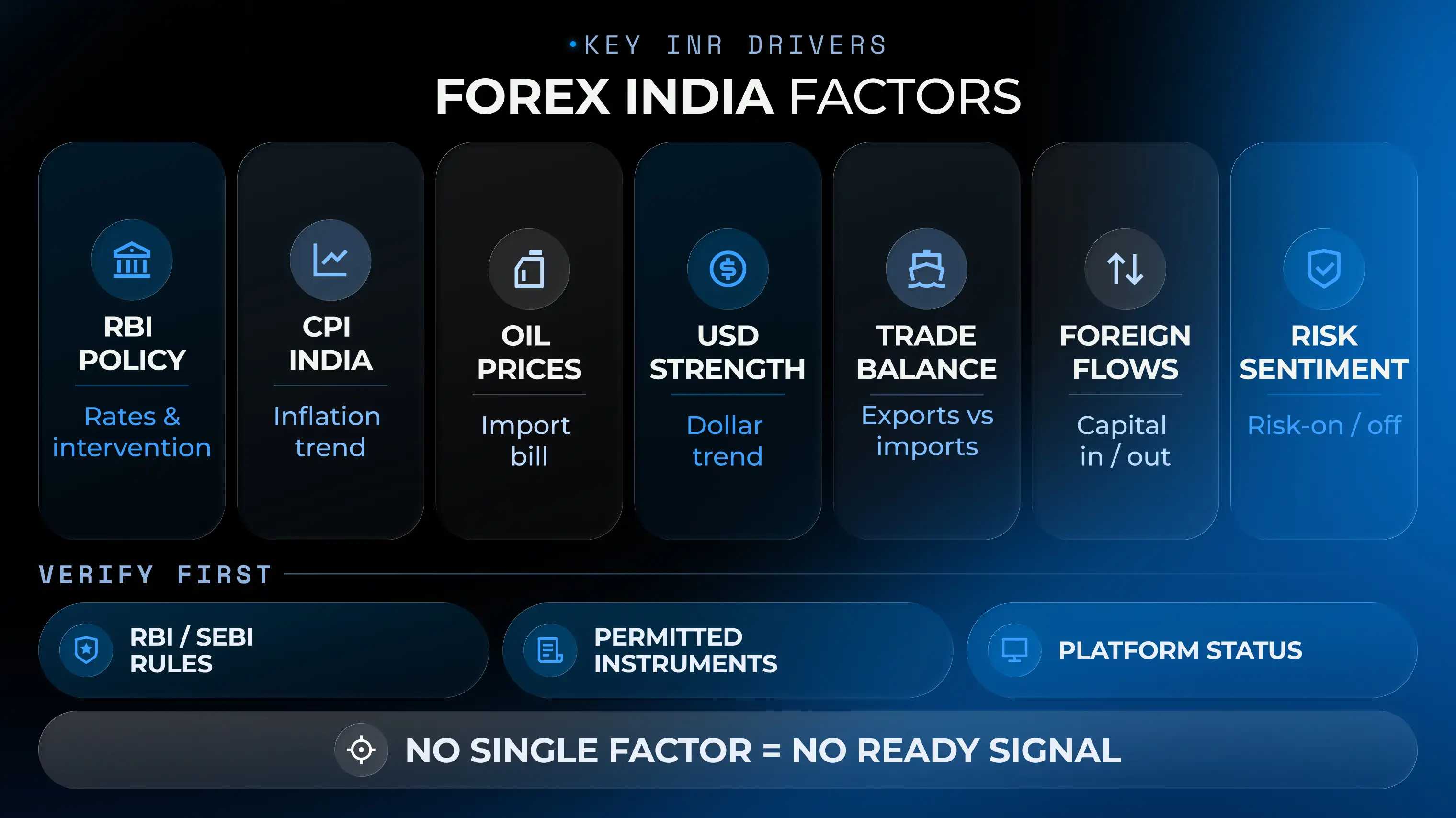
INR does not move in isolation. It reacts to USD strength, India's import bill, since the country imports much of its energy needs, inflation, capital flows in and out of Indian markets, RBI policy decisions, and broader global risk sentiment. Understanding is forex trading legal in india matters just as much as understanding what moves the rupee, since the legal framework shapes which instruments and channels are actually available in the first place.
Why USD/INR Gets So Much Attention
USD/INR draws outsized attention in the Indian context for a few reasons. Dollar liquidity dominates global forex, so most reference pricing runs through USD somewhere. India's import bill, oil chief among the line items, gets settled largely in dollars, so exporters and importers watch the pair closely. Any forex trading app in india worth using will likely surface this pair prominently, though this article is not the place for a dedicated USD/INR breakdown.
What Can Push the Rupee Around
A specific handful of inputs tend to move INR more than most other factors combined.
Factor | Description | Possible Impact on INR |
|---|---|---|
RBI Decisions | Interest rate policy and currency interventions | Rate changes and interventions can shift INR directly |
CPI India | Domestic inflation data | Higher inflation can pressure the currency |
Oil Prices | Cost of India's energy imports | Rising oil costs widen the import bill, pressuring INR |
USD Strength | The dollar's broader global trend | A strong USD often weighs on INR alongside other currencies |
Trade Balance | Difference between exports and imports | A wider deficit can add pressure |
Foreign Investment Flows | Capital moving in or out of Indian markets | Outflows can weaken INR, inflows can support it |
Global Risk Sentiment | Broader appetite for risk-on or risk-off | INR can move with broader emerging-market sentiment |
None of these factors works alone, and figuring out best time for forex trading in india in terms of macro conditions means watching several of these at once rather than fixating on just one.
The Trading Day in IST
Forex trades globally, twenty-four hours across five weekdays, but activity is not evenly spread across that whole window. Certain hours consistently carry more volume and movement than others, largely tied to which major financial centers are actively open. Any forex trading platform in india displays prices around the clock, but the liquidity and movement behind those prices still follows the same global rhythm regardless of what platform is showing them.
When London and New York Wake Up
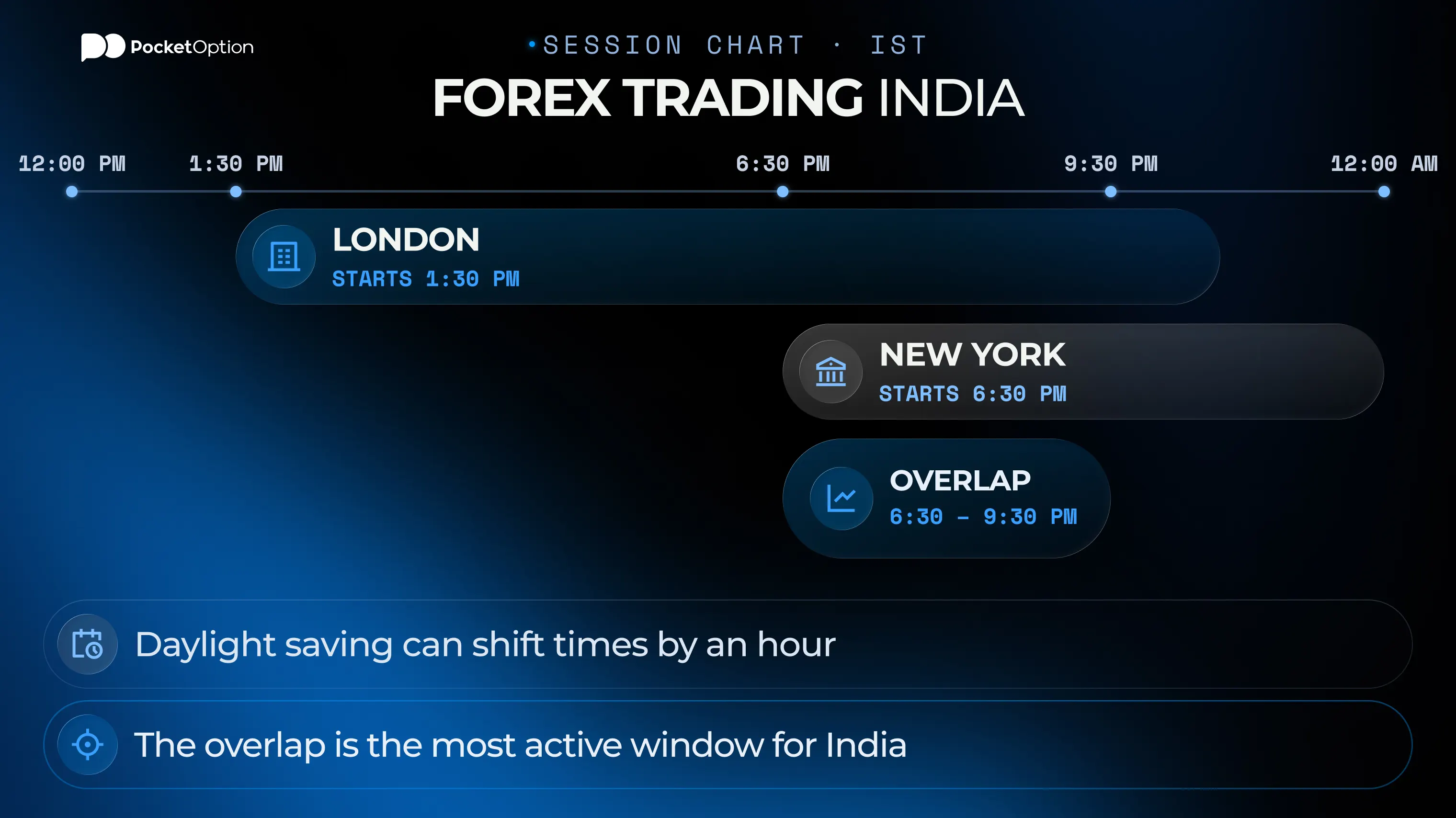
The overlap between London and New York trading hours is commonly cited as one of the more active windows globally, since two major financial centers are both open at once. Using standard time as a baseline, London opens around 1:30 PM IST and New York opens around 6:30 PM IST, so the overlap runs roughly from 6:30 PM to 9:30 PM IST before London closes for the day. Daylight saving changes in either London or New York shift these numbers by up to an hour in either direction depending on the season, so a current session-time converter beats memorizing a fixed number. Forex trading india during that evening window often lines up more conveniently with a typical workday than the earlier Asian session hours might, though nothing about timing alone guarantees a particular outcome for forex trading india on any given day.
Rules and Access: What to Verify First
Legal status deserves care rather than a confident verdict here. Traders based in India need to verify current rules, restrictions, permitted instruments, and platform status directly through official sources, RBI, SEBI, or the compliance pages of regulated providers, rather than relying on a blog post for anything resembling legal certainty. Rules here can be specific about which instruments and channels are permitted, and getting that wrong carries real consequences. This article offers no guidance on working around any restriction. Checking directly with RBI or SEBI first is the only reliable path.
Choosing Tools Without Chasing "Best App" Lists
Skip the "best app for India" lists that circulate online, since most rank on criteria that have little to do with what actually matters. Worth checking instead: regulatory status and whether it actually covers India, fee structure, which instruments are genuinely available, how clearly risk disclaimers are presented, the actual withdrawal process, real educational material, account security, and general transparency. None of this produces a single winner. It produces a checklist worth running through before committing to any option.
Local Data That Can Shift Expectations
CPI India, RBI policy statements, inflation trends, GDP figures, trade data, and USD-related global news all shift expectations around INR and the broader forex backdrop for Indian traders. None of these releases hands anyone a ready entry signal. They shift the context a trade gets evaluated against, which matters, but reading a headline is not the same thing as having an edge.
Beginner Mistakes in the Indian Market
A specific set of mistakes shows up often enough among newer traders based in India to be worth naming directly.
Ignoring local rules and restrictions rather than verifying them directly with RBI or SEBI first.
Choosing a platform based on advertising alone, without checking regulation, fees, or withdrawal terms.
Trading during genuinely low-liquidity hours and expecting the same movement as peak sessions.
Ignoring how IST lines up with the London and New York overlap entirely.
Treating educational content, including this article, as financial advice rather than background context.
Using leverage far beyond what the account size and experience level can reasonably absorb.
Skipping RBI and INR-related news entirely while trading a currency directly exposed to both.
Risks Before You Trade Forex From India
Forex trading carries real volatility and the possibility of losing capital, regardless of which country a trader is based in. Regulatory uncertainty adds a layer specific to this context, since rules can be specific and subject to change. Choosing a platform poorly, whether on fees, regulation, or basic transparency, compounds every other risk sitting underneath it. Leverage magnifies both gains and losses without distinction. News-driven gaps can move price sharply outside of normal trading hours. Currency risk itself, particularly around USD/INR, can shift a position's value independent of the actual trade thesis. None of these risks disappear with experience. They just become more familiar.
Risk Disclaimer: Trading involves significant risk of capital loss. This article is for educational purposes only and does not constitute financial advice. Always conduct independent research and consider your risk tolerance before making any trading decisions.
See more:GEO