Stakeholders Meaning. Who They Are in Business, Types and Real-World Examples
A company has meaning to more people than just the shareholders (the ones who actually own it). Some have signed a contract with it, some can shut it down completely, and some just allow it to function. All of them are called its stakeholders.

What Is a Stakeholder: Definition
A stakeholder is anybody who has an influence on a company, or gets moved by what the company does. That is the stakeholders definition, plain and simple.
This is a useful term, because if you trim the list down to only shareholders, you've already eliminated a lot of the people and entities who benefit from the company’s work, or can influence it on a daily basis. Like the supplier who produces for it, the regulator or government who can pull a licence, the town that the company resides in (and that can vote down the new powerplant being build, or turn down the important application).
So what is a stakeholder in business, plainly? It’s anybody that’s carrying something in how the business turns out in the end. Money, contracts, rules, influence, jobs. Even clean air and taxes. Anyone that has anything to do with a company has, in essence, some ‘stake’ to it. It’s not a share, so it doesn’t give them any rights directly, but still they care (or should care) about how this business works out.
What does stakeholder mean, once you're inside a real business? This depends on the perspective. A finance team of the company may define stakeholder groups by how much profit each one could bring. A comms team can sort same people by how loud they complain. Same names of people, but two different lists. Which is why these two departments can end up arguing past each other in meetings, trying to satisfy different types of stakeholders .
Main Types of Stakeholders
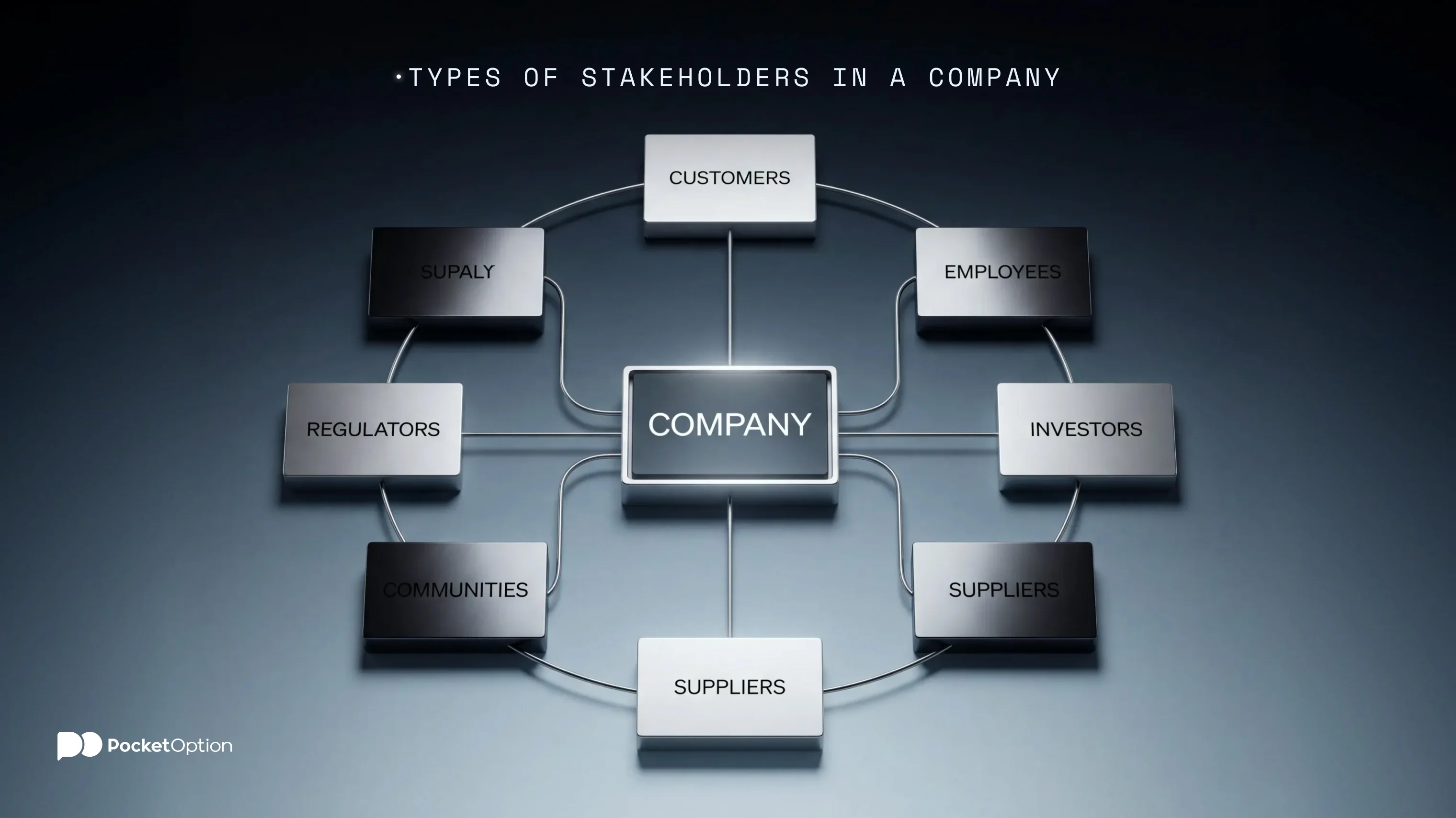
Then, what are stakeholders in an ordinary company? Thing is, there are different variants, and for some companies, their amount is very large. But the types of stakeholders most businesses deal with are:
Customers. They pay for the output, and carry some of the risks (when the product is poor, for example). So they have a stake in how the business is doing, and how the product is working, and how good its price stays.
Employees. These have direct influence on the company, and also have a stake in it due to their wages, hours, safety, job security, etc, being dependent on it.
Investors. Shareholders and lenders, both have exposure to the company. If it underperforms, they can get hurt. If somebody did an online investment into the company, they can be both a shareholder of a stock, and a stakeholder in the business.
Suppliers and vendors. They want to get paid on time, and ideally have the company grow in scale, so they would get more orders.
Communities. The people living near the company office or its production facilities. They have noise/traffic/jobs/water rights, etc, depending on this company, partly.
Governments and regulators. They can gain taxes from the business, and also influence its licensing, market conduct, et cetera.
Those all are standard stakeholders examples. But there can be some stranger ones as well. Such as a university roped into a research partnership, or a charity that’s leaning hard on one corporate donor. Some of those influences are just hard to see from the first pass. Understanding what stakeholders you have, as a business, is not quite as easy as it sounds.
Internal vs External Stakeholders
Internal stakeholders sit inside the organisation. Employees, managers, the board, and so on, who actually run the place. They can get the numbers before anybody else, and influence the goings of the company directly.
External stakeholders are outside of the business. They get affected by its actions and performance, but their influence are often less direct and straightforward. If a company has a supplier, it can find a different one (maybe even a better one). Customers are often largely replaceable. Lenders can be changed, neighborhood or town can be moved away from. The competitor can also be considered as one of stakeholders examples, in some cases.
Line between the two is not quite clean, though. Long-term contractor may work for this one company, and nobody else, for example. Does that make them internal or external? Formally, the latter, but functionally, especially if they’re located in the same building ,or on the same lot, it’s as if they were the former. Such examples are a dime a dozen.
The split of types of stakeholders mostly depends on how information moves around. Internal groups usually get the info first. They know how the company is operating underneath the hood, even before the press release or the earnings report happens. Meanwhile, external groups get information on the schedule, in set format, and often publicly, with everybody else. They get no ‘special privilege’ when it comes to access to the data.
Primary vs Secondary Stakeholders
Primary stakeholders have some direct transactional link to the company. They are customers, employees, investors, or suppliers, which the business relies on in some way. Break that link, and it may just stop working properly.
Meanwhile, secondary stakeholders don’t have any contract with the company, and don’t have the exact direct link. These can be media, various groups, academics, public, some organisations with indirect influence.
Secondary groups typically have no hard financial claim, but at the same time, they are important to consider. Not to mention, these categories are not constant, and can shift. Some member of the public might become primary stakeholder, some group from the outside may invest or start the supply line and become very important to the business directly. Remember that stakeholders meaning are much less concrete than the shareholders (which straight-up have to own shares, to be considered such).
Stakeholder vs Shareholder: Key Difference
Shareholders own equity. They have a slice of the company. Stakeholders, on the other hand, might own nothing at all.
Shareholders hold votes, dividend rights, a claim on some part of the business, potentially. A customer, a public member, or a neighbour has none of that. They can be slightly involved with the business, and have some influence on its success, but that’s about it.
Every shareholder is a stakeholder, but the opposite does not hold through. Most stakeholders do not own any shares, at all. So who is a stakeholder in a company is a much broader question than who shows up on the share register.
People that think stakeholders definition business means just shareholders can get caught flat-footed by strikes, boycotts, or an unexpected letter from a regulator turning up one morning, out of nowhere. Stakeholders are not as easy to keep the exact tabs on.
How Stakeholder Interests Can Conflict
Shareholders, typically, want costs down. Employees want their jobs kept. Governments want more taxes. Those are three goals that are hard to align. That’s why groups of stakeholders are often at odds with each other.
More examples:
Customers want lower prices, but suppliers want higher margins. Both are stakeholders, but they want the direct opposite thing, pretty much.
Lenders want a safe balance sheet. But equity holders often want more leverage there.
Communities want money reinvested into the site, the town, the location. Investors often want to not invest anything there, and have more free cash, to potentially buy the stock, for example.
So things can be quite complicated, with differentiation. Ask what does stakeholders mean ten times inside a real organisation, and the answers might come back different each time.
How Companies Manage Stakeholder Relationships
The key thing here is trust. Same as with any media or financial companies. That’s why people are googling a question for whether Pocket Option actually pays out: they want to have reassurance, before engaging with the company. Same thing happens with stakeholder relationships. Except, in turn of googling something, people are reading annual reports, or sustainability reports. Or watching the quarterly numbers. All of these things are part of engaging with stakeholders, and keeping them firmly on your side, for the company.
Another part is ESG initiatives. To many stakeholder, the business being on the right side of history is important. Therefore, environmental, social and governance programmes can be playing a part.
Also, investor dialogue. Earnings calls, investor days, meetings with the bigger holders to quell any of their fears. Information has to reach everyone, and in a positive light.
How Brokers Like Pocket Option Manage Their Own Stakeholders
A broker carries a stakeholder map same as any other business does. Clients come first: they hold the balances, and they can easily leave the moment execution or withdrawals go wrong on them. Anyone treating an online investment account as somewhere to just keep money has a stake in how well the firm gets run, they are, in essence, a stakeholder, and need to be treated accordingly.
Licensing conditions, AML and KYC duties, reporting obligations, etc, are another part of managing stakeholder expectations. It’s worth checking how a broker holds up against that kind of scrutiny. A firm that fails vs licensers and regulators doesn't get to go negotiate with its own clients afterwards.
Start with a demo, not a deposit.
Try Demo AccountPayment providers make up the third group, and the one outsiders rarely see. Card networks, e wallets, crypto processors, banks. Each one sets its own terms for brokers. Each one can also pull their service whenever they lose even an ounce of trust. So, in fact, the range of payment methods a platform supports is partly a resilience decision and a showcase, not just a convenience feature. The fact that Pocket Option has more than a few dozen payment networks working with withdrawals and deposits is a sign that company is trusted by many of those providers.
That's stakeholders meaning in business, applied down to one single industry. Three groups, three separate signs of trust, and all the good brokers have to hold all three up at the same time, without letting any one fall.
Conclusion
Stakeholders are a diverse group that encompasses both people (and entities) inside the company, and outside of it. They can affect, or be affected by, the said company, or have an interest in the success or failure of it. These can be employees, contractors, suppliers, governments, local towns, shareholders, investors, lenders, and a lot of other people. Which stakeholders a company caters to can determine its success on a particular front.
Disclaimer: This article is for informational purposes only and does not constitute financial advice. Trading and investing involve risk, and losses are possible.
See more:Education