Safe Haven Currencies Explained
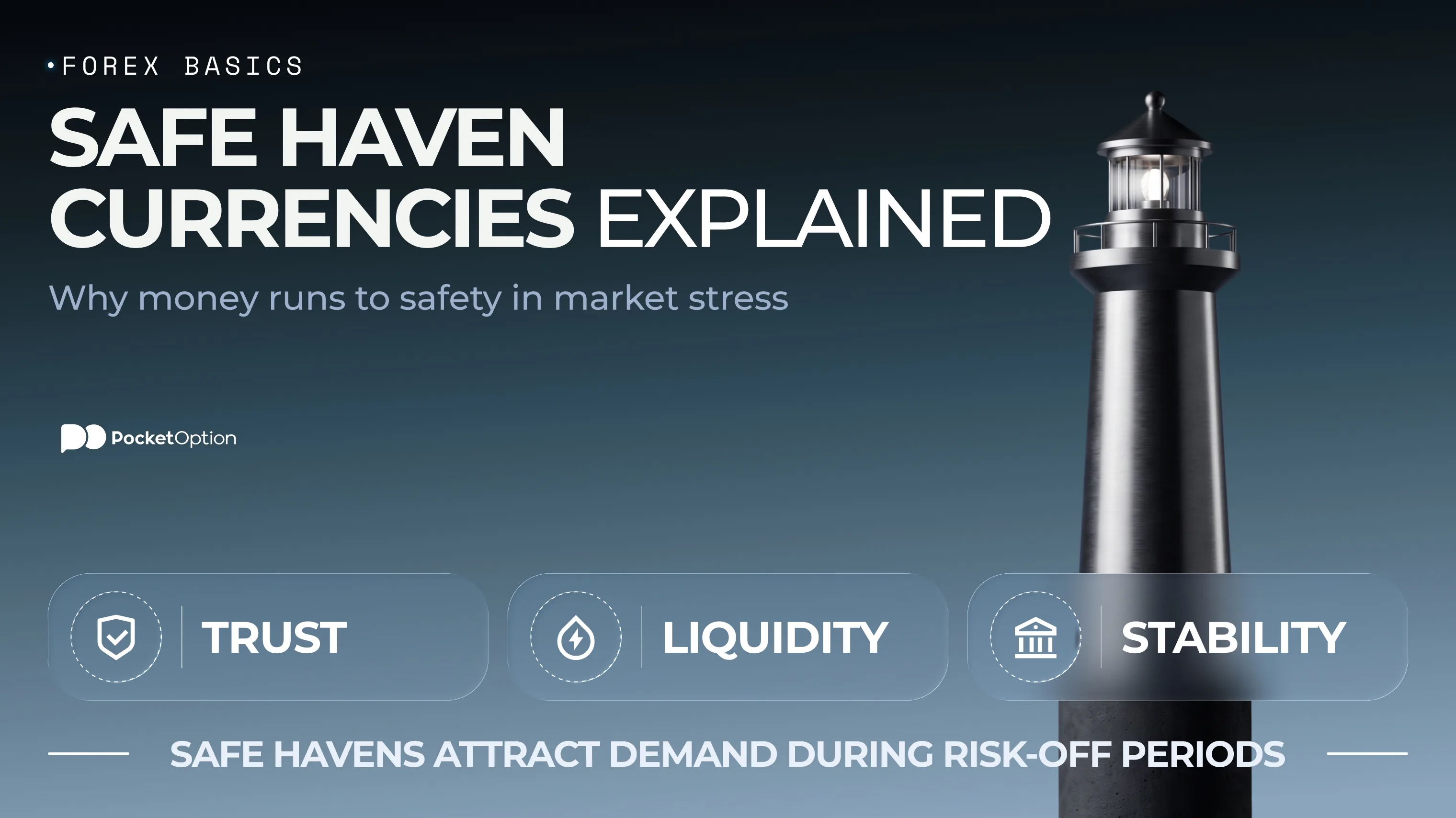
When a storm rolls in at sea, boats do not scatter randomly. They head for harbor, and not just any harbor. The deepest, most sheltered, most trusted ports fill up fastest, while smaller, shakier ones get largely ignored. Currency markets do something similar during periods of stress. Money looks for shelter, and a handful of currencies consistently attract more of that traffic than the rest.

Why Money Runs to Safety During Market Stress
A safe haven currency is one that tends to see rising demand specifically when markets get nervous, uncertainty spikes, or a broader risk-off mood takes hold. Nothing forces this to happen mechanically. It reflects where investors and institutions choose to park capital when they want to reduce risk.
Trust sits underneath the whole idea of a safe haven currency. Liquidity matters too, since a shelter that is hard to enter or exit quickly defeats the purpose during a genuine scramble. Economic stability rounds out the picture, since nobody seeks safety in a currency they suspect might be the next thing to wobble. Whatever pulls capital toward any safe haven currency during stress, that same trust can evaporate just as fast once conditions calm down.
Open a free demo account and watch how safe haven currencies trade during real volatility, using virtual funds.
Try Demo AccountCurious how one of these currencies actually behaves once real market stress shows up on a chart? Reading about defensive demand only goes so far. Watching how a currency actually trades during a genuinely volatile session teaches the pattern faster than any explanation can.
Open a demo trading account and watch how these currencies trade during real volatility, with virtual funds and nothing real on the line.
What Makes a Currency Feel Safer Than Others
A handful of traits show up again and again among safe haven currencies. High liquidity, so large positions can move in and out without distorting price too badly. Trust in the underlying economy and its institutions. Political stability, since sudden upheaval undercuts confidence fast. Deep, well-functioning financial markets capable of absorbing large capital flows. Low perceived risk relative to the alternatives on offer at that moment.
Factor | What It Means | Why It Matters |
|---|---|---|
Liquidity | How easily large amounts can move in or out | Shelter that is hard to access defeats the purpose |
Trust | Confidence in institutions and rule of law | Underpins the entire defensive reputation |
Political Stability | Low risk of sudden upheaval | Instability undercuts confidence quickly |
Market Depth | Capacity to absorb large capital flows | Deep markets handle stress without breaking |
Perceived Risk | How safe the currency seems relative to alternatives | Comparative, not absolute |
Not every trader's list agrees on every entry, since perceived risk shifts with context, but these traits explain why the same handful of safe haven currencies keeps showing up, and the pocket option tutorial covers chart basics first if any of this vocabulary still feels unfamiliar.
Liquidity, Trust and Global Demand
None of this works like a mechanical formula. Liquidity, trust, and global demand interact through the actual decisions of market participants reacting to risk in real time, not through some automatic rule that fires whenever volatility rises. A swiss franc safe haven currency reputation, built over decades, reflects exactly this kind of accumulated trust rather than any single mechanical trigger.
How Risk-Off Mood Changes FX Flows
During risk-off periods, market participants broadly reduce exposure and shift toward more liquid or defensive assets. Currencies can respond to that shift, but the reaction is never guaranteed to look the same twice. A japanese yen safe haven currency move during one stress episode can look completely different from its move during the next one, shaped by whatever else happens to be going on with rates and policy at that particular moment.
USD, JPY and CHF: Three Different Stories
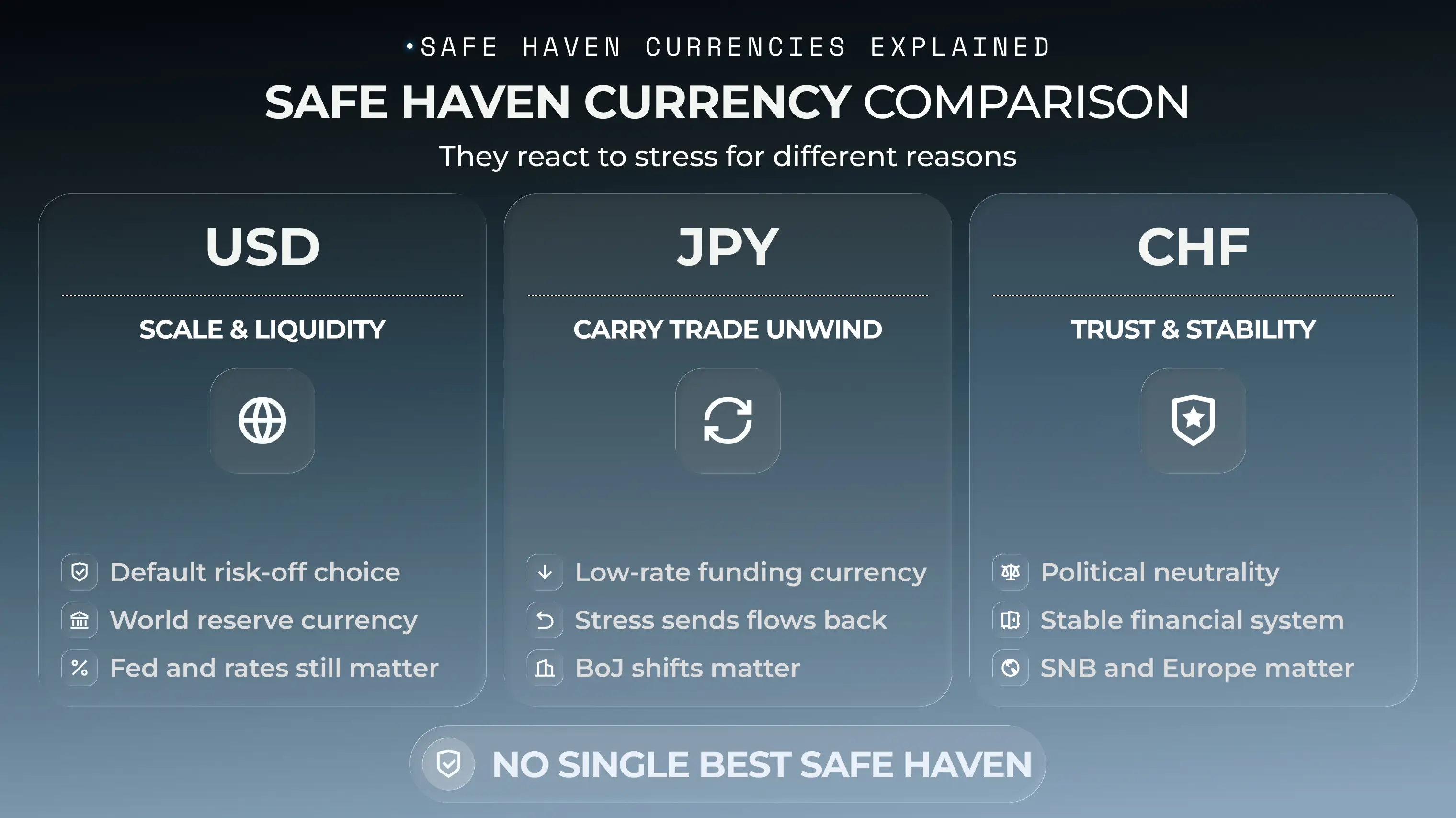
Ask what currencies are considered safe haven and USD, JPY, and CHF come up constantly, but treating them as interchangeable misses the point entirely. Each reacts to a different mix of drivers, carries different limitations, and responds to different kinds of stress. None deserves a single "best safe haven" ranking, since the right comparison depends entirely on what kind of stress is actually unfolding.
Why the Dollar Often Becomes the Default Choice
USD often becomes the default choice among safe haven currencies usd jpy chf conversations largely because of sheer scale. Its liquidity dwarfs any competitor, it functions as the world's primary reserve currency, and demand for dollar-denominated assets runs deep across the entire global financial system. USD does not move on risk-off sentiment alone either. Interest rates, inflation data, and Federal Reserve policy all pull on it just as hard, sometimes in a completely different direction than risk sentiment alone would suggest.
Why the Yen Can Move Against the Crowd
JPY earns its defensive reputation through a different mechanism than any us dollar safe haven currency comparison would suggest. Japan's historically low interest rates mean the yen gets used heavily to fund carry trades, borrowing yen cheaply to invest in higher-yielding assets elsewhere. When stress hits and those trades unwind rapidly, capital flows back into yen, sometimes pushing it higher even as broader sentiment sours. Bank of Japan policy shifts can change this dynamic considerably from one period to the next.
Why the Swiss Franc Gets Attention in Uncertain Times
CHF draws attention for reasons closer to trust than to any yen safe haven currency carry-trade mechanism. Confidence in Switzerland's financial system, political neutrality, and long-standing economic stability give the franc a defensive reputation that predates most of modern forex trading. Swiss National Bank policy, domestic inflation, and broader European market conditions all still shape CHF alongside that reputation, sometimes overriding it for a stretch.
When the Safe Label Stops Working
None of these currencies automatically rise every time stress appears. Interest rate differentials can pull in the opposite direction. Inflation and central bank policy can override the defensive narrative entirely. Local news specific to that currency's own economy can dominate over broader market mood. A strong USD can weigh on other defensive currencies even during genuine stress. Intervention risk from a central bank uncomfortable with rapid appreciation adds another layer. Even asking is swiss franc a safe-haven currency worth trusting in a given moment depends on which of these forces happens to be dominant right then.
Using Defensive Currencies in Forex Analysis
Traders who factor this context into analysis tend to watch overall market sentiment, volatility measures, bond yields, central bank signaling, the US dollar index, geopolitical headlines, and how currency pairs actually react as events unfold. Running through a mental safe haven currencies list is a starting point for context, not a replacement for watching how price actually behaves. None of this produces a ready buy or sell signal on its own.
Mistakes Traders Make in Risk-Off Markets
Answering what is a safe haven currency correctly in theory does not stop traders from making the same handful of mistakes once markets actually turn volatile.
Assuming USD, JPY, and CHF always rise together during stress, when each can behave differently depending on the specific trigger.
Ignoring interest rates and central bank policy entirely and focusing only on risk sentiment.
Confusing a short-term panic spike with a sustained, durable trend.
Forgetting which specific pair the currency is trading against, since that shapes the actual price move.
Treating defensive status alone as a standalone reason to enter a trade.
Risks Before Trading Defensive Currencies
Knowing what are safe haven currencies in theory does not guarantee they behave defensively in any specific instance. A defensive currency may simply fail to strengthen when expected. Market sentiment can reverse within hours. Unexpected news can trigger a sharp move in either direction. Central bank policy can override the risk-off factor entirely, regardless of how much stress is present elsewhere. Leverage magnifies losses on any trade built around an assumption that turns out wrong.
Risk Disclaimer: Trading involves significant risk of capital loss. This article is for educational purposes only and does not constitute financial advice. Always conduct independent research and consider your risk tolerance before making any trading decisions.
See more:Education