What Is Profit Factor in Trading and How Is It Calculated?
Profit factor compares total gross profit to total gross loss in a trading strategy, showing how much came in against how much went out. This guide covers the formula, a simple example, how to read the result, and its limits.

Profit Factor: What This Number Tells You About a Strategy
A farmer doesn't measure a good season by how many plants survived. What matters is the total harvest, weighed against everything lost to pests, weather, and spoilage. Nine healthy plants and one wiped-out row can add up to less food on the table than four healthy plants and zero disasters, depending on how big that one disaster actually was. Profit factor works the same way with a trading strategy. It's not about how many trades won. It's about how much came in against how much went out.
The number compares the total result from winning trades against the total result from losing trades: gross profit against gross loss. A profit factor above 1 means gross profit outweighs gross loss for that stretch. Around 1 means the two sit close together. Below 1 means losses actually outweigh profits, regardless of how the individual trades felt along the way.
None of this alone settles whether a strategy is actually good, though. A single profit factor reading, sitting by itself with nothing else around it, doesn't carry enough information to judge a strategy on its own. Reading profit factor in isolation, without anything else for context, is exactly the mistake worth avoiding here.
Open a free demo account and get a feel for real trading results, using virtual funds.
Try Demo AccountCurious how gross profit and gross loss actually stack up on a real trading history? Reading about the formula only goes so far. Watching wins and losses actually accumulate shows the pattern faster than any description can.
Open a demo trading account and get a feel for how results actually build up over a series of trades, with virtual funds and nothing real on the line.
How to Calculate Profit Factor Step by Step
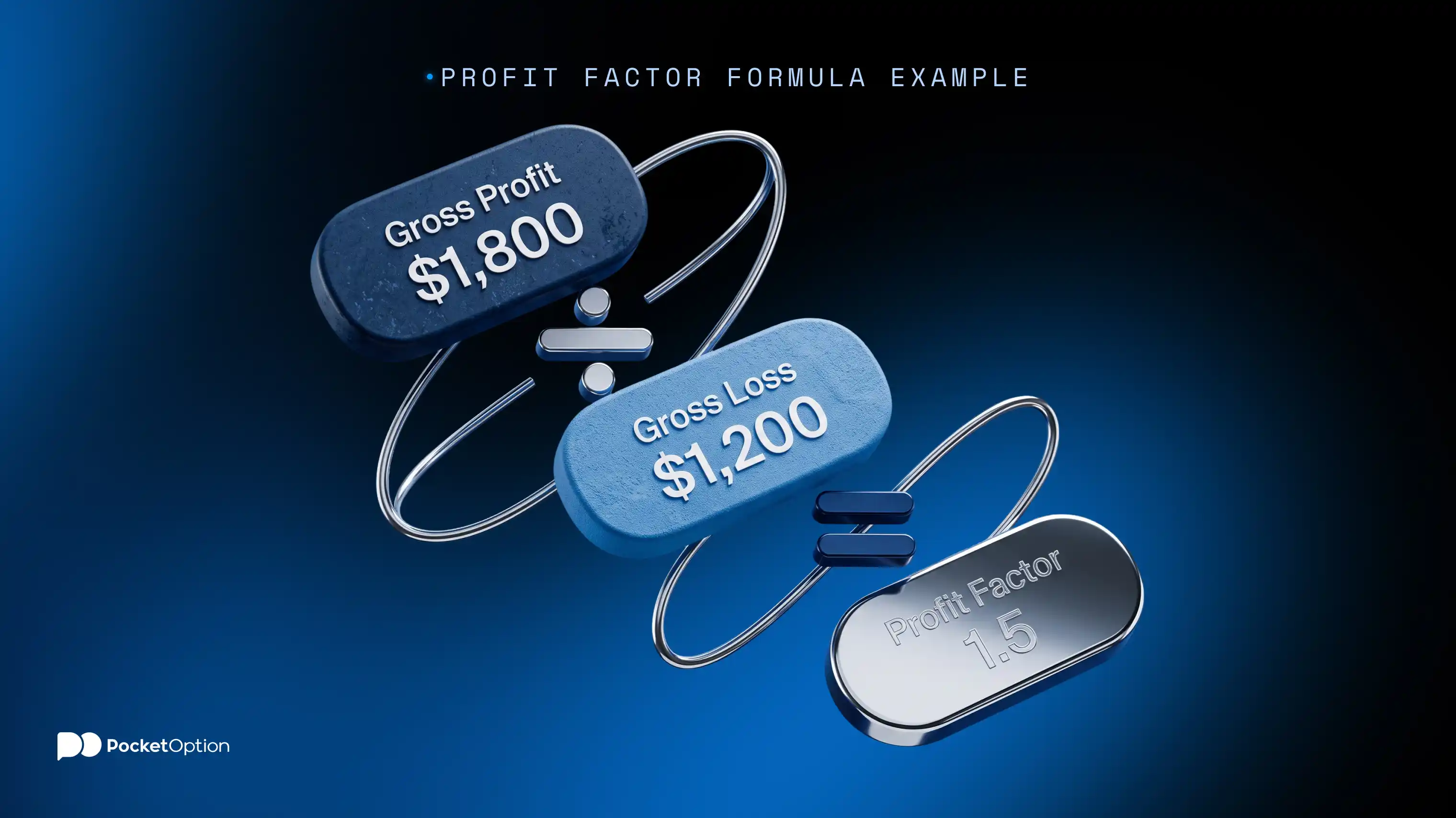
Answering what is profit factor in trading starts with a simple formula: Gross Profit divided by Gross Loss, using the absolute value of that loss figure. Gross Profit adds up the results from every winning trade in the set. Gross Loss adds up the results from every losing trade, treated as a positive number for this calculation.
Here's a simple example. Gross Profit comes to $1,800. Gross Loss comes to $1,200. Divide the two and the result lands at 1.5: for every unit of gross loss, 1.5 units of gross profit came in alongside it. Understanding what is profit factor in trading really comes down to this one division, once the two totals are actually in hand.
Don't confuse this with net profit or with risk-reward ratio. Net profit is simply gross profit minus gross loss, a dollar figure. Risk-reward ratio compares a single trade's planned reward against its planned risk before the trade happens. This metric works backward from actual results across many trades instead. Checking your own trading history directly through your Pocket Option login account is a good way to see these actual figures rather than working from memory.
What Is a Good Profit Factor?
A value above 1 in profit factor trading shows gross profits outweighing gross losses, but that fact alone doesn't say how reliable the strategy is or whether it suits a particular trader. Some sources cite figures like 1.5, 1.75, or 2.0 as reference points for a strong profit factor trading result. None of these numbers function as a fixed, universal line separating good from bad.
How to actually read the number depends on the number of trades behind it, trading costs, the specific strategy, drawdown, market conditions, and whether the result holds up across different stretches of time. A strong-looking reading over ten trades means something very different from the same number over a thousand.
Profit Factor vs Win Rate: Why the Difference Matters
Win rate counts how many trades came out ahead. The profit factor formula cares about something different: the dollar size of wins and losses, not just how often each happened.
Picture two hypothetical strategies. Strategy A wins 70% of its trades, but each winner nets a small $50 while each loser costs $100. Strategy B wins only 40% of its trades, but each winner nets $300 while each loser costs $100. Running the profit factor formula on both flips the story: Strategy A, despite the higher win rate, actually comes out worse once the dollar sizes get counted properly. A higher win rate doesn't automatically mean a better outcome, and neither metric wins out over the other in every situation.
Why a High Profit Factor Can Still Be Misleading
Knowing how to calculate profit factor is one thing. Trusting a single result blindly is another. A handful of situations can distort what the number actually shows: a small sample of trades, one or two unusually large winners skewing the whole set, whether trading costs and commissions even made it into the original data, overfitting during backtesting, and market conditions that shift between when the data was collected and now.
Results can also look completely different across separate stretches of time, even from the same strategy. That instability matters. This ratio works best sitting alongside total trades, win rate, expectancy, and maximum drawdown, not as a standalone verdict. There's no fixed trade count at which how to calculate profit factor suddenly becomes automatically reliable. More data helps, but it doesn't flip a switch.
Using Profit Factor When Reviewing a Trading Strategy
Comparing results across different periods, or across different backtests entirely, is where this metric earns its keep. Checking whether a strategy's number holds up when the testing window changes says more than any single reading taken on its own.
Looking at this ratio alongside expectancy, drawdown, and win rate rounds out the picture, without needing to relitigate every limitation of each of those metrics again here. A historical reading describes exactly one thing: what happened in that specific sample. It doesn't guarantee the same result shows up going forward. Anyone asking what is a good profit factor for their own strategy should treat the answer as context-dependent, not as a fixed target to chase.
Risk Disclaimer: Trading involves significant risk of capital loss. This article is for educational purposes only and does not constitute financial advice. Always conduct independent research and consider your risk tolerance before making any trading decisions.
See more:Education