What Is the Fisher Effect? Inflation and Interest Rates Explained
The Fisher Effect links nominal interest rates, real interest rates, and expected inflation. This guide explains the exact and simplified formulas, works through a plain numeric example, and covers why the observed relationship can diverge from the clean theory in practice.

Lend a friend $100 today. Ask for exactly $100 back in a year, nothing more. Inflation quietly eats into what that $100 can actually buy by the time it comes back. Lenders know this. So they build an inflation cushion into the rate upfront, before the money ever leaves their hands. That's roughly the logic behind what economists call the Fisher Effect.
What Is the Fisher Effect?
The Fisher Effect describes a relationship. Nominal interest rate. Real interest rate. Expected inflation. Named after economist Irving Fisher. The core idea: if expected inflation rises, and the real interest rate stays relatively stable, the nominal interest rate should rise too, to account for the purchasing power a lender expects to lose.
This is a relationship, a framework for thinking about rates. Not a rule where every inflation shift mechanically triggers an identical move in market rates. Short term, the connection can get messy. The framework still holds up as a way to think about why rates move the way they do.
Create an account and watch how rate expectations shift in real time.
Try Demo AccountA formula on a page doesn't show how nominal rates actually shift day to day.
Watching how rate expectations ripple through a live chart, as inflation data lands and gets priced in, explains this far better than the equation alone ever could. The connection between inflation expectations and nominal rates stops being abstract once you're actually watching it happen in real time.
Open a demo trading account and watch how rate expectations show up in live price action.
The Fisher Effect Formula Explained
Here's the exact Fisher equation. (1 + i) = (1 + r)(1 + πᵉ). Where i is the nominal interest rate. r is the real interest rate. πᵉ is expected inflation.
For relatively small rates, a simpler approximation gets used instead. i ≈ r + πᵉ. In words: the nominal rate roughly equals the real return plus compensation for the purchasing power you expect to lose to inflation.
The approximation drops something, though. An interaction term, r times πᵉ. That term is usually tiny when rates are low. It grows more noticeable as rates climb. So the simple version is an approximation. Not an exact equality.
Checking what is the fisher effect through an example makes this concrete faster than the algebra alone.
A pocket option tutorial walks through rate-sensitive instruments in more depth.
Nominal vs Real Interest Rates
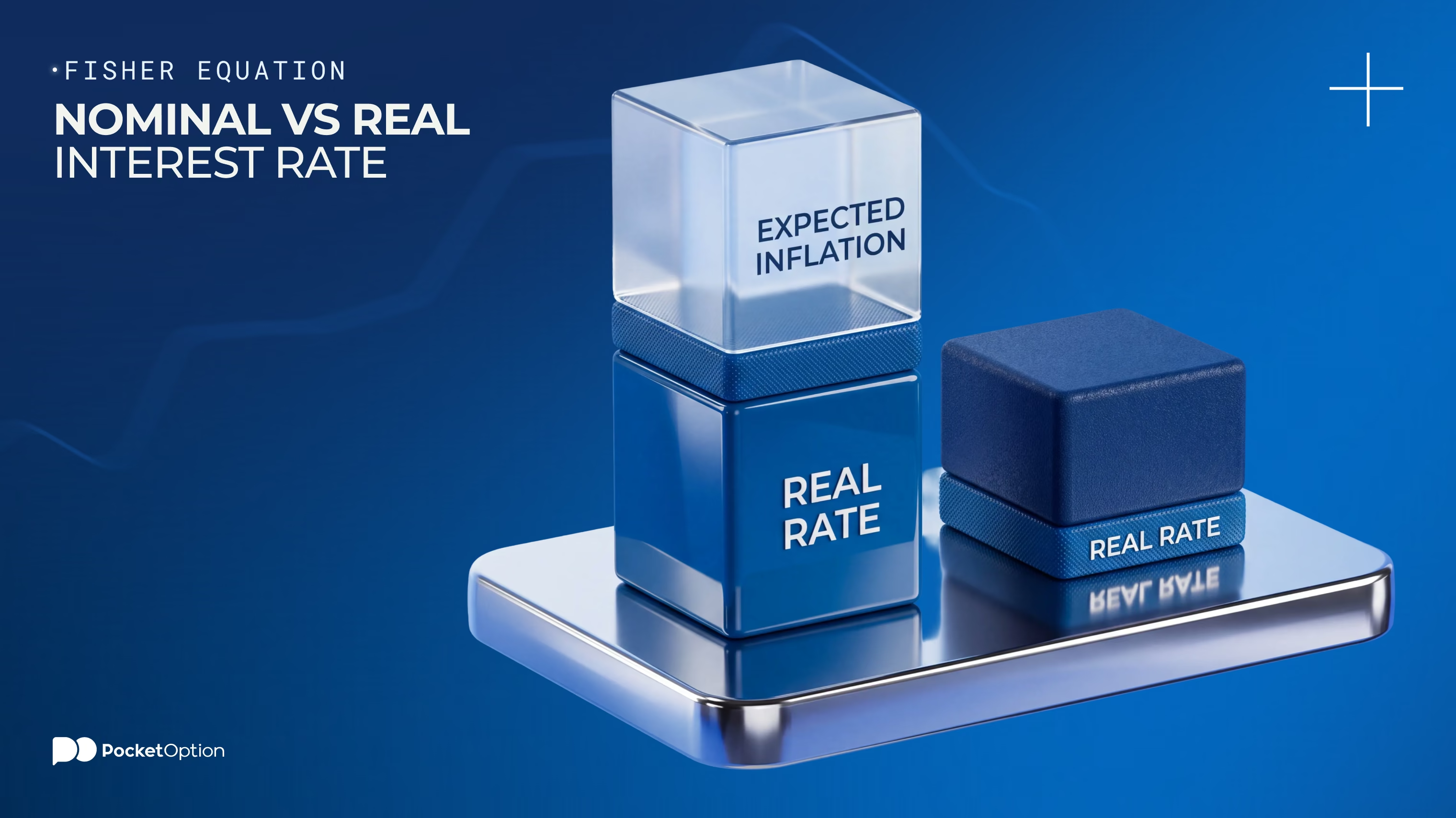
Nominal interest rate. The stated rate. No adjustment for inflation. Real interest rate. What that return actually means once purchasing power gets factored in. A rough approximation for the real rate: r ≈ i − πᵉ.
One distinction matters here. Expected real return, calculated before the fact, isn't the same as realized real return, calculated after actual inflation becomes known. Fisher effect economics treats these as genuinely different things, not interchangeable numbers.
Why Expected Inflation Matters
This whole relationship runs on expected inflation. Not future actual inflation. When a lender and borrower agree on a nominal rate, nobody actually knows what inflation will turn out to be. Expectations are what's available at the time.
Those expectations shape what compensation lenders ask for upfront. What real borrowing cost borrowers brace for over the life of the loan. Realized inflation can end up higher or lower than what was originally expected. When it does, the actual real return drifts from what either side originally had in mind, sometimes by a meaningful margin.
A Simple Fisher Effect Example
One plain example, no current market data involved. Expected real rate: 2%. Expected inflation: 3%. The simplified formula puts the nominal rate around 5%. The exact formula lands slightly higher, because of that interaction term.
Now raise expected inflation while holding the real rate steady. The nominal rate climbs. Not because something broke. Because lenders are pricing in a bigger expected loss of purchasing power.
Expected Real Rate | Expected Inflation | Approximate Nominal Rate |
|---|---|---|
2% | 3% | 5% |
2% | 6% | 8% |
Nothing complicated here. Just two scenarios, laid side by side, to show the direction things move.
How Inflation Expectations Affect Nominal Interest Rates
With the formula in hand, the mechanism itself gets easier to see. Holding the expected real rate roughly stable, rising inflation expectations should show up as a higher nominal rate. Falling expectations, a lower one.
Purchasing power is the lens here. A lender cares about the nominal number. But just as much about what that return will actually be worth once prices have moved. Nominal rates don't shift one-to-one with inflation at every moment, on every market horizon, though. The relationship holds more as a general tendency than a precise dial.
Why the Fisher Effect May Not Match Markets Perfectly
Simple theory, messier reality. A handful of reasons the observed relationship can diverge from the clean version:
Real interest rates can shift on their own, not just inflation
Inflation expectations aren't directly observable, only estimated
Risk and term premiums layer on top of the base relationship
Expectations can move faster than published inflation data
Short-term and long-term rate relationships can behave differently
The empirical relationship can look weaker, or less stable, across specific stretches of time. Mostly because the assumption of a constant real rate doesn't always hold up in practice.
Fisher Effect vs International Fisher Effect
Worth separating these two, briefly. The classical version connects nominal rate, real rate, and expected inflation within a single economy. The International Fisher Effect takes interest-rate differentials between two countries and links them to expected changes in exchange rates. Different question, different framework. The currency-forecasting mechanics behind it are a separate topic entirely.
How Traders Can Interpret the Fisher Effect
The practical value here doesn't require turning any of this into a trading strategy. This framework helps separate nominal and real rates. It explains why inflation expectations matter for bond yields, borrowing costs, and broader rate expectations generally.
The formula itself doesn't forecast a central bank decision. Or bond prices. Or currency movements. Or where stocks head next. Interpreting it well means weighing expected inflation, real-rate expectations, the maturity of whatever rate is being examined, and the broader market context around it. A scheme like "higher expected inflation means sell bonds" skips over all of that nuance.
Risk Disclaimer: Trading involves significant risk of capital loss. This article is for educational purposes only and does not constitute financial advice. Always conduct independent research and consider your risk tolerance before making any trading decisions.
See more:Education