CRWV Stock Forecast 2030
CoreWeave sits at the center of the AI infrastructure build-out, but a coreweave stock forecast through 2030 depends on real, checkable factors, not hype. This guide covers how the business makes money, what drives analyst price targets, the Nvidia relationship, and bull, base, and bear scenarios worth watching instead of a single guaranteed number.

CoreWeave Stock Forecast 2030: What Investors Should Know
CoreWeave went from a niche GPU rental operation to one of the most talked-about names in AI infrastructure in a short window. That jump is exactly why so many people search for a crwv stock forecast: the company sits at the center of an expensive build-out of AI computing capacity, and investors want to know whether that position translates into a stock worth holding through 2030.
There is no honest way to answer that with a guaranteed number. This article walks through what actually drives the outlook, revenue growth, capital spending, debt, partnerships, competition, and the broader mood around AI stocks, so any forecast you read elsewhere makes more sense in context. Nothing here promises a price outcome.
Open a free demo account and follow volatile AI infrastructure names on a live chart, using virtual funds.
Try Demo AccountCurious how a name like CRWV actually trades day to day before you form a view on where it might head by 2030? Reading about a stock's story only tells part of it. Watching how a volatile, AI-linked name like this one actually moves on a real chart, through ordinary sessions and sudden swings alike, fills in the part a forecast article cannot.
Open a demo trading account and follow CRWV or similar AI infrastructure names on a live chart, with virtual funds and no capital at risk.
CRWV Stock Forecast: Key Factors Behind the Outlook
A handful of factors do most of the work in shaping a coreweave stock price target. GPU-based AI compute demand is the obvious starting point, since the entire business exists to rent out that capacity. New contracts matter almost as much, since they signal whether demand is broadening beyond a small handful of large customers. Data center buildout costs sit on the other side, expensive and largely debt-funded. Margins, competition from cloud giants building their own AI infrastructure, and risk appetite for AI-linked growth stocks round out the picture.
Factor | Description | Possible Impact |
|---|---|---|
AI compute demand | How fast companies need GPU capacity for training and running AI models | Rising demand supports growth, a slowdown pressures the outlook |
New contracts and partnerships | Whether the customer base broadens beyond a few very large clients | Diversified demand reduces concentration risk |
Data center buildout costs | Capital spent building and equipping new capacity ahead of demand | Heavy spending pressures margins short term, enables growth long term |
Debt load | Financing used to fund that buildout | Manageable debt supports growth, excessive debt raises financial risk |
Competition | Rival GPU cloud providers and hyperscalers building their own AI infrastructure | Intensifying competition can pressure pricing and margins |
Market sentiment toward AI stocks | Broader investor appetite for AI-linked growth names | Sentiment shifts can move the stock independent of company fundamentals |
How CoreWeave Makes Money
The coreweave stock forecast conversation only makes sense once the business model is clear. CoreWeave rents out large-scale GPU computing power, built primarily around Nvidia hardware, to companies that need heavy compute for training and running AI models without building that infrastructure themselves. Customers range from AI labs to larger tech companies handling overflow demand. Revenue comes from long-term capacity contracts plus usage-based billing.
Understanding this coreweave stock forecast question also means understanding the cost side. Data centers, networking, power contracts, and GPU hardware require enormous upfront spending, much of it committed years before a given contract's revenue fully materializes. That timing gap between spending and payoff is central to how the stock actually behaves.
CoreWeave Stock Price Target: What It Can and Cannot Show
A coreweave stock analysis built around analyst price targets is useful for context and dangerous if treated as a promise. A price target reflects one analyst's model of future earnings, growth, and risk at one point in time, nothing more. Those targets shift, sometimes sharply, after earnings reports, contract news, or a broader swing in how the market prices growth stocks. Two analysts covering the same company can land on very different targets depending on how they weigh debt against growth potential. Treat any figure you see elsewhere as dated the moment it is published.
What Analysts Usually Look at Before Setting a Target
A crwv stock analysis worth taking seriously walks through the same handful of inputs: revenue growth and how much comes from renewals versus new customers, operating margins, since a capital-heavy business can grow revenue while still struggling on profitability, debt levels and serviceability, the broader AI infrastructure demand curve, and competitive positioning against both dedicated GPU rivals and the AI infrastructure arms of larger tech companies.
CRWV Stock Analysis: Growth Drivers and Weak Points
Every coreweave stock price prediction worth reading weighs the same tension. Strengths: structural AI compute demand showing no clear sign of fading, a close Nvidia relationship that has historically helped with GPU supply access, and real investor appetite for pure-play AI infrastructure names. Weaknesses: high capital intensity, meaningful debt from that buildout, dependence on a small number of large customers, intensifying competition from rivals and hyperscalers alike, and the volatility of any richly valued growth stock.
CoreWeave Stock Price Prediction: Bull, Base and Bear Scenarios
Thinking in scenarios beats chasing a single number, and it keeps a coreweave stock nvidia partnership from carrying more weight than it deserves.
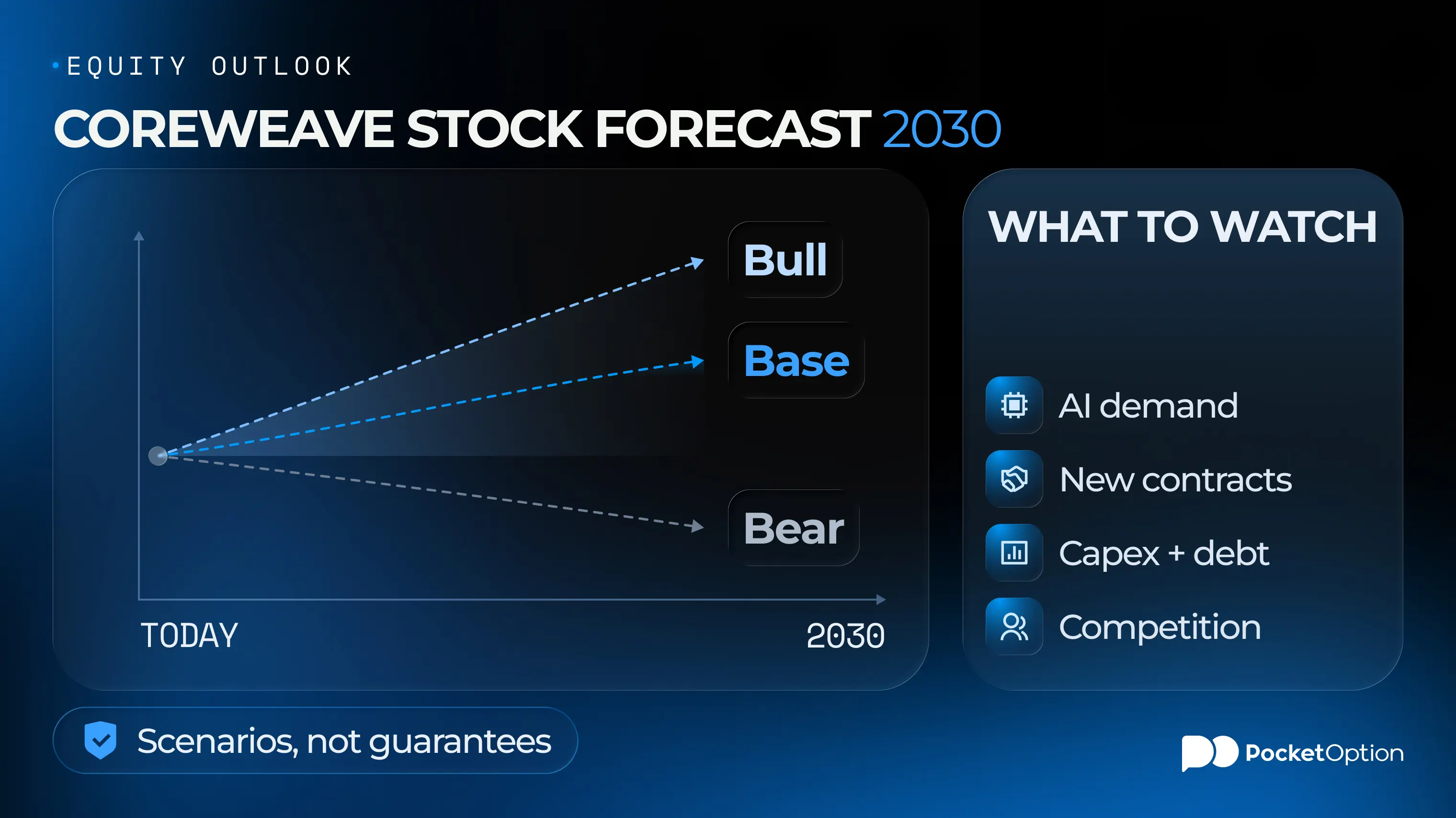
A bull case needs AI compute demand expanding faster than new supply, existing customers expanding contracts rather than shopping competitors, and debt staying manageable against growing revenue. A base case assumes steady, moderate demand growth, renewals roughly offsetting new wins, and disciplined spending that slowly improves margins. A bear case involves demand cooling faster than expected, key customers cutting back, and debt service becoming a real strain if growth stalls. None of these are predictions, just the conditions worth watching.
What Matters Beyond the AI Hype
A coreweave stock prediction built purely on AI excitement skips the part that actually determines long-term value. Hype moves a stock short term. Contracted revenue, the ability to expand capacity on reasonable financial terms, and genuine customer retention determine whether that move holds up over years rather than weeks. A company can sit at the center of a real trend and still struggle if spending outpaces disciplined execution, or a handful of major customers walk away.
CoreWeave Stock and Nvidia Partnership
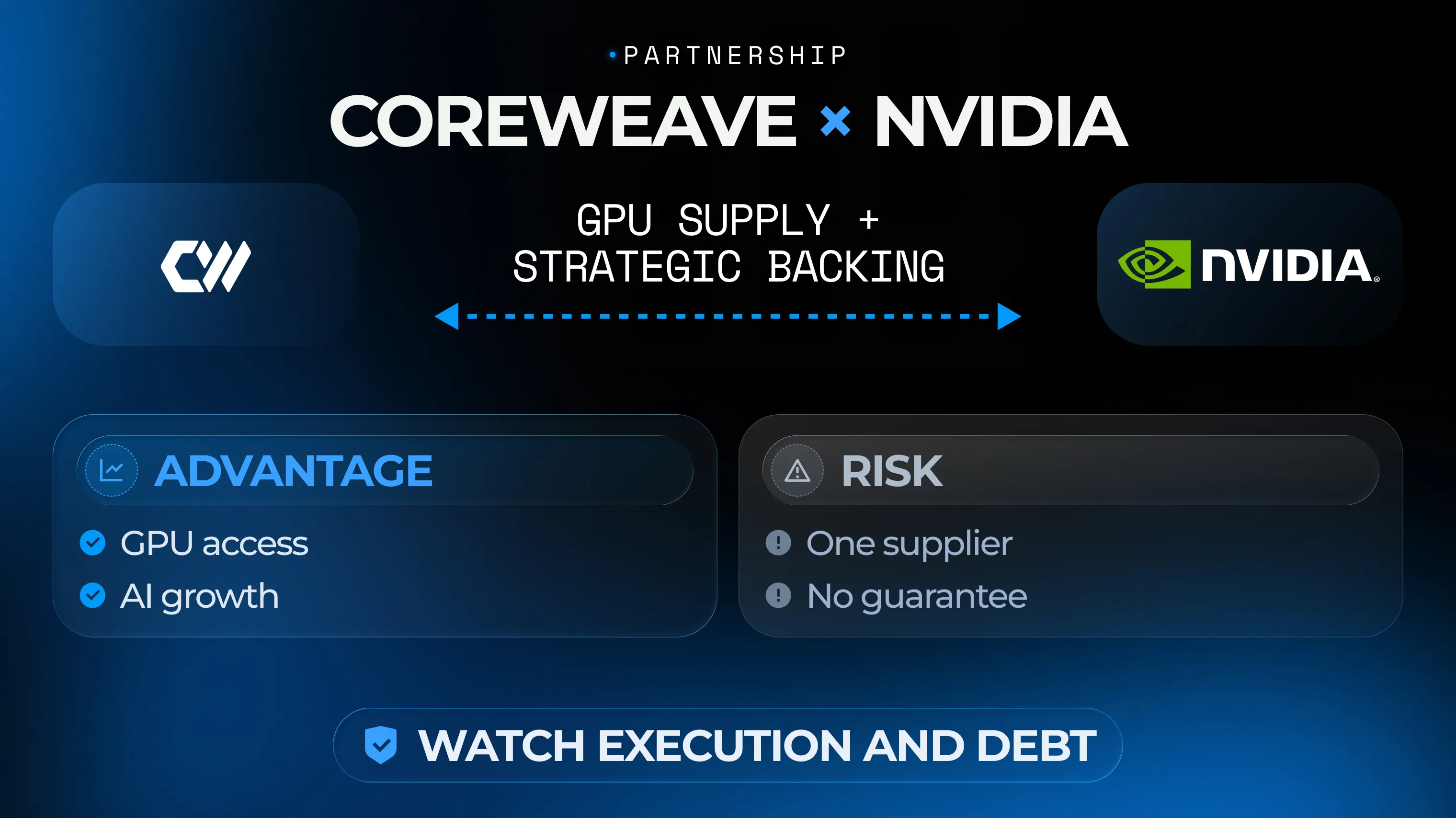
A crwv stock prediction rarely goes far without mentioning Nvidia. Nvidia has been both a major GPU supplier and a strategic investor, which has historically helped CoreWeave secure hardware during periods of severe scarcity. That relationship is a genuine structural advantage, not a guarantee of stock performance. Supplier relationships can shift, Nvidia has its own competing priorities, and a close tie to one supplier concentrates risk as much as it confers advantage.
Risks of Trading CoreWeave Stock
CRWV carries the volatility typical of a richly valued, capital-intensive growth stock tied to one fast-moving industry. Expectations around AI infrastructure demand can swing hard on a single earnings call, and the stock tends to move with them. Debt taken on to fund expansion adds real risk if growth slows even temporarily. Competition is intensifying from multiple directions, and valuation built on optimistic assumptions can unwind quickly on one disappointing quarter.
Before any trading decision, a short list of checks matters more than any single forecast.
Latest earnings report and revenue trend, not a headline from months ago.
Current debt levels and how comfortably they are being serviced.
Recent analyst price targets, checked for the date they were issued.
Recent news on AI infrastructure demand and major contracts.
The stock's actual price chart and recent volatility, not just the narrative.
Your own risk tolerance for a highly volatile, capital-intensive growth stock.
Risk Disclaimer: Trading involves significant risk of capital loss. This article is for educational purposes only and does not constitute financial advice. Always conduct independent research and consider your risk tolerance before making any trading decisions.
See more:Education