
What Is Crypto Winter? How Prolonged Bear Markets Reshape the Market
If crypto prices are falling for months, and activity is thin, this is a 'crypto winter'. Distinct by its length and depth, it seems to happen on a cycle, and gets shallower every time. There are three past winters with patterns worth analysing.

What Is Crypto Winter: Definition
So, in practical terms, what is crypto winter? It's an extended period of suppressed crypto prices. Measured in many months, and sometimes even years. Assets stay depressed, volumes of trading shrink, crypto seems to fade from the attention of the general public. Then, however, often comes spring and summer (such as the 'DeFi summer' of 2020), when the prices, on the other hand, explode, and rise drastically, surprising many people.
For the context on the timeline, when did Bitcoin come out matters, because so far, every crypto winter has occurred as part of the 4-year BTC halving cycle, usually 1 to 1,5 years after the previous halving. But so far a market is still less than two decades old, so historical sample size remains relatively small, and this is an observed pattern rather than a guaranteed rule, with some analysts warning not to read too much into it.
Crypto Winter vs a Normal Correction
Under a 'normal correction' people usually mean a decline in prices of roughly 10-30%, that resolves within a few weeks or a few months. There's no large shift in sentiment or a prolonged capitulation period. In comparison, what is crypto winter is different. It's a prolonged decline, reaching 50-70%, or more. People lose trust, the questions of is Bitcoin going to go back up ever are surfaced. Projects collapse, valuations plummet, new funding ends. Depressed conditions last for a long time, sometimes persisting over a year.
This distinction between the correction and a real 'winter' is important. If a normal correction is treated as if the winter has come, it may result in underestimating the recovery speed, or not 'buying the dip' at the opportune time. On the other hand, if a trader/investor thinks this is just a correction, when in actuality this is the start of the winter, they may lose more after entering the position, or end up holding 'the bag' for far longer than they expected.
The 2014 to 2015 Crypto Winter
This was the first major, and noticed by market participants, winter. It followed BTC's run toward roughly $1,150 in late 2013. The depressed prices were caused by the collapse of the Mt. Gox exchange, the largest at the time. Trust and liquidity were both pretty much gone from the market, and people were asking will Bitcoin go back up, ever, if the largest exchange can disappear just like that (spoiler: this was not the last time this thing happened).
Prices for BTC and other crypto assets fell more than 85% from the peak. BTC ended up bottoming near $150 in mid-January 2015 (another spoiler: each subsequent winter has so far been shallower than the one before it, though that pattern is not guaranteed to continue).
The 2018 to 2019 Crypto Winter
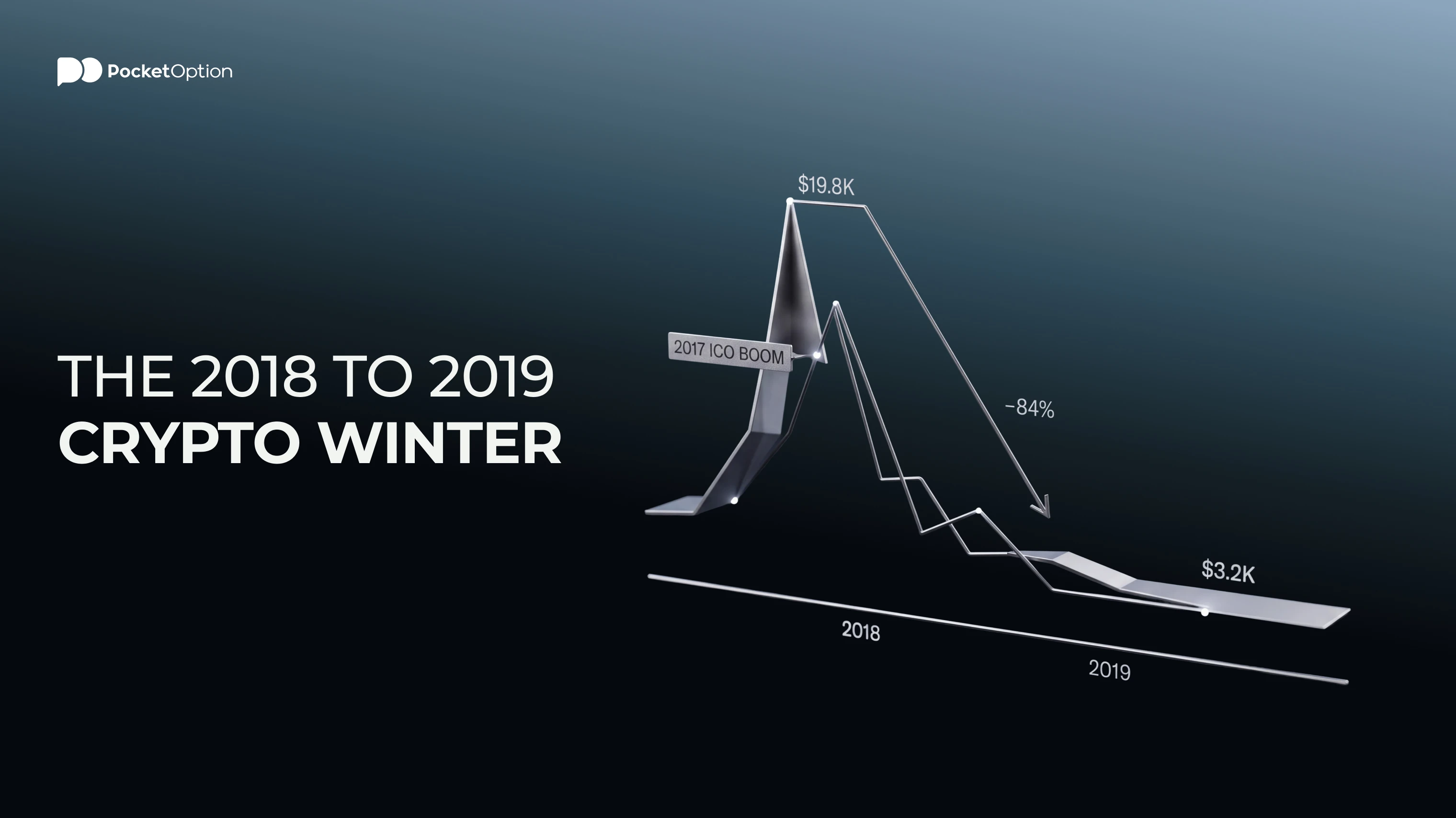
Following the 2017 ICO boom (which, coincidentally, happened during summer), where thousands of new projects and tokens were being launched, the market corrected in 2018. BTC fell from a $19,800 level to roughly $3,200 in around a year. This was a drawdown of 84%, and a winter that lasted a full 12 months. Many altcoins never recovered since.
The 2022 Crypto Winter
Fully recognized winter, which followed BTC's peak near $69,000 in November 2021. The bear market was already underway by the time the Federal Reserve delivered its first rate hike of the cycle in March 2022, and rising US interest rates through the year added further pressure on risk assets. This culminated in many crypto projects shutting down, and investors losing their funds. TerraUSD stablecoin collapse, Celsius collapse, the bankruptcy of hedge fund Three Arrows Capital, and finally the collapse of the FTX exchange in November 2022.
BTC fell from a $69,000 peak to roughly $15,800 in a year, a 77% loss.
What These Crypto Winters Had in Common
A clear trigger that removed liquidity or trust from the market.
A drawdown of 77-85% from the previous high.
A wall of worry for will crypto recover, and will Bitcoin recover after such an event (it always did, so far).
A wave of project failures, one by one, culminating in the last one that happened near the crypto winter bottom.
A recovery that took around a year, or more, to establish. Long after the first questions for is Bitcoin going to go back up have run their course.
After each winter, relatively fewer projects, but more established ones (like BTC, ETH, and later SOL) led the road to the eventual recovery. Many smaller and lesser known projects have never reached their ATH prices again.
How Trader Behavior Changes During a Crypto Winter
New account activity and overall trading volumes usually fall in the 'winter'. On the other hand, search interest in questions like will Bitcoin go back up and will crypto recover tends to rise. People are waiting for signs that the worst is over, but relatively few participants are actively positioning.
A smaller cohort of long-term holders and 'whales' has historically increased its holdings during previous winters. You can read our review on how long-term holders of Bitcoin behaved through past drawdowns. It shows that patience historically has been rewarded, but investors have to have a multi-year horizon in this case.
How Projects and Companies Behave During a Crypto Winter
Weaker projects often shut down entirely. They have no real revenue or user base. So for them the answer to the question of will crypto recover is 'no'. The ones to recover are more established names, like Bitcoin or Ethereum. Smaller projects that do survive the winter tend to focus on core development during this time, rather than expansion or marketing. Budgets for promotions dry up.
Exchanges, funds, and other projects with weak risk controls or leveraged balance sheets can go under during this time, often with users' funds. In each of the three historical periods we covered above, at least one major exchange or fund has blown up completely.
What Has Historically Helped End a Crypto Winter
Usually there were multiple factors for the start of recovery:
new institutional/retail interest;
new use cases;
new infrastructure;
broader macroeconomic shift, more favourable for risk assets.
Often the pivots happen around historical Bitcoin resistance levels, sometimes coinciding with previous ATH peaks. Growing institutional adoption has featured more heavily in recent cycles, though no indicator has reliably called the exact bottom of a winter in advance. So questions like is Bitcoin going to go back up or will Bitcoin recover do not have a definitive and knowable answer ahead of time. Previous history shows, however, that winters give way to a new cycle, even if the catalysts and durations change.
Is Crypto Currently in a Winter
You can check it yourself, no matter which year it is. To do that, check the drawdown from the most recent all-time high, and see if it reaches the 50% to 80% percent threshold seen in every past winter. You can also look at whether trading volume is low, and whether some projects have publicly failed, and new launches are significantly contracted. If depressed prices remain for 6+ months, or a year, this all points into the direction of a full-blown 'winter'.
In 2026, Bitcoin dropped around 50-54% from ATH (from ~$126,000 to ~$57,900 near the bottom), and the market downturn lasted close to 8 months, at the very least. So by majority of the metrics, 2026 was a 'winter' year for Bitcoin. Although there were not as many large project or protocol failures.
Applying the accumulation and distribution phases of a Bitcoin cycle to current price action can also offer a durable way to assess the current market dynamics.
on Pocket Option
Get StartedConclusion
A crypto winter is defined by its depth and duration. It's far from just a red week or a red month. The three past winters each had more than 70% drop in price for BTC from its previous peak, although each drop was shallower than the last. Understanding a sustained bearish trend against these historical markers can offer more context than trying to predict the exact bottom.
Disclaimer: This article is for informational purposes only, and it does not constitute any financial advice. Remember that trading involves risks, and losses can exceed initial deposits.
See more:Crypto