What Are Smart Contracts? How They Power DeFi and Affect Crypto Trading on Pocket Option
Behind every DeFi protocol, token swap, or staking reward is a piece of code that does things automatically when a set of conditions is met. It is called a smart contract. It works essentially like a legal document bound to blockchain, governing its rules. This guide explains what are smart contracts, how they work, and how they can move prices of cryptos traded on Pocket Option.

What Are Smart Contracts: Simple Explanation
So, what is smart contracts, in simplest possible terms? A smart contract is a self-executing programme stored on a blockchain. Once deployed, it does exactly what it was programmed to do, regardless of who is interacting with it. The program can be quite large (there had been whole games built this way), but usually it is rather tiny. The best benefit of it is that there is no middleman. Code itself enforces whatever rules were set by the developers.
The concept was first described by computer scientist Nick Szabo in 1996, but it became reality only once Ethereum launched. It was built in 2015 specifically to support such programmable and immutable contracts. Today this is one of the biggest applications of cryptocurrencies. There are millions of smart contracts running on Ethereum, Solana, Avalanche, BNB, and other popular chains. Such contracts are even available, in a more limited version, on Bitcoin (and the desire to build even more of them, and even of a more advanced variety, is what lead to fork of BTC in 2017).
To understand what are smart contracts in blockchain, you can think of a vending machine. You insert the right amount of coins, select what you want the machine to perform, and it does it. There’s no haggling, scams, or human errors. Whatever was programmed in, happens, by the rules. It’s as simple as that. Except now it can happen on a wide scale, on the Internet, through a blockchain.
How Do Smart Contracts Work?
Understanding how do smart contracts work requires knowing the lifecycle of a contract:
A developer writes the piece of code in the language of that particular chain (like Solidity for ETH, or Rust for Solana). The code has all the conditions and actions that need to be followed, if a person is to engage with this contract.
This contract is compiled and deployed to the blockchain, usually requiring some gas fee to get started. Then it receives its own address, becoming visible and accessible by anyone, publicly.
If they choose so, users of the chain interact with this contract, by transacting to it. Each such transaction (if the amount of tokens is appropriate) triggers the logic that was built into the contract. Such as, ‘if condition X is met, then action Y is executed’.
The blockchain records every interaction that happens. Execution of the contract is transparent, fully automatic, verifiable by everyone, and, importantly, irreversible. If an interaction happened, the fact that it happened cannot be undone: the interaction is written on a blockchain, forever.
This is how smart contracts work in practice. Code is the ultimate authority, according to the libertarian ideas that underpin the blockchain technology.
What Are Smart Contracts Used For
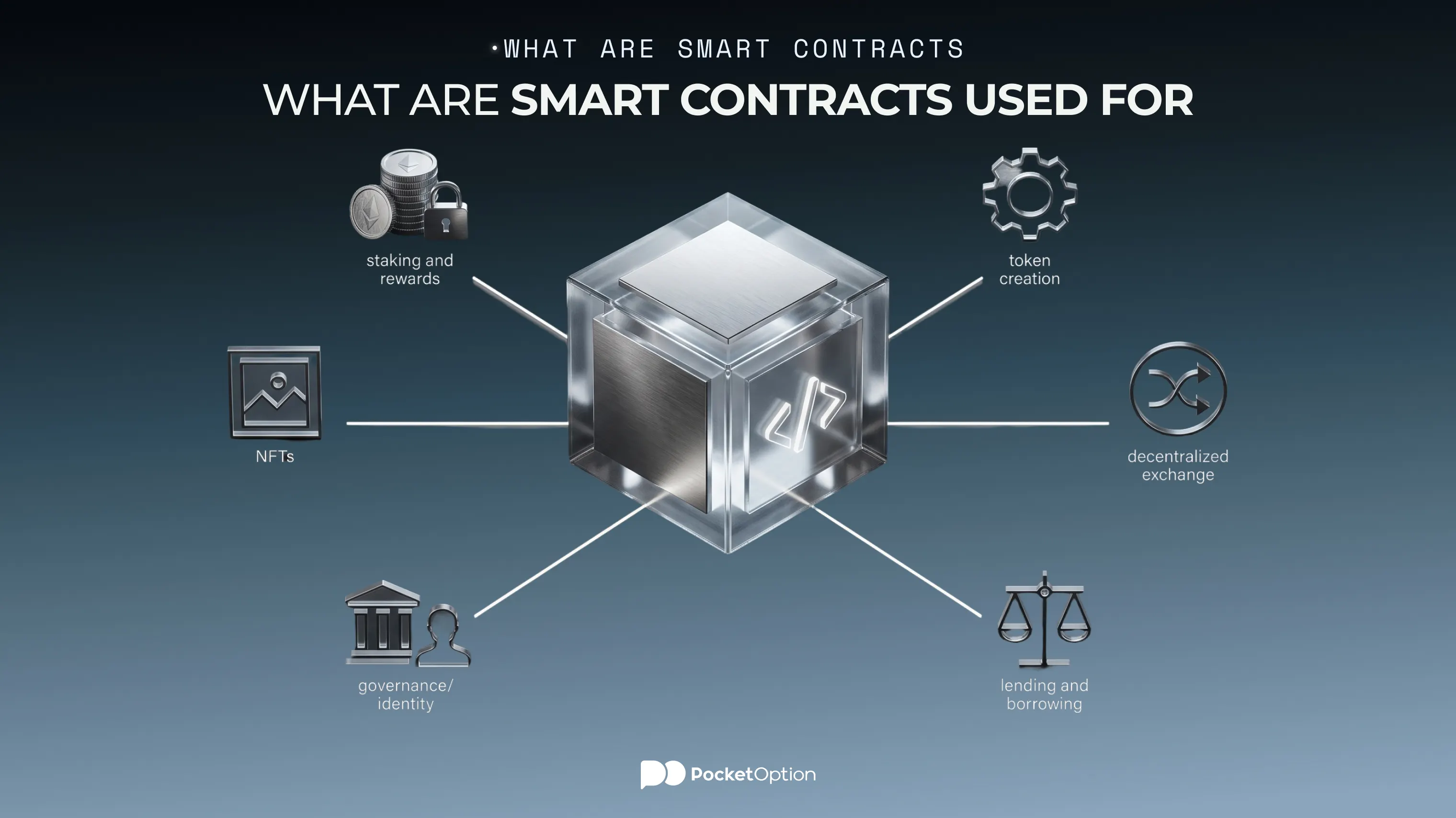
Surprisingly, the question of "what are smart contracts used for" has a very broad answer. Almost any interaction over the Internet can be written into a code, if a blockchain is good enough to support it. Most commonly used applications of smart contracts are for:
Token creation and management. Every ERC-20 token on ETH, for example (and there are millions of them) is issued through a contract, and later governed by it. Permissions, supply, burn mechanics, amount of tokens, etc, are all pre-built into a contract, so that anyone can view the rules beforehand, before investing into a token or interacting with it.
Decentralised exchanges (DEXs). Uniswap, SushiSwap etc have deployed smart contracts that enable them to match buyers and sellers, directly on the chain, without an order book or any governing body.
Lending and borrowing online. Protocols like Aave and Compound have smart contracts that do the interest calculation, match lenders and borrowers, set liquidation thresholds, and overall fully automate lending, pretty much for any token. This is done, again, without any human involvement (other then the coders that first deployed the rules).
Insurance, governance, identity. These are less popular use cases, but they are being explored by some developers. Voting rights, processing of large amount of data, verification of humans (as opposed to bots or AI), and so on. This is some of what are smart contracts in crypto can be used for.
NFTs. Everything here is the smart contract. Creation of the tokens, ownership, their transfer, royalties received, etc.
Staking, yield farming. Users can deposit tokens into contracts, that then collect and distribute rewards for that over time, for example rewards due to the token inflation, mining, or trading activity. Everyone knows the formulas the contracts will be doing the allocation and distribution, because the code is visible before you choose to transact with it, which makes the system more fair overall.
Smart Contracts in DeFi: Lending, Staking, and Cash Flow
DeFi (decentralised finance) are applications built entirely on smart contracts. They live on the chain (whichever one they were published on). They can perform every function of a traditional bank, and then some. Lending, borrowing, earning interest, exchanging, except all of this with cryptos and not fiat currencies.
The concept of smart contract cash flow investing refers to on-chain protocols that generate revenue through transaction fees, interest spreads, or liquidation penalties (see: GMX, dYdX, Hyperliquid, etc). All of this is managed by smart contracts. A DEX can earn a fraction from every trade executed through its contracts, which is again, pre-programmed in its code. These cash flows are visible on-chain, giving traders a form of fundamental analysis that is unique to crypto, and is more transparent than even in traditional equities.
QT mode, MT mode, social trading, AI trading
Get StartedHow Smart Contract Activity Can Help Identify Project Health
Several on-chain metrics are derived from smart contracts and into platforms that collect this data. There are thousands of such platforms, with popular ones being Coinmarketcap, CoinDesk, CryptoQuant, and others. They collect activity and present it in the form of readable data and charts. These are used by traders and analysts to assess the health of the chain, or the protocol running on it, to see if they’re worth trading/investing into.
Amongst collected metrics, the ones people look into the most are:
Total value locked (TVL). USDT/USDC value of all assets deposited in a blockchain's smart contracts. If a TVL is increasing, this means chain is growing in adoption, and its popularity is rising. Chances of higher prices for its token in the future increase.
Daily active users (DAU) of smart contracts. How many unique addresses (on-chain wallets) interacted with contracts of a particular DEX, dApp, or other DeFi protocol. If the daily user count is growing, the price of the token of that particular DeFi project is likely to follow.
Transaction volume: the value (in USD terms) transacted through smart contracts, per day, per week, or per month. If volume increases, this means the network can collect higher fees, which bodes well to the token prices and the DeFi project survivability chances.
Developer activity: the number of new contracts that are being deployed. If a chain is still active in this regard, it's unlikely that it will completely fade in the future. High developer activity is usually treated as a positive long-term sign.
Smart Contract Risks: Bugs, Hacks, and Exploits
Smart contracts are just the code, so if a programmer has made a mistake, it’s rather easy to exploit. This is the source of all the ‘hacks in crypto’ that are often in the news.
Code vulnerabilities. These are logic errors, and overflow bugs. Many DeFi projects have succumb to this over the years.
Governance attacks. If a protocol has token-based voting, if someone collects enough of that token, they could push a vote through, which benefits only them. This happens sometimes with DAO-related projects. Developers need to update their contracts so that this avenue of attack doesn’t exist.
Oracle manipulations. Some smart contracts rely on external price feeds (“oracles”) to understand pricing of various assets. If that oracle data is somehow manipulated, the smart contract rules can be potentially exploited for profit.
Immutability risks. Once deployed, most smart contracts can’t be changed anymore. If a bug is discovered, the only way is to disable the contract entirely, and create (and deploy on chain) a different one, without the bug. As this also involves migrating the userbase to the new contract, this is often very disruptive to the entire project, and might lead to its downfall.
With modern AI capabilities, identifying ways to exploit the code is easier than ever now, requiring more vigilance and precautions.
How Smart Contract News Moves Crypto Prices
For traders on Pocket Option, what are smart contracts in crypto is not just a theoretical question. Events related to them have a direct, sometimes drastic impact on the prices of the tokens traded on the platform. For example:
Protocol upgrades which improve efficiency (lower fees, faster execution) can be mid-term and long-term bullish for the token.
Hacks and exploits are sharply bearish, with selloffs sometimes reaching 30% or 40% in a few hours. These are events which can be traded on for immediate profit.
Reaching TVL milestones (crossing $1 billion mark, $10 billion mark, etc) attracts attention from media and can force some speculative inflows. Watching as a particular platform is about to reach that milestone can be a decent trade idea.
Regulatory actions against smart contracts or platforms that deploy them (such as from China, EU) can force extended downtrends, and force bearish bias when trading.
What This Means for Trading Crypto on Pocket Option
Pocket Option has BTC, ETH, SOL, and dozens of other cryptos which have prices that are directly tied to smart contracts. When ETH gas fees spike because of the NFT craze (like in 2021), or when a new large DeFi event is happening, ETH price is affected. When a protocol based on the Solana chain is hacked, SOL price drops sharply by ten percent, or more. This is why knowing how do smart contracts work, at least on a basic level, is important when doing analysis on crypto trades.
Both our Quick Trading mode (with short duration and fixed time expiry) and our MetaTrader trading (regular CFDs) are available for crypto. The demo account is where you can practice this without any risk of losing real funds.
Unlimited funds and possibilities
Try Demo AccountConclusion
What are smart contracts, in one sentence? They are self-executing programs running publicly on a blockchain. They automatically enforce rules that are written into them, without human intervention or oversight. Understanding these smart contracts is not a necessity, but an additional advantage that a trader or investor can have over the market. It allows them to interpret why the prices are moving the way they do, and what might happen during a particular event in the future.
Disclaimer: This content is for educational and informational purposes. It does not constitute financial, investment, or trading advice. Do your own research before doing anything on the financial markets.
See more:Crypto