Stablecoin Depeg Explained
Tie a boat to a dock with a solid line and it barely drifts, however choppy the water gets. Fray that line and the boat goes wherever the current decides. A stablecoin runs on the same logic, except the dock is one dollar and the line is trust plus a redemption promise. Nobody thinks about the line on a calm day. Then one weekend it goes slack, the coin prints 87 cents, and a quiet corner of crypto becomes the loudest headline around.

What Is a Stablecoin Depeg?
A depeg is that slack line. The coin is meant to sit at a fixed target, almost always one dollar, and for long stretches it does. Depeg shows up the moment buyers refuse to pay full price, say 96 cents on the day. Whether that gap is a shrug or a genuine problem depends on the reason behind it. A thin Saturday wobble is nothing like a slow bleed driven by real doubt about the coin's backing.
Duration tells you almost everything. The usdc depeg of 2023 sat under a dollar for roughly two days before snapping taut again, exactly why it counts as a scare and not a failure. A cracked peg rarely stays contained. Volatility spikes, order books thin out, and money rotates toward whichever coin still looks solid.
Ever wondered what one of these breaks looks like tick by tick on a live book?
New to crypto volatility? Open a free demo account and watch real market data on 100+ assets with virtual funds, zero risk.
Try Demo AccountYou can watch quotes stretch apart and prices come unglued in real time, no capital on the line. A practice account runs on the same live feeds the exchanges do, so a peg scare lands on your chart just as it happens out there.
Spin up a demo trading account, pull up a few pairs, and see how fast a "stable" price can stop being stable.
Why Stablecoins Lose Their Peg
Nothing exotic keeps that line taut. Two things do the job: confidence, and a working way to trade the coin back for a dollar. Damage either one and the price drifts. In most cases, the triggers are nothing new. People begin to question the reserves or lose access to them, the bank holding those assets runs into trouble, everyone heads for the exit at once, or liquidity suddenly becomes scarce across the market.
A regulatory headline can start the slide, and so can an exchange glitch. Whatever lights it, the real stablecoin depeg risk sits in one place: the instant enough traders stop trusting the redemption promise, some sell under a dollar to be first out. That flow of selling is the depeg itself. New to order books? The pocket option tutorial walks through how they work.
USDC Depeg in March 2023: A Real Market Example
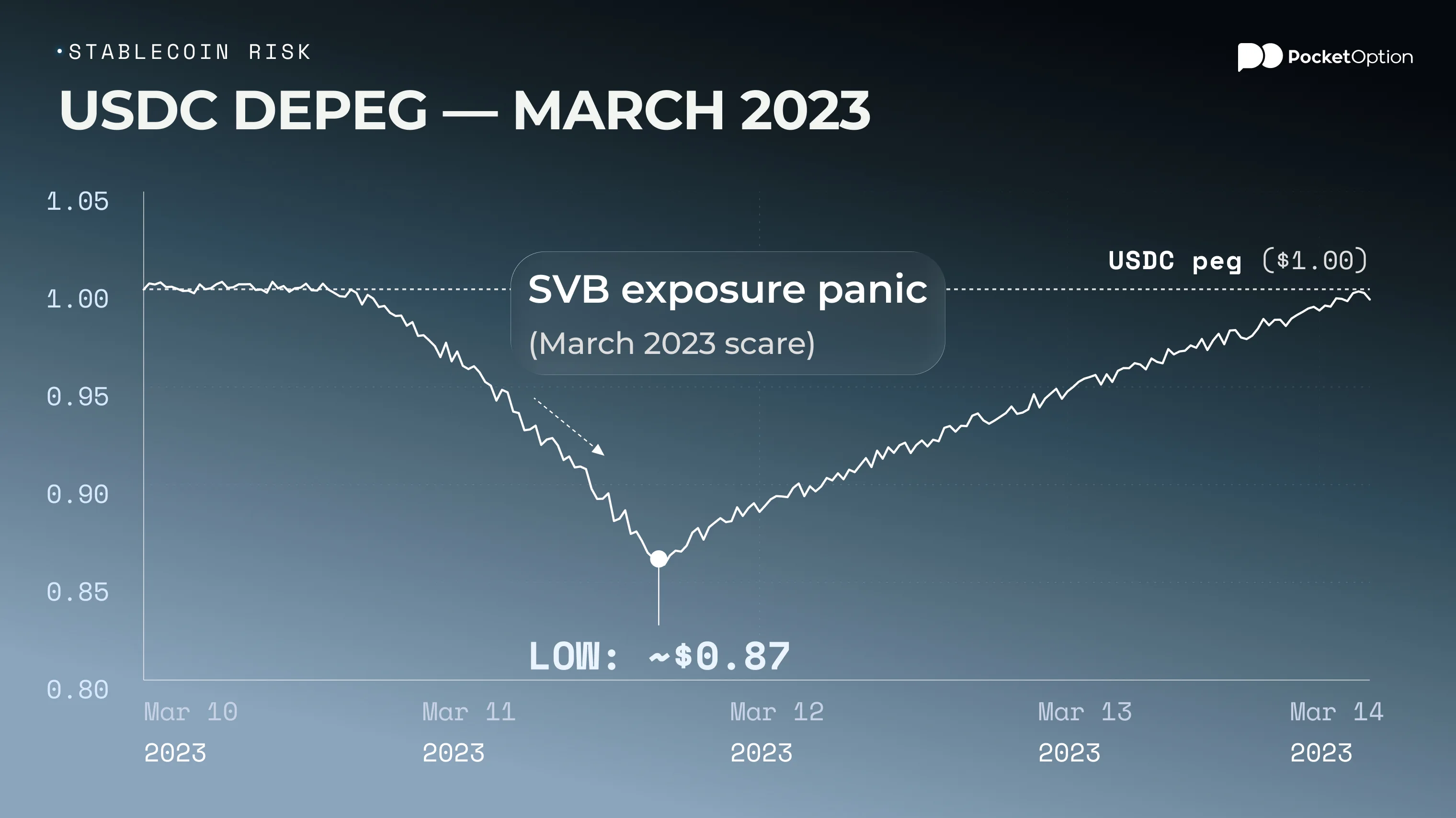
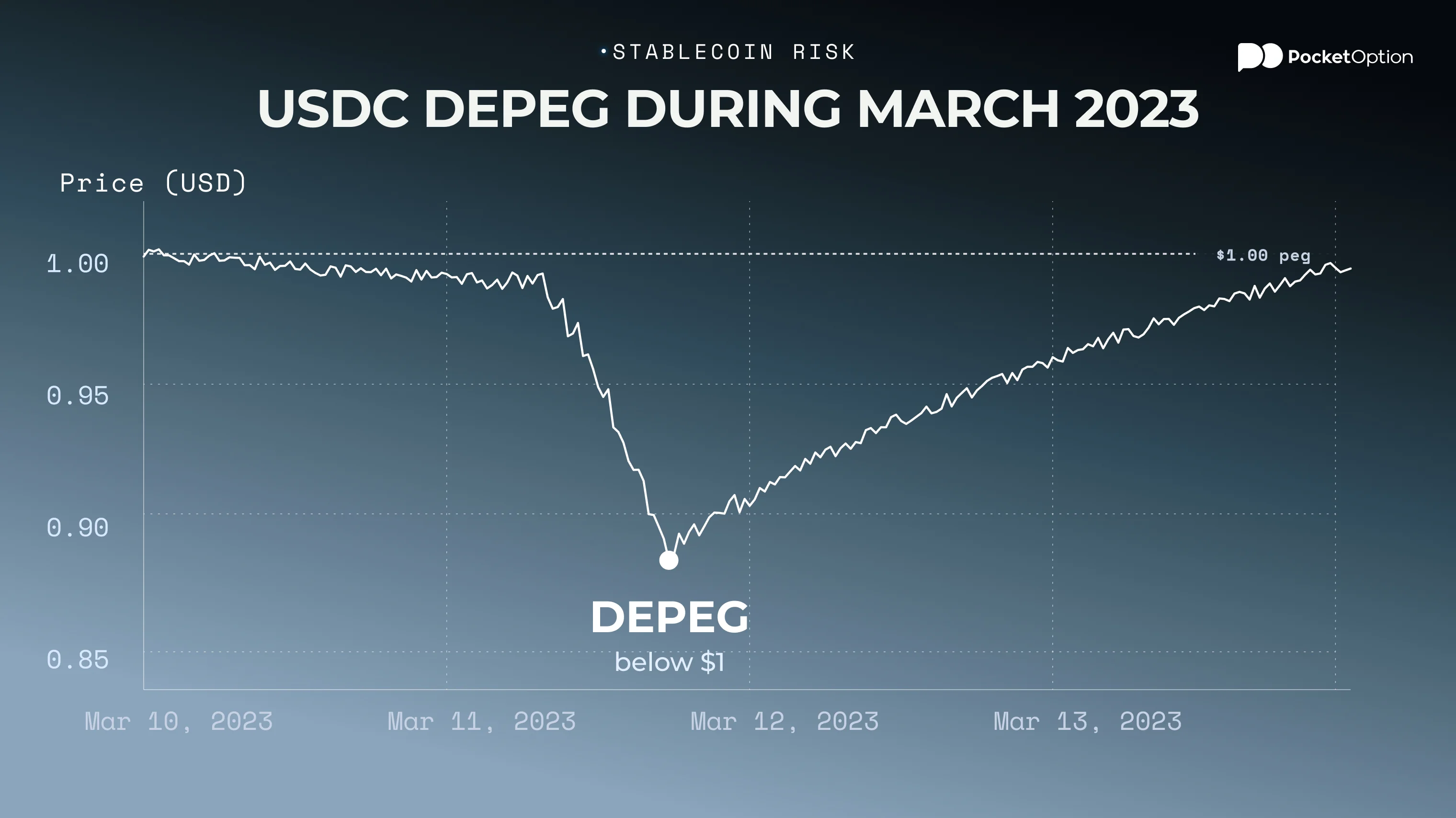
Spring 2023 is the case study everyone in crypto eventually hears about. Circle, the company running USDC, held a slice of its cash reserves at Silicon Valley Bank. That bank collapsed inside a single weekend, and close to 3.3 billion dollars of backing sat frozen behind a lender that no longer functioned. The usdc depeg march 2023 silicon valley bank episode pushed the coin to about 87 cents on some exchanges within hours.
What happened next matters as much as the drop. USDC did not fail. Once regulators backstopped that bank's depositors, the price climbed back to a dollar within days. A real scare, a real gap below par, a full recovery. Even a large, regulated coin can wobble when the bank behind it, not the coin itself, is what breaks.
How Depeg Risks Differ Across USDC, USDT and DAI
Not every coin holds its line the same way, because not every coin is built the same way. What triggers trouble for one barely touches another. It comes down to what backs the token and how easily anyone can check.
Stablecoin | What Backs It | How Transparent | Where Depeg Risk Starts |
|---|---|---|---|
USDC | Dollar cash and short dated T bills | Attested regularly | Which bank holds the cash |
USDT | Mixed cash, bills, other assets | Attested, often questioned | Whether reserves are real |
DAI | Crypto collateral, other stablecoins | Visible on chain, real time | Collateral swings, USDC link |
USDC leans on cash and short-dated Treasuries with regular attestations, so a stablecoin depeg here is mostly about which bank holds the money, exactly what 2023 exposed. USDT carries more daily volume, but its reserve reporting has drawn years of skepticism, so its stablecoin depeg leans on confidence rather than custody. DAI runs a different engine, propped up by crypto collateral and other stablecoins, so a stablecoin depeg in USDC can ripple into DAI.
Warning Signs Traders Watch During a Stablecoin Depeg
You do not need a Bloomberg terminal to catch this early. A handful of signals show up before the price does anything dramatic, and all are free to check. The usdc depeg march 2023 silicon valley bank details make the pattern obvious in hindsight: the reserve news broke first, the price followed, and order books showed the stress before most retail traders noticed.
How far the price sits from a dollar. A cent or two is noise, ten plus is a headline.
Redemption requests piling up, large holders cashing out inside the same window.
Exchange depth thinning fast, wider gaps between bid and ask.
News about the issuer or reserves, especially where the money physically sits.
Volume and spread spikes on the coin's biggest pairs.
A sudden spike in social chatter and news alerts, since fear moves faster than facts.
None of this needs a paid subscription. Public price feeds, the issuer's own attestations, and on-chain redemption data cover almost everything.
How to Read Depeg Charts, Data and News
A bold headline does not always reflect the reality. Reading a stablecoin depeg usdt usdc scare properly means checking three things together: how far the price moved, how long it stayed away, and whether liquidity or reserves show real strain underneath.
Picture USDT slipping to 99.7 cents for an hour on one exchange while every other venue keeps quoting a dollar. That is a local hiccup. Now picture it holding at 97 cents across several exchanges for a full day while reserve questions circulate. Same word, different situation. Read the move next to its reason.
Why a Depeg Does Not Always Mean Collapse
A broken peg looks like the end of the world and usually is not. Deep liquidity, verifiable reserves, a working redemption door, put those together and the market usually drags the price back on its own. Arbitrage traders buy the discounted coin, redeem it for a full dollar, and pocket the difference, and that buying drags the price home. That mechanism rescued USDC in 2023.
The opposite case is just as real. A break that goes deep and stays there, with no working redemption and reserves nobody can confirm, is a different signal. That pattern has preceded actual collapses. Depth and duration separate a scare that fixes itself from a coin quietly dying.
Common Mistakes When Reading Depeg Signals
The same handful of errors shows up again and again around a depeg.
Treating every small wobble like a crisis. Half a cent off target is not a collapse.
Ignoring the size of the move and how long it has lasted.
Trusting one screenshot or one exchange's feed instead of checking several.
Mistaking a scary headline for confirmed market damage.
Forgetting that liquidity and redemption mechanics decide whether a peg snaps back.
Get it wrong and you either panic out of a fine coin, or sit calm through one actually breaking.
Risks of Trading During a Stablecoin Depeg
Trading straight into a live depeg is closer to gambling than strategy. Volatility runs both directions at once, a coin can crater and rip back within the same session. Depth vanishes exactly when it matters, spreads gap wide, and your fill lands nowhere near the price you clicked. Panic selling feeds on itself, and news alerts fire false signals that reverse before you can react. Worse, capital can end up stuck in a pair with no clean exit until things settle. Even a full recovery can trap a position at the worst moment.
Risk Disclaimer: Trading involves significant risk of capital loss. This article is for educational purposes only and does not constitute financial advice. Always conduct independent research and consider your risk tolerance before making any trading decisions.
See more:Crypto