Perpetual Futures Explained
Rent a car for the weekend and you know exactly when you are handing back the keys. Saturday morning, done, no negotiating. Some contracts never bother with that return date at all. You can hold the position for an afternoon or three years, nobody is calling you Saturday morning demanding the keys back. The catch is there is no such thing as a free ride that never ends. Something has to keep the arrangement honest instead of a calendar date, and that something is a small recurring payment most beginners have never heard of until it shows up on their account.

What Are Perpetual Futures?
Perpetual futures are a derivative contract that lets you speculate on where an asset's price is headed without ever owning the asset itself, and without a fixed date when the contract closes out. Open a long position and you profit if price climbs. Open a short and you profit if it falls. Nothing about owning actual Bitcoin or actual gold, just a contract tracking the price. Crypto exchanges lean on this format more than almost any other corner of finance, since it lets traders get leveraged exposure to a coin's price around the clock, weekends included, with none of the calendar constraints a traditional contract carries.
Open a free demo account and trade perpetual futures with virtual funds, no expiry date and no real capital at risk.
Try Demo AccountTraditional futures markets on stocks or commodities close for the night and for holidays. Crypto never really closes, and a contract with no expiry date fits that around-the-clock rhythm far better than one that forces a rollover on a fixed schedule.
Curious how a contract with no expiry date actually behaves once price starts moving? Watching a perpetual position stay open through real price swings, with no looming deadline, makes the whole concept click faster than reading about it.
Open a demo trading account and hold a position for as long as you like, with virtual funds and no calendar pressure at all.
How Perpetual Futures Work Without an Expiry Date
Answering what are perpetual futures really comes down to three moving parts, in order. First, you open a position, long or short, at whatever the current price happens to be. Second, the contract tracks that underlying price continuously, marking your account's profit or loss in real time as the market moves. Third, and this is the part with no equivalent in traditional finance, the position simply stays open. Not for a month, not until a set date, indefinitely, provided your margin holds up and liquidation never gets triggered.
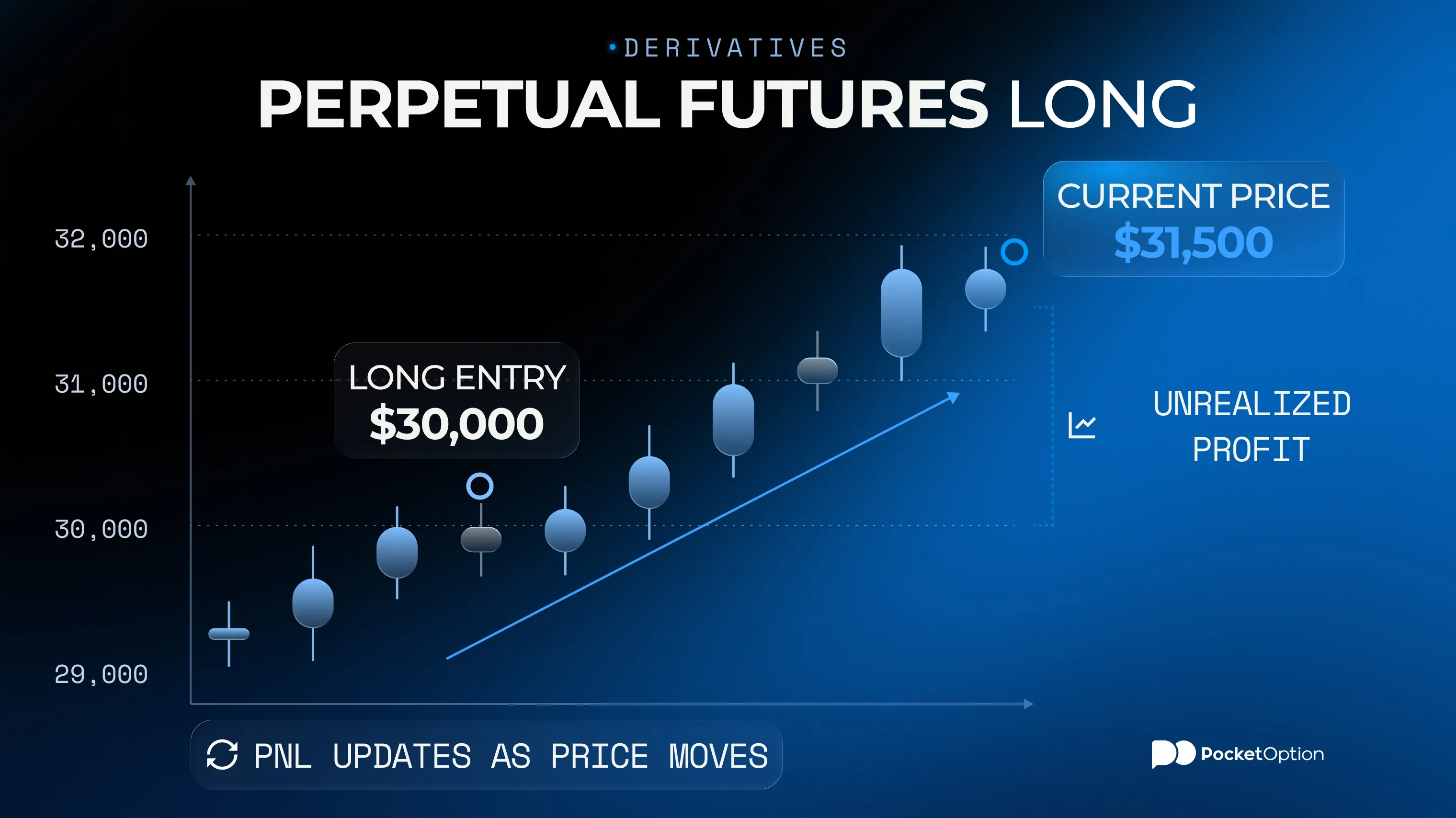
Picture opening a long position on a coin at 30,000. Price climbs to 31,500 the next day, and your position shows a profit, still open, still tracking. Price could keep climbing for a week, a month, longer, and the contract just keeps marking that difference against the current price, day after day, with no clock counting down toward a forced exit anywhere in the background.
Still working out how to actually place a trade? The pocket option tutorial walks through the fundamentals before any of this needs to matter.
Perpetual Futures vs Regular Futures
A regular futures contract behaves like that rental car. It has a settlement date baked in from day one, and when that date arrives, the contract closes, whether you wanted out or not. A btc perpetual futures funding rate mechanism replaces that whole return date with an ongoing toll instead, a periodic payment that keeps the contract's price tethered to what the asset is actually worth on the spot market. No settlement day. No forced rollover. Just a running relationship between longs and shorts that either side can walk away from whenever they like.
Feature | Regular Futures | Perpetual Futures |
|---|---|---|
Expiry date | Fixed, set in advance | None |
Settlement | Happens automatically at expiry | Never happens on its own |
Funding payments | Not used | Periodic, keeps price near spot |
Holding period | Limited to contract term | Open-ended |
Risk control | Tied to time left until expiry | Tied to margin and liquidation price |
Why Funding Rates Matter in Perpetual Futures
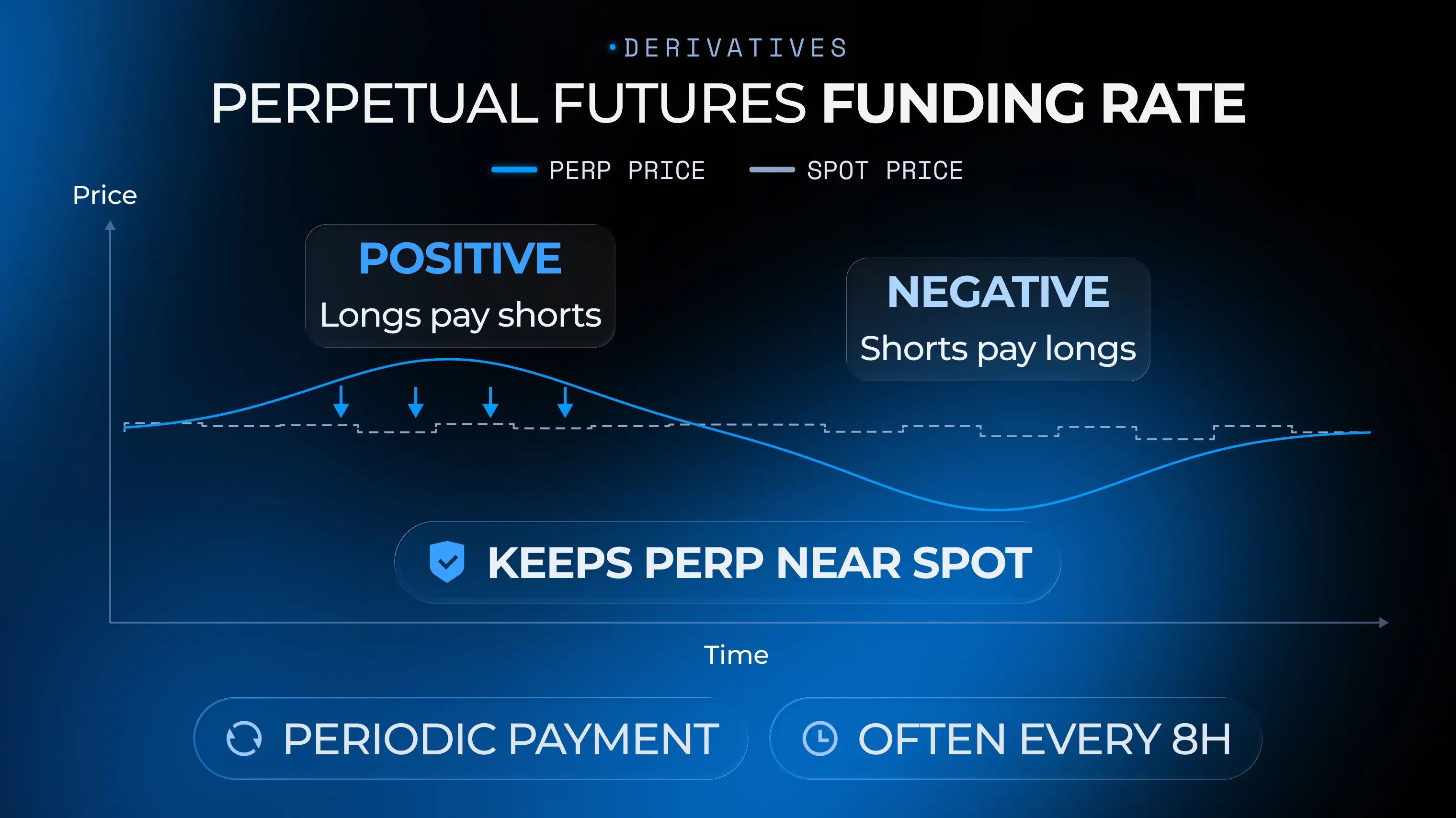
Here is the toll that keeps the whole arrangement honest. Funding rate works like a toll passed hand to hand between whoever is long and whoever is short, nothing skimmed off by the exchange running the show. Trade the contract a touch above spot and longs foot that bill, paying it over to shorts. Let the gap open the other way, contract below spot, and the payment flips direction entirely, shorts now covering longs. That flow nudges the contract back toward spot every time it drifts, exactly the anchor a fixed expiry date would otherwise provide. Say the rate reads a small positive number every eight hours, a common payment interval on most crypto platforms. Every long holder pays that tiny percentage to every short holder at each interval, purely because more traders are leaning long and pushing contract price above spot. The rate itself is not fixed. It floats based on how far apart the contract and spot price have wandered, and how skewed the market is toward one side, sometimes flipping from positive to negative within the same week.
Leverage, Margin and Liquidation Risk
Leverage is what lets a modest deposit control a much bigger position, and it cuts sharply in both directions. Margin is the slice of your own capital backing that leverage, the collateral keeping the position alive. The more leverage stacked on top of a given amount of margin, the closer your liquidation price sits to where you actually entered. Put 1,000 dollars of margin behind a position with no leverage and price would need to fall close to zero before you lost everything. Put that same 1,000 dollars behind a position at 20x leverage and a drop of only around 5 percent can wipe the margin out completely. A small, ordinary price wiggle that would barely register on an unleveraged position can erase a heavily leveraged one entirely, and once liquidation triggers, the position closes automatically, whether you were watching the chart or not.
Common Uses of Perpetual Futures in Crypto Trading
None of this is a suggestion for what you should do, just a map of what the tool actually gets used for. Traders reach for this format for very different reasons, and the same contract ends up serving purposes as varied as protecting an existing holding and betting on a move that might last only minutes.
Going long, betting a coin's price rises, without ever holding the coin itself.
Going short, betting a coin's price falls, something far harder to do in most spot markets.
Hedging an existing spot holding, offsetting risk on coins already sitting in a wallet.
Short-term speculation on a specific move, in or out within hours rather than months.
Managing exposure to a coin's price without the hassle of custody, wallets, or actually buying anything.
Risks to Know Before Trading Perpetual Futures
The same leverage that makes this format appealing is exactly what makes it dangerous. Volatility in crypto markets can be brutal, and a leveraged position amplifies every one of those swings, in both directions. Liquidation risk is real and often faster than beginners expect, sometimes a matter of minutes during a sharp move. Funding payments add up too. Hold a position against a persistent funding rate for weeks and that recurring toll becomes a genuine cost of staying in the trade, separate entirely from where price actually goes. Sharp, sudden market moves and the emotional decisions they trigger cause plenty of damage on their own, no leverage required. Chasing a position back in right after a liquidation, doubling size to recover a loss fast, these patterns tend to compound the original problem rather than fix it.
Risk Disclaimer: Trading involves significant risk of capital loss. This article is for educational purposes only and does not constitute financial advice. Always conduct independent research and consider your risk tolerance before making any trading decisions.
Zobacz więcej:Crypto