Crypto Liquidations Explained
Hang around crypto derivatives for a while and one word keeps surfacing whenever the market lurches: liquidations. Hundreds of millions gone in minutes, price candles spiking or collapsing right alongside them. To a newcomer it looks dramatic, even frightening. Yet the machinery underneath is surprisingly plain once you take it apart. This guide unpacks how it works, why it matters, and the habits traders use to keep their distance.

What Are Crypto Liquidations?
In leveraged trading, crypto liquidations happen when an exchange forcibly closes a trader's position because there is no longer enough margin to keep it open. This is the key difference from a normal exit. When you close a trade yourself, it is your choice, made at a price you pick. A liquidation is not your choice. Once your losses eat through the collateral backing the position, the platform steps in and closes it automatically to stop the balance going negative. Leverage is what makes this possible, since it lets you control a position far larger than the money you actually put down.
Want to see how leverage and margin behave without risking real funds? Open a free demo account and test it on 100+ assets with virtual money.
Want to see how leverage and margin behave without risking real funds? Open a free demo account and test it on 100+ assets with virtual money.
Open DemoThe safest way to understand any of this is to watch it happen without money on the line. Seeing how a margin balance shrinks as a position moves against you teaches the concept far better than any definition can. That hands-on feel for how fast things can turn is exactly what separates a prepared trader from a surprised one.
A demo trading account gives you virtual funds and live prices, so you can experiment with leverage and see how positions behave long before real capital is involved.
How Crypto Liquidations Work
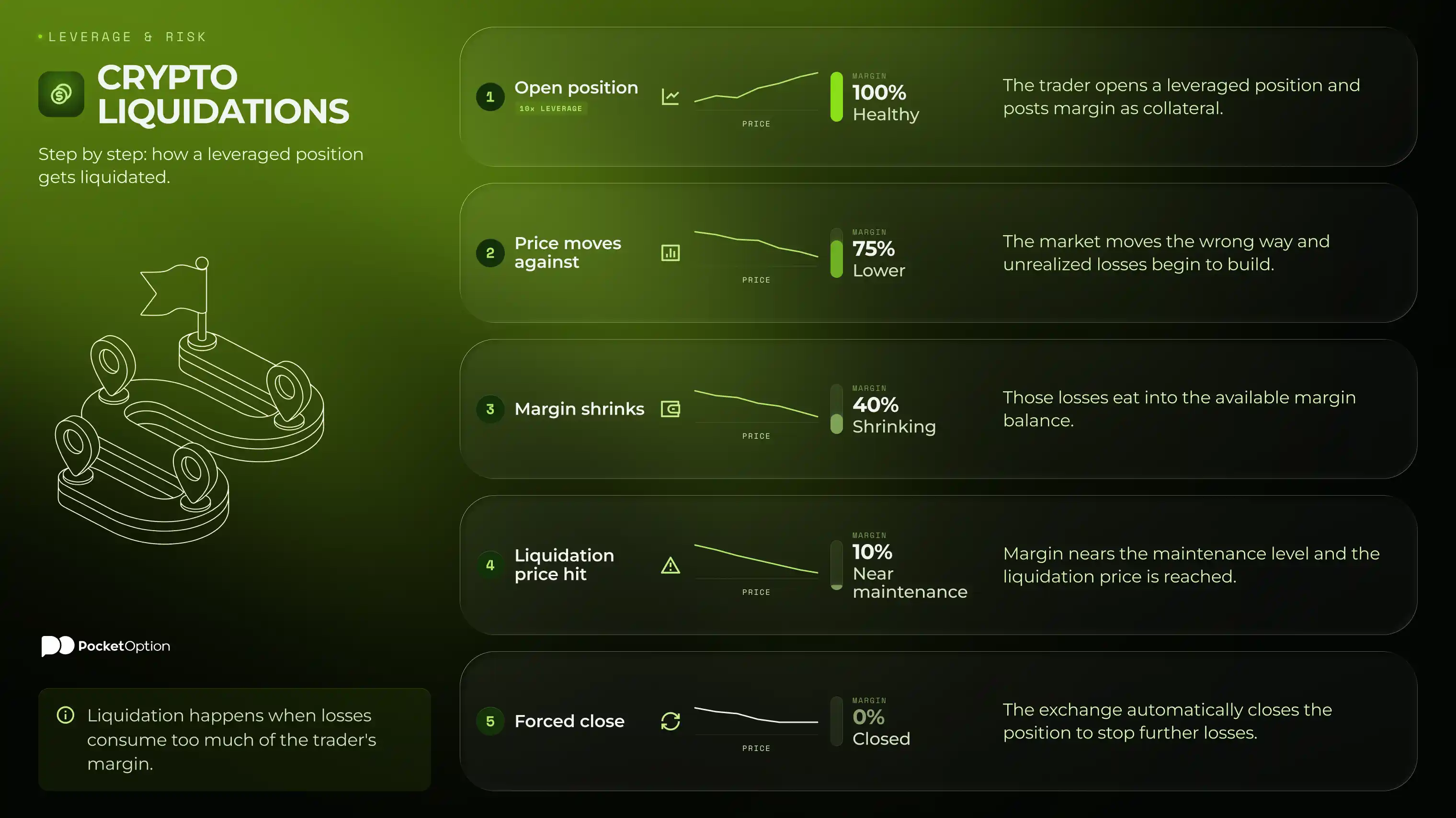
To make sense of crypto market liquidations, walk the mechanism through slowly. It starts when someone takes a leveraged position, putting down margin to control a bigger trade. Then the market turns against them. The margin balance behind the trade begins draining as the loss widens. Bit by bit, the position edges toward its liquidation price, and the instant that level is tagged, the platform shuts the trade down on its own. That last, involuntary step is what crypto market liquidations boil down to, and it explains why they land so abruptly.
Stage | What Happens |
|---|---|
1. Open position | The trader opens a leveraged position, posting margin as collateral |
2. Price moves against | The market moves the wrong way and unrealised losses build up |
3. Margin shrinks | Those losses eat into the available margin balance |
4. Liquidation price hit | Margin nears the maintenance level and the liquidation price is reached |
5. Forced close | The exchange automatically closes the position to stop further loss |
Most of this plays out on perpetual futures, the contracts that dominate crypto leverage trading. If any of these steps feel abstract, the pocket option tutorial shows how opening and managing a position works in practice.
Long Liquidation vs Short Liquidation
Most crypto derivatives market liquidations fall into two camps, and the split is straightforward. A long liquidation hits a trader who bet the price would rise, and it triggers when the price drops far enough. A short liquidation hits a trader who bet the price would fall, and it triggers when the price climbs instead. Same mechanism, mirror image. Here they are set against each other:
Aspect | Long Liquidation | Short Liquidation |
|---|---|---|
The trade | Betting the price will rise | Betting the price will fall |
Triggered when | Price falls to the liquidation level | Price rises to the liquidation level |
Trader outcome | Position closed, position margin lost | Position closed, position margin lost |
Market effect | Forced selling can push price lower | Forced buying can push price higher |
What Is Liquidation Price?
One number sits at the center of the liquidations crypto beginners keep asking about: the liquidation price. It is the level where your position gets closed automatically, and people mix it up with two other things it is not: your entry price and your stop loss. A stop loss is something you choose. The liquidation price, by contrast, is calculated by the exchange from your leverage, the size of your position, the margin behind it, and how volatile the asset is. Here is a simplified example. Open a long with 10x leverage and, very roughly, a move of around 10% against you can be enough to wipe the margin and trigger liquidation, before fees and maintenance margin are even counted. Lower leverage pushes that level further away.
Margin Call, Leverage and Liquidation
Margin call, leverage, and liquidation are three links in the same chain. A margin call is the warning stage, a signal that your margin is running low and the position is at risk. Leverage decides how much room you have before that warning arrives. The higher the leverage, the smaller the price move needed to burn through your margin, which means the liquidation price sits much closer to your entry. That is the trade-off: more leverage, less breathing room. Some traders even watch a crypto liquidations heatmap to see where large clusters of liquidation levels are stacked up across the market, since those zones can act like magnets for price.
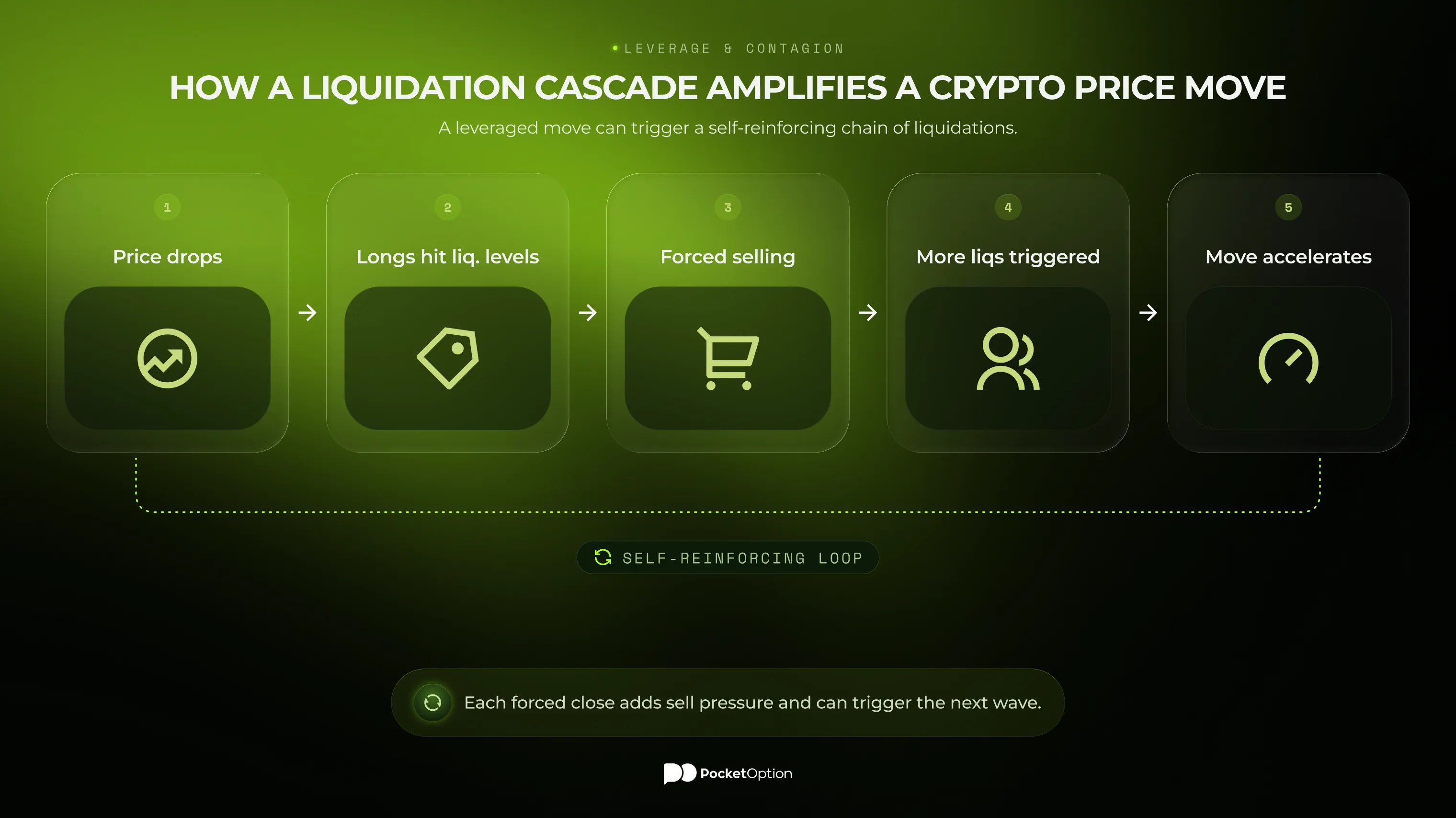
What Is a Liquidation Cascade?
A liquidation cascade is what happens when many positions get closed at once and feed on each other. Picture a sharp drop that liquidates a batch of longs. Those forced closes are sell orders, which push the price down further, which trips the next batch of liquidation prices, and so on. The result is a self-reinforcing chain that can move the market far faster than normal trading would. Wondering how to track crypto liquidations as they build? Data dashboards and heatmaps map these events in real time, giving traders a sense of where pressure is concentrated.
How Traders Try to Avoid Liquidation
Once you grasp what are crypto liquidations and how they trigger, the natural next question is how to stay clear of them. There is no magic shield, but a few habits push the risk down sharply:
Use lower leverage: this is the single biggest factor in how close your liquidation price sits.
Keep position size modest: size trades relative to your whole account, not just what feels exciting.
Leave a margin buffer: do not commit every last bit of collateral to one position.
Set a stop loss: exit on your own terms, at your price, before the exchange does it for you.
Do not go all in: keeping funds in reserve gives you room to manage a bad move.
Respect volatility: fast-moving coins can reach a liquidation price in seconds.
Risks of Trading With Leverage
Understanding what are liquidations in crypto really comes down to respecting what leverage does. It magnifies both sides of a trade, so profits grow faster, but so do losses. In a volatile market, a liquidation price can be reached in seconds, and a single cascade can accelerate the move even more. The hard part to accept is the worst case: a liquidation can wipe out the entire margin committed to that position. Leverage is a powerful tool, but it is unforgiving when the market turns, and beginners routinely underestimate how quickly that can happen.
Risk Disclaimer: Trading involves significant risk of capital loss. This article is for educational purposes only and does not constitute financial advice. Always conduct independent research and consider your risk tolerance before making any trading decisions.
Ver más:Crypto