Crypto Lending: How It Works, Returns and Key Risks
Mechanics of crypto lending allow holders to earn yield on their idle coins, giving a percentage profit over time, but also implying some risks. We cover how that yield appears, what rates can be offered by various platforms, and the risks associated with this.

What Is Crypto Lending: The Lender's Side
In basic terms, crypto lending is when digital assets (coins, crypto tokens) are deposited to a centralized or decentralized platform where borrowers can get access to them for a set period. In exchange for letting people borrow their assets, the lender gets interest, usually in the realm of a few percentages a year.
This arrangement, in spirit, is like a banking savings account: you deposit to a bank, it lends your money to various people or organizations, and you earn yield on your deposit. Although protections involved are a lot weaker, as crypto loans are a new mechanic. But, at the same time, earnings can also be a lot higher. Plus, a lender does not need to actively do anything: just place the asset once, and periodically get the accruals from the platform distributing them.
Sometimes a trader might borrow against Bitcoin instead of just selling it, or use crypto loans without collateral, but most reputable platforms in the space still require depositing some coins to protect lenders. Whether it's Bitcoin lending or not, the underlying mechanics of borrowing and yield are usually the same, and the yield also works the same way.
How Lending Yield Is Actually Generated
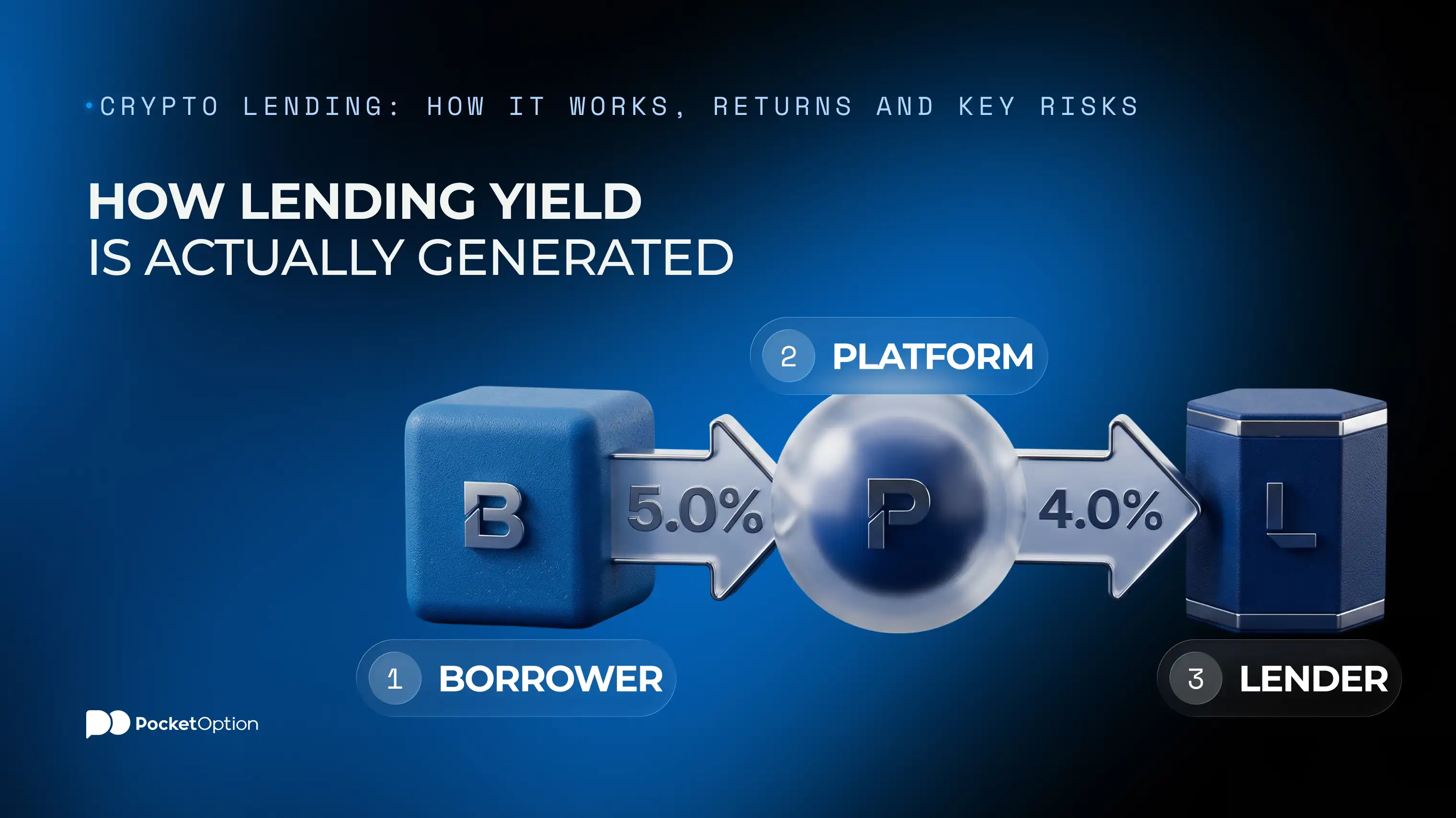
In crypto lending, yield comes from what borrowers pay. They take out term loans against some collateral they have (different coins, or some other asset), to open a short, fund a large trading position they're confident in, or cover their temporary liquidity needs. If they're not able to pay that loan back in time, the platform liquidates the collateral to make the loan whole; that process protects the principal being lent out, but it isn't an extra income source for the lender.
The interest a lender gets over time is a share of what borrowers are charged, minus a fee the platform takes for running the service, which is usually not large and taken automatically.
Because the industry of crypto loans is so new, some platforms like Aave and Morpho additionally attract users through token incentives, giving both lenders and borrowers some of their tokens, which can increase in price as the platform collects more fees. This incentivizes people to stick to one platform, and spread the news about it to other people.
CeFi vs DeFi Lending Platforms
Centralized finance platforms (CeFi) are an intermediary, with staff and customer support. But the biggest distinction is that CeFi platforms hold custody of assets deposited to them. They control them, at least for a time. Then, they give them to borrowers, through an internal system. This creates insolvency and counterparty risk: the platform itself can fail, or misuse funds, before it ever gets to a borrower. Still, for both lenders and borrowers, such a system can be easier to work with, as there are no bridges or specific quirks involved.
Decentralized finance platforms (DeFi) have no customer support or staff, and don't hold any coins themselves. Instead they route tokens through smart contracts, entirely on-chain. Rates are set not internally, but algorithmically, through supply and demand. There is no company holding custody, but that doesn't remove risk, it shifts it: into protocol risk, smart contract risk, oracle risk, liquidity risk, and bad debt risk, where a shortfall from unpaid loans isn't automatically absorbed by anyone. That is why they usually can't offer crypto loans without collateral, because there's no way to enforce repayment beyond the chain.
Neither model removes risk for lenders completely, they just change where that risk sits: whether it's insolvency and counterparty risk sitting with a company's balance sheet, or protocol, smart contract, oracle, liquidity, and bad debt risk sitting inside code that runs without one.
Why Lending Rates Vary So Much Between Platforms
Yield rates for the same coin can differ by 20%, 30%, or more, between various platforms. There are 3 factors to explain such a gap:
Platform risk premium: if a platform is a newcomer in the space, or has weaker balance sheets, or has ties to previous exchange insolvency, they often have to pay a higher rate, to keep users.
Borrower demand: if there are more people requiring tokens, rates climb. When demand cools off, lending rates go down with it.
Asset volatility: stablecoins usually pay smaller, but steadier yields. Volatile altcoins can swing widely, sometimes having high promotional rates, and sometimes offering lower base rates, if incentives have ended.
A CeFi lending platform can set its rate arbitrarily, sometimes helping projects inside of its ecosystem. A DeFi lending pool, on the other hand, recalculates its rate anew with every block, according to supply and demand. This is also one of the reasons why two platforms lending the same asset often quote different numbers.
Key Risks for Lenders
Lending is more risky than just holding an asset. A lender is exposed to the decisions of the platform, and the code running underneath it. There are 4 key risks that deserve your attention.
Platform Insolvency
Both CeFi and DeFi platforms can become insolvent. For example, it can lend out more than it can recover, or borrow against Bitcoin and be unable to pay it back, because BTC went up, and its own coin went down. These are the most obvious risks, however, and most platforms take precautions about them.
Counterparty Risk
Can only happen on centralized platforms, where they ‘run away’ with your money, or misappropriate users' funds. Severe default on obligations can also pass losses through to lenders on the DeFi front. To try to mitigate those risks, check borrower concentration and collateral policies in advance.
Smart Contract Vulnerabilities
Most common on DeFi platforms, and on bridges leading up to them. They are all run entirely by code, with no human oversight day to day. An unaudited update, an exploit, or a bug, can result in a permanent loss of deposited funds, and in DeFi, there's no company to appeal afterwards.
Lock-Up Periods and Loss of Access
Some products lock deposits for a fixed term, and lenders often go for it to get higher rates. But funds during that period can't be withdrawn, even if markets change, and the capital is needed elsewhere. Also, tokens after the period may cost less than before it, effectively reducing the total earnings received. That's why some people prefer to trade assets, or to borrow them, rather than own them.
How to Evaluate a Lending Platform Before Depositing
A few checks before depositing can help catch most avoidable losses when using crypto loans. For example, look at the proof of reserves for a CeFi platform, or a recent audit for a DeFi protocol. Neither one guarantees a platform is safe, but their absence, or a report full of unresolved findings, is a meaningful warning sign.
Then compare the rate for the asset you're interested in lending or borrowing. Check it against a base rate for the same asset elsewhere. If one platform is a significant outlier, it may be because it's new, or because it's considered less trustworthy. In both cases, it usually implies extra risk.
Read the lock-up terms in full, and check how severe the early-withdrawal penalty is.
Finally, only deposit an amount you can afford to lose, if anything goes wrong. Regardless of how attractive the advertised return looks, don't take out loans to lend anything, to any platform.
Conclusion
Idle holding of the coin can turn into a profitable venture, and a source of yield, through crypto lending. But that yield is compensation for real risks taken on, and should be evaluated first. Comparing various CeFi and DeFi platforms, understanding their safety and given rates, and checking their track record, is mandatory before making any decisions about depositing funds.
on a demo account
Open Free AccountDisclaimer: Trading and lending digital assets involves risks of capital loss and may not be suitable for investors. Past performance and advertised yields are not a reliable indicator of future results.
See more:Crypto