Forex Spread Explained: Costs, Calculation and Trading Impact
Every forex trade starts with a small built-in cost. You will not see a fee line for it. It hides in the two prices your broker quotes, and it is there on every single trade you place. Learn to read it and you understand one of the biggest hidden costs in trading. Ignore it and it quietly eats your profits.

Every forex trade starts with a small built-in cost. You will not see a fee line for it. It hides in the two prices your broker quotes, and it is there on every single trade you place. Learn to read it and you understand one of the biggest hidden costs in trading. Ignore it and it quietly eats your profits.
What Is Spread in Forex?
The forex spread is the difference between two prices your broker shows: the bid and the ask. Sell at the bid. Buy at the ask. The ask always sits a hair above the bid, and that sliver between them is the spread. It is a core trading cost, plain and simple, because the second your position opens you are already underwater by that amount. The market has to move your way just to get you back to zero.
Want to watch bid and ask prices move in real time? Open a free demo account and practice on 100+ assets with virtual funds.
Want to watch bid and ask prices move in real time? Open a free demo account and practice on 100+ assets with virtual funds.
Open DemoThe spread is one of those things that clicks the instant you see it live. On a chart, the bid and ask sit right next to each other, ticking up and down, and the gap between them widens and narrows as the market breathes. Reading about it is fine, but watching it shift in real time, especially around busy hours, teaches you far more than any definition can.
Opening a free demo account is the easiest way to see it for yourself, with live prices and virtual funds so nothing is at stake while you learn.
How Is Forex Spread Calculated?
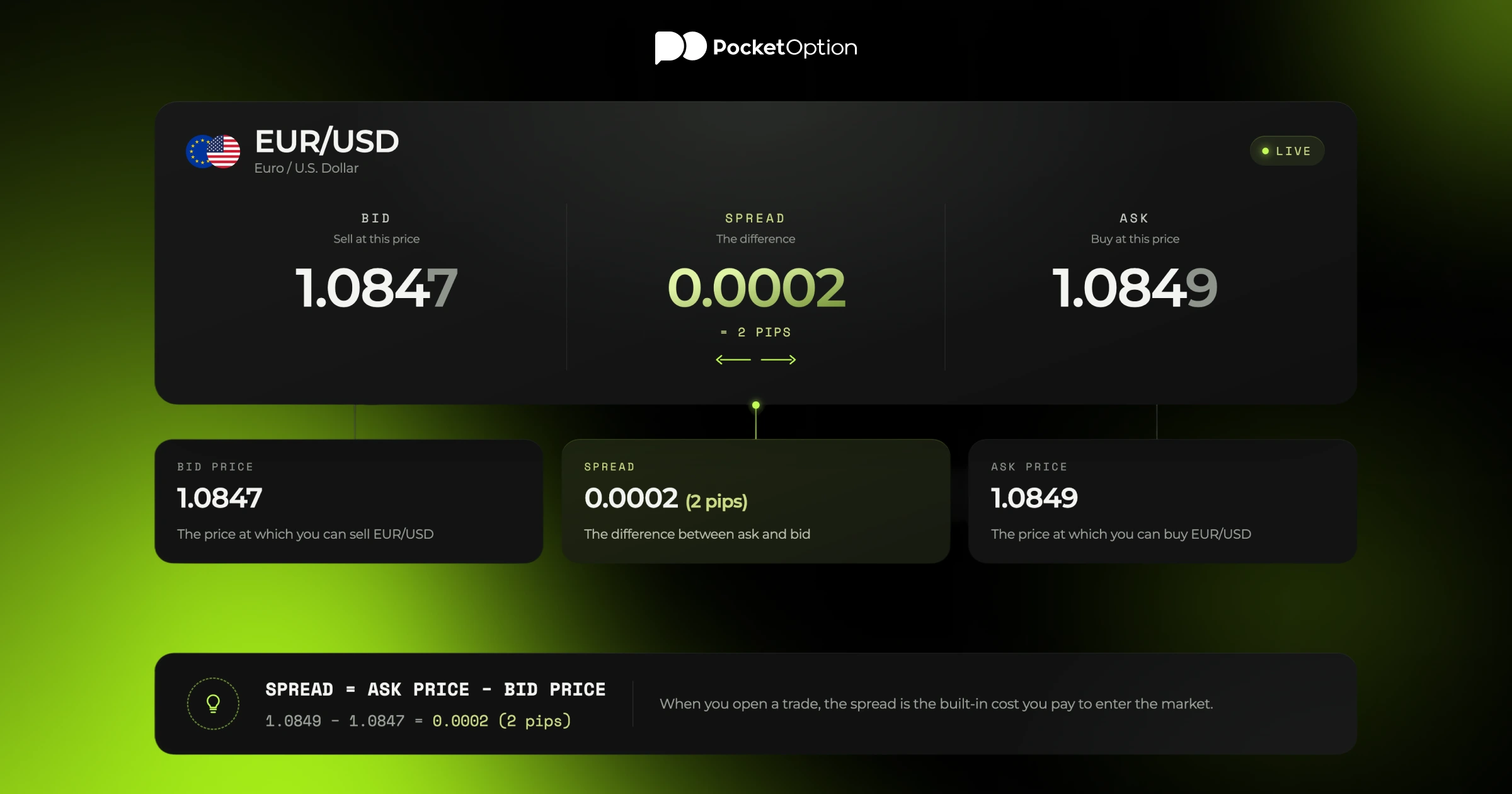
The spread in forex gets quoted in pips, and the sum takes seconds. A pip is the tiniest standard tick a price makes, usually the fourth digit after the decimal, or the second digit on any pair with the yen in it. The formula could not be simpler:
Spread = Ask Price − Bid Price
Picture EUR/USD showing 1.0847 on the bid and 1.0849 on the ask. Run the numbers: 1.0849 − 1.0847 = 0.0002, which is 2 pips. Trade one standard lot, where a pip runs roughly 10 dollars, and you have paid about 20 dollars just to step in the door. Tiny on its own. Relentless across a hundred trades.
If pips and quotes are brand new to you, the pocket option tutorial runs through the basics of reading prices and placing a trade.
What Is a Good Spread in Forex?
Once you know how to calculate spread in forex, the next question is what actually counts as good. Tight means cheap. Wide means expensive. On a busy pair like EUR/USD, anywhere from a sliver of a pip up to about 1.5 pips counts as low. Step down to minor pairs and it widens. Wander into exotics and it can balloon past 10 pips. What decides it is liquidity. More active buyers and sellers, tighter the gap. That is the whole reason the majors cost less to trade than some currency almost nobody touches.
Raw Spread vs Standard Spread
Part of answering what is a good spread in forex is knowing which account type you are on. Brokers usually offer two. A raw spread account shows near-interbank prices with a separate commission per trade. A standard account has no separate commission but builds a markup into a wider spread. Here is how they stack up.
Feature | Raw Spread Account | Standard Account |
|---|---|---|
Spread | Very tight, near interbank | Wider, markup included |
Commission | Fixed fee per lot | None, baked into the spread |
Total cost | Often lower for active traders | Simpler, fine for low volume |
Best for | Scalpers and frequent traders | Beginners and casual traders |
Neither is simply better. For a high-volume scalper, the raw spread plus commission usually works out cheaper. For someone placing a few trades a week, the simplicity of a standard account often wins.
What Affects Forex Spreads?
Here is the forex spread explained from the angle of what actually moves it. Spreads are not fixed. They breathe with market conditions, and a few factors do most of the work:
Liquidity: more buyers and sellers means tighter spreads.
Trading session: spreads pinch tightest when London and New York are both open at once, and loosen in the sleepy overnight stretch.
News and volatility: a big release can blow spreads out in seconds.
Currency pair: majors stay tight, while exotics run wide by default.
Put simply, calm and busy markets are cheap to trade. Wild or sleepy ones are not.
How Forex Spreads Affect Trading Costs
So what does spread mean in forex for your bottom line? Every position opens at a small loss equal to the spread, and you only turn a profit once price clears it. For a long-term trader holding for hundreds of pips, a 1-pip spread barely registers. For a scalper grabbing 5 pips at a time, that same spread is a huge slice of the target. The more often you trade, the more the spread matters, which is why active traders obsess over shaving it down.
How to Reduce the Impact of Spreads
By now what is spread in forex should be clear, so the practical question is how to pay less of it. You cannot remove the cost, but you can trim it:
Trade during peak liquidity, especially the London and New York overlap.
Stick to major pairs, which carry the tightest spreads.
Avoid trading right through major news releases, when spreads widen fast.
Match your account type to how you trade, raw for high volume, standard for casual.
Always fold the spread into your risk and profit targets before you enter.
Common Forex Spread Mistakes
Even traders who stick to low spread forex pairs fall into a few familiar traps. The usual ones:
Leaving the spread out of the risk and reward math entirely.
Trading through high-impact news, when spreads can balloon in an instant.
Chasing exotic pairs without counting their heavy spread cost.
Scalping on wide-spread pairs, where the cost quietly eats the whole edge.
Every one of these is avoidable. Just factoring the spread into your plan removes most of them.
Risks and Important Considerations
The last thing to know about what is spread in trading forex is how violently it can change. Day to day, spreads stay tight and boring. Then a big data release drops, or the book thins out after hours, and they can multiply several times over within seconds. That hits execution hard: a blown-out spread can knock out a stop too soon, spoil an entry price, or quietly stretch a small planned loss into a painful one. Treat the spread as a live cost that expands under stress, not a fixed number you can forget about.
Risk Disclaimer: Trading involves significant risk of capital loss. This article is for educational purposes only and does not constitute financial advice. Always conduct independent research and consider your risk tolerance before making any trading decisions.
See more:Education